Why Eagles should target Kenyon Sadiq, KC Concepcion, and Germie Bernard — even if it means trading A.J. Brown
The Eagles’ opportunity is that this year’s draft looks like it aligns with their needs. And there are at least three prospects who would make a Brown trade worth it.
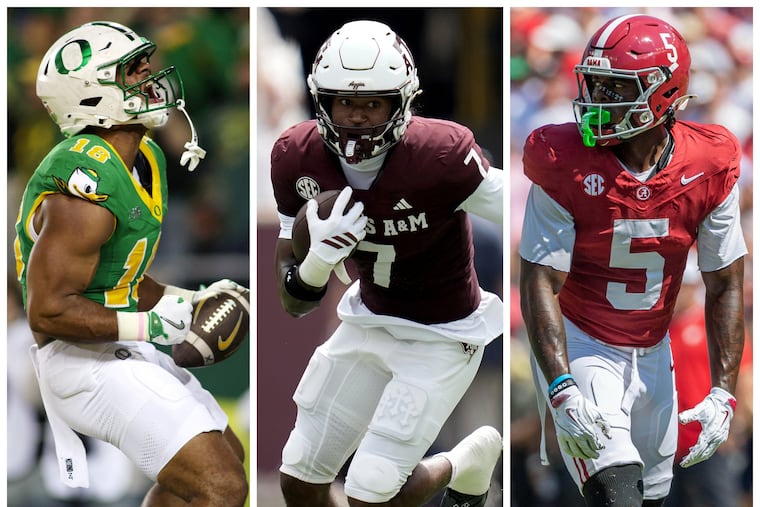
The next two months will be franchise-defining for Howie Roseman and the Eagles. That’s partly a function of how much they need to accomplish in order to get their offense on a sustainable footing. But it’s also a function of how much opportunity they have to do so. In fact, they have more of it than most teams in their situation can hope to have.
The decision-making revolves around the draft, as it always does. The most honest thing anybody can say about the draft is that the best decisions are primarily a result of what’s available. Roseman deserves a ton of credit for projecting Quinyon Mitchell as an elite cornerback. But he gets credit for drafting him only because he lasted until the 22nd pick. Same goes for Cooper DeJean in the second round at No. 40. Who knows what this Eagles defense looks like if Mitchell and DeJean weren’t on the board.
I see a lot of parallels between that 2024 draft and this year’s. The Eagles’ offense is at a similar juncture, particularly in the pass-catching department. DeVonta Smith is great. He’s also the only guy on the depth chart at wide receiver and tight end, if we’re assuming that A.J. Brown is potentially on the way out. The best way to get yourself into trouble when you are on the clock is to focus on immediate needs over expected future value. The Eagles’ opportunity is that this year’s draft looks like it aligns with their needs.
If the mock drafts are to be trusted, the Eagles could have their choice of one of at least three potential difference-makers at No. 23 and perhaps a second if they can move up in the second round. Last year, I was beating the drum for Missouri receiver Luther Burden III, who ended up going No. 39 to the Bears. This year’s trio is even better.
Oregon tight end Kenyon Sadiq. Texas A&M wide receiver KC Concepcion. Alabama wide receiver/utility man Germie Bernard.
The comps are Vernon Davis, Antonio Brown/Stefon Diggs, and Deebo Samuel.
I’m not going to sit here and pretend I have an opinion on any of the linemen who could be on the board in the late first round. If the Eagles have a chance to draft one with a Lane Johnson or Jalen Carter grade, they should obviously do it. What I do know is that the pass-catchers should be a priority, and that there are three guys who could offer the value that Mitchell and DeJean did on the defensive side.
This draft is better than people are giving it credit for, particularly in the range where things start to look realistic for the Eagles. The precombine consensus had Sadiq going No. 19, Concepcion going No. 27, and Bernard going No. 69. The Eagles have picks No. 23 and 54, but I’m skeptical that they’ll be in position to pick two of the three.
The idea that Sadiq will last anywhere close to No. 23 always seemed detached from reality. That’s especially true after a combine performance unlike any we’ve seen at the tight end position in recent memory. Sadiq’s 40-yard dash time of 4.39 seconds was the fastest by a tight end since converted quarterback Matt Jones in 2003. His 1.54-second 10-yard split would have ranked him among the Top 12 wide receivers at this year’s combine. He also put up wideout-like numbers in the broad jump and vertical leap.
It would be one thing if Sadiq’s measurements were at odds with his game tape. But they aren’t. The game speed and explosiveness are there. Most notable is the way they show up off the ball. His combination of acceleration and compact strength allowed Oregon to use him in all sorts of ways in their blocking schemes: out wide on wide receiver screens, across the formation on running plays, etc. It is impressive to watch. This isn’t Kyle Pitts. I have to imagine every cutting-edge play designer in the NFL would love to have Sadiq’s skill set at his disposal. Don’t listen to the folks who try to compare him to fellow workout warrior Eli Stowers. The Vanderbilt tight end is a worthy late-second-round gamble. But watch both of their cut tapes and you’ll quickly realize one of these things is not like the other.
To be clear, Sadiq’s isn’t a conventional skill set. He isn’t anything close to your classic tackle-adjacent receiver-lineman tweener tight end. Which might be one reason why the draft industry rates him where it does. At 6-foot-3 with 31½-inch arms, he is at the negative extreme in terms of length at the position. Of the 14 tight ends who had a 1,000-yard season since 2010, only one was listed at 6-3 or shorter, according to Pro-Football-Reference.com (Delanie Walker, 2015). Sadiq’s arm length measurement ranks in the bottom 10% of tight ends at the combine since 2010. Combined with his chiseled 246-pound frame, he looks more like an H-back than a prototypical pass-catching tight end. That’s only a problem for a scheme that lacks imagination.
If anything, Sadiq’s overall pass-catching numbers are at odds with his game tape. His 892 career receiving yards in three years at Oregon would be the lowest for any tight end drafted with a top-28 pick since at least 2010. Every tight end drafted in the top 15 since 2010 had at least one season with 58-plus receiving yards per game. O.J. Howard at No. 19 in 2017 averaged 40.1 yards, which is about what Sadiq averaged this season (51 catches, 560 yards, 14 games).
Thing is, Sadiq looks the part on film. The guy pops in all phases of the game. Look at his two touchdown catches against USC in October. On goal-to-go from the 8-yard line, he beat USC safety Christian Pierce on a perfect in-breaking route and then was in the process of running away from him when he made the catch in the back of the end zone. On the second, he got behind a late rotation on a seam route and then made a great catch in traffic in front of the deep man before being sandwiched. Sadiq finished the season as one of two major conference tight ends in the last five years to have five TD catches of 20-plus yards.
» READ MORE: The Eagles are assessing A.J. Brown’s trade market. Just don’t expect Howie Roseman to give him away.
Sizewise, I see Vernon Davis. The more intriguing comp is George Kittle. Sadiq may never be the blocker that Kittle is, i.e., one of the best ever at the position. But that’s not the point. The point is Kittle as a pass-catcher. In four years at Iowa, he had 48 catches for 737 yards, topping out at 22 catches for 314 yards as a senior. The 49ers drafted him in the fifth round. He would go higher in a redraft.
No position in the NFL draft is less contingent on college production than tight end. Jimmy Graham played one year at Miami, caught 17 passes, and was drafted in the third round. Antonio Gates never played college football. When Travis Kelce turned 23 years old, he was a senior at Cincinnati who’d caught 19 passes for 247 yards in 25 career games. They are the exceptions, sure. But name another position where three such exceptions went on to become three of the greatest of all time (four if you count Kittle).
Let’s reiterate our point here. It isn’t that Sadiq is the same type of prospect as the guys I just mentioned. He’s on a much higher level. It isn’t that he is going to become those guys. The point is that Sadiq’s relatively paltry receiving numbers shouldn’t make him fall in the draft. Chances are, they won’t.
Concepcion is more likely to be there at No. 23. He’s a bit slight at 6-foot, 196 pounds. He didn’t run the 40 or take part in any of the other athleticism tests at the combine. Silence in a court of law, etc. But none of that should matter when you see the film. The ability to create change-of-direction separation is elite. It shows up in the numbers. In addition to his 61 catches for 919 yards and nine touchdowns as a junior at Texas A&M, and his 70 carries for 431 yards and three touchdowns in three collegiate seasons, he is coming off a season where he averaged 18.2 yards with two touchdowns on 25 punt returns after returning just five in his first two seasons. Whatever the physical measurements, his is an NFL frame, and an NFL game.
Bernard is the DeJean of this year’s draft. Midway through his rookie season everyone will look back and say, how did this guy fall as far as he did? Assuming the current projections are correct and he won’t be a first-round pick. Comps are usually fuzzy things. Man, does he look a lot like Deebo Samuel did during his peak with the 49ers. At 6-1, 206 pounds with a low center of gravity and ballcarrier instincts, Bernard could easily pass for a third-down back. But he is a wide receiver, one who averaged 57 catches for 828 yards over his last two seasons at Alabama. He has as high of a floor as anybody can have at his position. Too many GMs chase upside in a draft. The real test is projecting a player’s probability of achieving that upside. Bernard plays the game with a fluidity and instinct that will translate in some meaningful capacity. So much so that the Eagles shouldn’t hesitate to draft him at No. 23 rather than gambling he’ll still be there beyond.
» READ MORE: The NFL salary cap is going up $22 million per team this year. What does that mean for the Eagles?
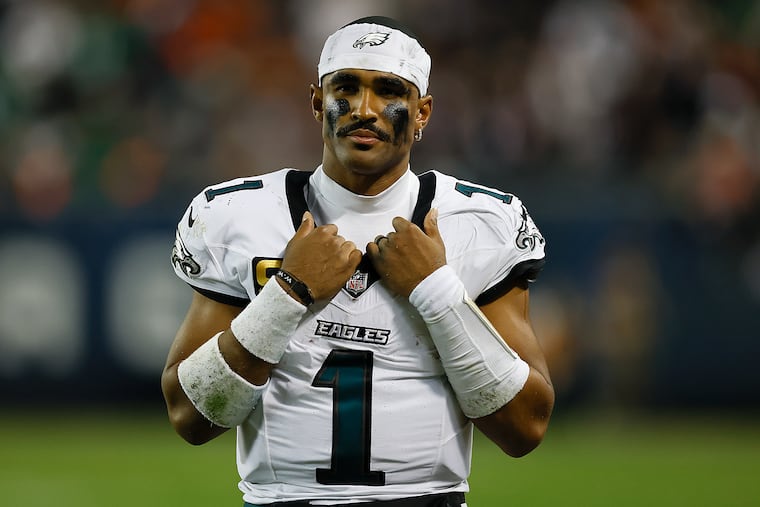
There is an elephant in the room here, one so large that he has already been mentioned. The Brown thing is simple. Even if he is here next year, he won’t be here much beyond that. Jalen Hurts isn’t one of the rare quarterbacks who makes the pass-catching talent around him better. The Eagles will fail and fail miserably if Smith is his only pass-catcher who is above replacement level. They would be wise to trade Brown if it lands them a draft pick that facilitates the acquisition of someone with the ability to help replace him.
“If someone is going to give you something you didn’t anticipate and you won’t even have the conversation, I don’t think you’re necessarily doing your job or really servicing the team you’re with,” Roseman said at the combine last week. “You never know what someone is willing to do.”
The perfect draft for the Eagles is Sadiq first and then one of Concepcion or Bernard second. Given the value that teams place on the trenches, it’s hard for me to believe in a worthwhile certainty/upside ratio with any lineman who would also be available.
I’m skeptical that Sadiq will last anywhere close to where the current mock drafts have him going. At this time last year, Daniel Jeremiah and Pro Football Focus both had Colston Loveland going in the 18-20 range. In 2024, PFF had Brock Bowers going 18th. Loveland ended up going 10th and Bowers 13th. Both were among the top nine non-quarterbacks off the board. So, I wouldn’t put too much stock into the current projections, which have Sadiq lasting into the 20s and potentially reaching the Eagles at No. 23. I also don’t think the Eagles can bet on Concepcion being there. Nor can they with Bernard at 54.
The idea of trading Brown makes a lot more sense from that perspective. It’s only true if Roseman can somehow finagle something like the No. 31 overall pick from the Patriots. Maybe by swapping No. 54 and No. 68 for the Pats’ No. 63. So, the Eagles trade Brown in order to move up 23 spots from No. 54 to No. 31 while moving down nine spots from No. 54 to No. 63.
There are at least three prospects who would make it worth it.

The Eagles seem reluctant to address the handling of the Jalen Hurts blood clots saga, but the key questions involved in the story aren’t going anywhere. Throughout the week, in the absence of remarks from general manager Howie Roseman or team medical personnel, head coach Nick Sirianni was peppered by reporters. He’s offered few details in return. After speaking with high-ranking medical officials currently or previously employed by NFL teams, The Inquirer’s Jeff McLane frames four central issues that remain unanswered, while also looking at what this situation means for Hurts’ future in Philadelphia. Listen here.
Listen to all episodes here or wherever you get your podcasts.