How Eagles rookie Uar Bernard prepared for the NFL before playing a down of football
The seventh-round pick and native of Nigeria received a 12-week crash course in a game that he has never played. Now he'll find out whether the work can land him an NFL job.
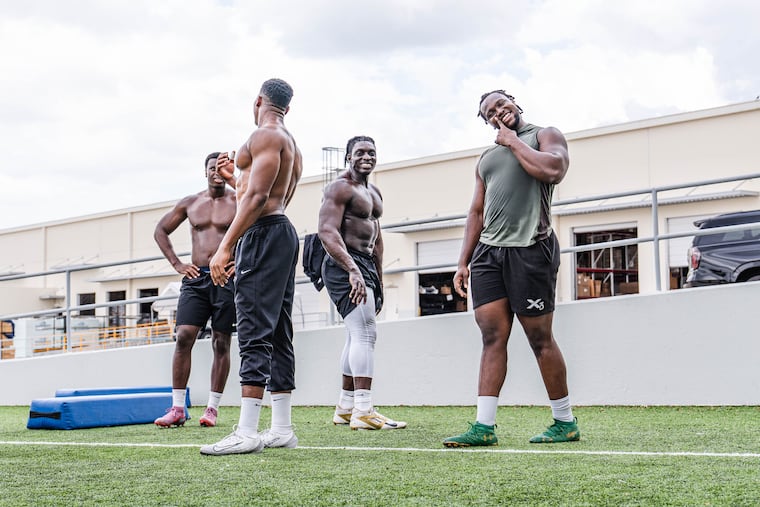
Nearly 6,000 miles away from his native Abuja, Nigeria, Uar Bernard found a taste of home.
While Bernard was training in Fort Myers, Fla., ahead of the International Player Pathway program pro day in late March, he wasn’t fond of some of the American foods that were part of his meal plan. So his defensive line trainer, Javon Gopie, decided to bring him a West African dish. A friend of Gopie and her family made a pan of jollof rice, one of Bernard’s favorite dishes, with lamb at the trainer’s request.
Bernard expressed his appreciation for the meal to Gopie. But Gopie said Bernard made it clear that his craving for traditional cuisine wasn’t a longing for home.
» READ MORE: Meet Uar Bernard, the athletic marvel and Eagles draft pick who has never played football Bernard
“‘I love it,’” Gopie recalled Bernard saying. “‘But I want you to know I’m never going back, and I’m going to bust my ass to make sure that I don’t.’”
Bernard is on his way to keeping that promise. The Eagles selected the 6-foot-4, 306-pound defensive tackle in the seventh round, making him the first African IPP player to be drafted into the NFL.
Like the other members of his draft class, his physical abilities helped him punch his ticket — at the IPP pro day, he ran a 4.63-second 40-yard dash (the average among defensive tackles is 5.1, according to MockDraftable) and leaped 39 inches in the vertical jump (29.4 average for defensive tackles).
Unlike his peers, he didn’t have any game tape. At 21 years old, Bernard has never played a down of organized football. He played basketball growing up, then recently discovered football through Osi Umenyiora, the British-Nigerian former defensive end for the New York Giants.
But Bernard is bringing a foundation of football knowledge to Philadelphia. After dazzling at the NFL International Combine in London in October last year, where he also jumped 39 inches in the vertical and completed 30 reps on the bench press, according to Gopie, Bernard was invited to train at X3 Performance and Physical Therapy in Fort Myers beginning in January.
The 12-week program wasn’t solely focused on helping IPP players ace the pro day drills. Bernard and his peers also got a crash course in defensive line play from Gopie, who has worked as a consultant for the NFL and the IPP program for the last four years. The mentality and on-field growth that Bernard displayed throughout the program has prepared him to take the next step with the Eagles, according to his defensive line trainer.
“That was his goal, that he was going to maximize his time in Florida so he could dominate the showcase and get an opportunity to play in the league,” Gopie said. “He made a statement, and he stood on that, and he did everything he could to earn this opportunity.”
Defensive line 101
Gopie met Bernard in October in London, but Bernard was already well-acquainted with his future trainer by that time.
Bernard revealed that he and his friends followed Gopie on Instagram for years. On the social media platform, Gopie posts clips of his clients going through pass-rush drills. Gopie’s clientele throughout his 12 years as a trainer has included former Eagle Jaelan Phillips, the Denver Broncos’ Nik Bonitto, and the Dallas Cowboys’ Quinnen Williams.
Later, Gopie visited Bernard’s Instagram profile and discovered videos of drills he had been working on back home, subbing in a tree for a pop-up bag.
“That showed me that he had been putting in work for some time now, in what they believe was relevant to being good at the position,” Gopie said. “And he came in with that confidence because he had already been working.”
Bernard and his cohort of IPP defensive linemen in Fort Myers, which also included Eagles undrafted free agent edge rusher Joshua Weru, were at the facility from 8 a.m. to 5 p.m., six days a week. Beyond the pro day training, Gopie estimates he spent four hours with them daily on position-specific work, from chalk talk to film breakdown to walk-throughs to skill development.
» READ MORE: Eagles first-round receiver Makai Lemon will wear No. 9 (with Nick Foles’ blessing)
But his program wasn’t constructed for Instagram highlight reels, and his players wouldn’t work pass-rush moves on Day 1. Gopie designed his curriculum to provide a progressive, step-by-step education on football and all aspects of defensive line play.
“Everybody wants sacks, but we did probably almost none of that,” Gopie said. “To the bare minimum. Because for me, I needed to know that they understood the game and the culture before we even got into what looks good on camera.”
Phase 1 focused on terminology, alignment (the various positions along the defensive line), and assignment (the responsibilities at those positions). Gopie had a weekly test that required the players to draw different positions on the whiteboard using the same language that they would encounter at the NFL level.
What is a 2-tech? What is a 2i? What is a 5? Where do they line up? What is a two-gap, one-gap?
By starting with alignment and assignment, Gopie showed the players that defense is like a puzzle, and every position represents a piece within it. The next phase centered on different types of rushing offenses, from zone schemes to gap schemes, and personnel groupings and how to attack each of those looks.
“I explained to them that you can really speed up your learning curve and slow things down if you know what you’re seeing,” Gopie said.
Then, he moved on to more advanced education on defenses. He taught different types of coverages and the responsibilities of each defensive player on the field in their respective zones.
Their classroom work included film study. They watched practice film from the Alabama, LSU, and Auburn teams of the late 1990s and early 2000s. Gopie said he wanted to show them what it looks like to practice, because those sessions are harder than the games they’ve seen on Sundays. He also showed them film of a variety of defensive linemen throughout league history, as recent as Bonitto and as old as Reggie White, to show different body types at the position.
At every phase, they would take what they learned in the classroom and apply it on the field. On low-impact days, Gopie would do a “walk and talk” in which he would arrange five pop-up bags to represent offensive linemen. He asked his players to line up in specific positions. He would bring in offensive players and line them up or have them motion to various spots, requiring his players to read their keys and communicate their responsibilities to the rest of the group.
Bernard and the prospects learned how to get into different stances. On high-impact days, they worked on their run defense technique by striking sleds while wearing pads, which helped them learn how to be explosive out of their hips and where to place their hands. Finally, they learned pass-rush strategy and technique.
Gopie said Bernard “caught on very fast” to all components of the game. Above all else, he seemed to understand the physicality required to thrive as a defensive lineman, according to Gopie.
“He fell in love with that,” Gopie said. “Literally, when we were doing walk-throughs, he was trying to put people in the dirt.”
From the classroom to the football field
In early March, Gopie introduced the competitive phase of the on-field training. His defensive linemen and the offensive line group that was also training at the facility put on pads and helmets for the first time and did one-on-ones.
That was when Gopie said everything started to click for Bernard.
Gopie told his group beforehand that he had no expectations, as it was the players’ first time doing a full-speed one-on-one drill against offensive linemen. Bernard showed some encouraging traits during his initial reps, including his physicality and motor.
That was about it, though. According to Gopie, Bernard’s get-off needed improvement. His leverage was a little high. While Gopie didn’t have any expectations for Bernard, he could tell later on, while the group was dissecting film of the drill, that the defensive tackle didn’t meet his own standard.
“He was pissed off about what he looked like,” Gopie said.
Gopie stoked the fire within Bernard, reminding him he was capable of a better performance.
“I was on his ass,” Gopie said. “I’m like, ‘Bro, people are going to expect a lot out of you being 6-4, 300 pounds and being as big as you are.’ So he had to really understand what it means to throw his weight around. And that’s what he did not do the first time around.”
Through film study, Bernard identified areas where he had room to grow. He also learned how to improve his get-off by watching Weru, who has a background playing rugby in his native Kenya and was more advanced in certain aspects of football as a result.
A week and a half later, Bernard “looked completely different” on his next attempt at the drill, according to Gopie. He saw an improvement in Bernard’s get-off, which was a result of his vision. Bernard did a better job anticipating the movement from the offensive lineman and moving with him because his eyes were in the right place.
“He was running through guys,” Gopie said.
Gopie’s program was just the beginning for Bernard. Gopie provided a “very vanilla” introduction to a variety of defensive schemes, he said. Now that Bernard is a member of the Eagles, he will learn the specifics of Vic Fangio’s defense and how the coaches want to use him within it.
Bernard also has plenty of room to grow as an athlete, especially regarding his deceleration and acceleration. Gopie said he can improve those skills over time with reps at speed and agility drills. The incorporation of Pilates workouts can help, too, by enhancing flexibility. If Bernard can improve his athleticism over time, Gopie said, he could even move from defensive tackle to edge rusher in the future.
“He compares with some of the greats that I’ve worked with over the past 10 years,” Gopie said. “And I’ve seen guys who were super stiff coming into the NFL who became super nimble, twitchy. He can definitely do it and be able to bump out and play on the edge maybe someday.”
Bernard left his home in Nigeria behind, but he found a community in Fort Myers. Part of that community will also make the trip to Philly — not only is Bernard close with Weru, but he also spent time with left tackle Jordan Mailata, another graduate of the IPP program. Throughout the 12-week program, Mailata would come to the facility to watch film and speak with the players, both on offense and defense.
Gopie will remain a part of Bernard’s support system, too. After organized team activities and mandatory minicamp in the spring, Bernard will return to the Fort Myers facility to train with a group of pros. Gopie will communicate with Clint Hurtt, the Eagles defensive line coach, so he knows what Bernard needs to work on over the summer before training camp.
In just a three-month span, Gopie gave Bernard the tools to construct a football foundation. It’s up to Bernard to keep building.
“He adapted well, and that showed me a lot early on, just his mindset and how he approached things,” Gopie said. “I’m super excited for what’s to come with him, because he has an opportunity to really change the game of football [for players] from Nigeria.”