Veterans Stadium had a secret lounge where stars became normal people and hoped to leave their mark
The Vet opened in April 1971 with the 700 Level, Phil and Phillis’ cannon, and a place where stars could hang and then sign the wall on their way out.
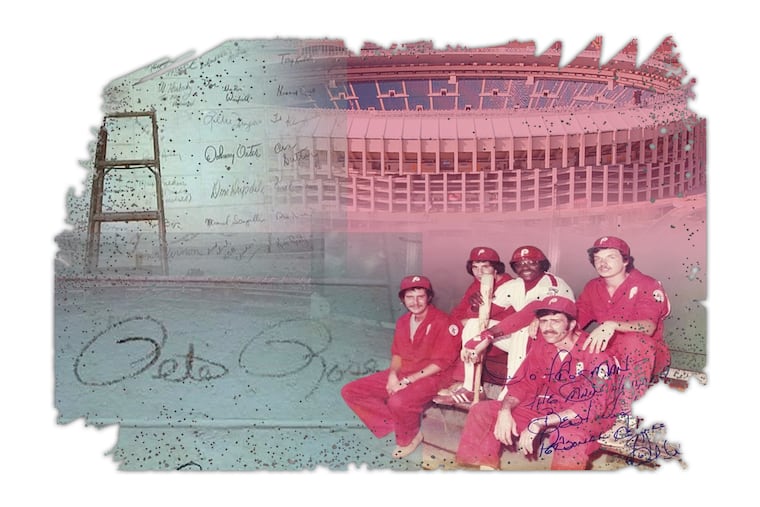
The couch was old and worn, which is why someone upstairs wanted to discard it. So the grounds crew — the gang who helped grow the fake grass at Veterans Stadium — helped get it to the dumpster. They agreed that the couch was ugly.
“It wasn’t something I would put in my house,” said Jody Boon, 68.
But it certainly was not trash. The crew pivoted, carrying the couch downstairs to its office in the bowels of the stadium.
It was a perfect piece for the drab cinder block room they transformed into a lounge where Hollywood stars and baseball Hall of Famers often hung.
» READ MORE: Phil and Phillis didn’t last long as the original Phillies mascots. But they live on at Storybook Land.
One half of the room had piles of dirt, some rakes, and shovels. The other side had an old couch, a couple of chairs, a fridge full of beer, and even a hot plate for cooking.
“We were scroungers,” Boon said, as they furnished it by finding items in the stadium like that ugly couch.
Dick Allen and Tony Taylor hung there in the 1970s, Greg Luzinski brought bushels of corn and crab legs from his home in New Jersey, and Larry Bowa purchased drinks for the boys. Visiting players like Dave Parker, Lou Brock, and Willie Stargell came by. Actor Kelsey Grammer once stayed in the lounge for an entire game, sportscaster Howard Cosell was there, and even singer Lou Rawls paid a visit.
The Vet opened in April 1971 with the 700 Level, Phil and Phillis’ cannon, and a Schmidt’s Beer sign hanging from the roof. It also had the grounds crew room: a place where stars could feel normal and then sign the wall on their way out.
“It was just a place to go to sit down and smoke a couple cigarettes, if that’s what you wanted to do,” said Mike DiMuzio, 72. “Have a drink, wait out traffic. The players went into the clubhouse, did their thing, and knew the grounds crew was still going to be there if they wanted to come in and grab a beer and kill some time.”
‘One of the coolest jobs ever’
DiMuzio started working at the Vet in 1971 as a 17-year-old junior groundskeeper when he was still a student at Bishop Neumann High. Boon was from Glenolden and joined the crew in 1976 at 18 just before graduating from Monsignor Bonner.
South Philly’s Mark Carfagno was known as “Froggy” and came to the Vet with DiMuzio. Gary Tinneny was from Manayunk, played softball in the Air Force, and had a sister on the stadium’s Hot Pants Patrol.
They were a gang of kids who grew up living and dying with the Phils. And now they were helping to manicure the field, learning from the guys who mowed the grass at Connie Mack Stadium. That’s how they connected with Allen.
» READ MORE: When Dick Allen wanted a bigger contract from the Phillies, he sold cars in South Jersey
The Hall of Famer stopped by the lounge as a visiting player in the early 1970s to see his old friends from Connie Mack, guys like Wimpy, Barney, and Stabber, whom Allen called the “nuts and bolts” of the stadium.
“Dick would always eat dinner at my mother’s house if she would make him meatloaf,” said Tinneny’s sister Donna Persico. “One night, he said, ‘Mom Tinneny, this is so good that I’m going to hit two home runs tonight.’ My mother sat in the front row on the third base line. He hit a home run, came by, patted his heart and blew her a kiss. He was a great guy.”
More stars soon began to frequent the room, making the lounge behind home plate their last stop before leaving the Vet at night. They sipped a beer with the grounds crew, talked about anything but baseball, and picked at whatever Tinneny made on his hot plate.
“When I talked to Dick Allen or Tony Taylor, it was all about family,” DiMuzio said. “‘How’s your family?’ And then they said, ‘How’s your family?’ It was all about getting personal with the players. It was getting away from the hustle of the game. That’s what the players did. They got away and talked to the guys on the grounds crew about non-baseball stuff. It was a neat gathering place.
“Here’s players who everyone looks up to and I get to have conversations with these guys who are normal people. They say hello to you and you say hello back. You had a conversation with them like you were sitting around the dinner table and it just shows the other side of the ballplayer: the human side. To me, that’s what was special.
“People saw them as celebrities and big-time athletes, but I got to know them in a different light. That was really special to me.”
» READ MORE: A rowdy Eagles-49ers game led to Eagles Court, where the hardest part was ‘keeping a straight face’
Tinneny had a grill in left field by the visiting bullpen where he would cook in the afternoon as plumes of smoke usually came over the outfield wall around lunch time.
Tinneny was a character who once kept a pet parrot on his shoulder as he moved around the stadium. It was his idea to have the guests sign the wall.
Each person was allocated his own cinder block and they scribbled their autographs in the center. Mike Schmidt, Richie Ashburn, Tug McGraw. If notable people were passing through the stadium, Tinneny would track them down and bring them to the room. Walter Alston, Bob Costas, the San Diego Chicken. If someone wanted to sign the wall, he or she had to first ask Tinneny.
“I couldn’t grab somebody and say, ‘Sign the wall,’” DiMuzio said. “I had to go through Gary. That’s just the way that it was. There were some players who said, ‘Hey, I need to sign the wall.’ And Gary was like, ‘Look, you haven’t made it yet. You make it and you’ll get to sign the wall.’ There were some guys who Gary just said ‘No’ to.”
The room was busy in the ’70s and ’80s but business began to die down in the stadium’s final years. The ballplayers became more private as the game became businesslike. Everything changed. Their final stop was no longer the room behind home plate with the beat-up couch.
“The ’70s and ’80s guys were good to us,” Boon said. “They just wanted to hang out. We would just sit around at night and shoot the [stuff]. It was one of the coolest jobs ever.”
The Wall goes ‘down with the ship’
The Phillies told their employees before the Vet’s final season in 2003 to give them a “wish list” of things they hoped would be brought to the new ballpark. DiMuzio said he wanted “The Wall” to be removed from the Vet and installed across the street at Citizens Bank Park. Sure, he was told.
Tinneny was murdered in 2001 and Allen — his old friend from the lounge — was a pallbearer. Tinneny’s family hoped to have the cinder block Tinneny signed encased in bronze and used as his tombstone. It would be the perfect tribute.
» READ MORE: A massive brawl in the Vet’s 700 Level turned the 1999 Phillies home opener into ‘something out of the Wild West’
“Gary was one in a million,” said his sister. “He really was. He loved those days with the Phillies.”
Citizens Bank Park opened in April 2004, two months after the Vet was demolished. DiMuzio could not find the wall. He asked where it was and could not get an answer. Finally, someone told him that it wasn’t saved.
“It went down with the ship,” said DiMuzio, who retired from the Phillies in 2022 as the director of ballpark operations. “They didn’t have to take my autograph off the wall, but Steve Carlton? That could’ve come down. He didn’t say whose decision it was, and I’m glad he didn’t. Because they wouldn’t be on my Christmas card list after that.”
It was like a childhood dream to be in that environment. It was some of the best times of my life.
The wall was left behind as the Vet turned into a pile of dust and rubble. The Phillies removed every seat, sign, and even urinal before selling them off. But they didn’t take out the wall with signatures of Hall of Famers and memories of a bygone era where ballplayers hung out with groundskeepers in a lounge with an old couch. Tinneny’s wall probably would have looked out of place at Citizens Bank Park. It belonged at the Vet.
“It was unbelievable,” Boon said. “Alls they wanted to be was normal people. They were so down-to-earth. When I first started, I couldn’t imagine it. Like, ‘Man, look at this.’ I can’t explain it. It was like a childhood dream to be in that environment. It was some of the best times of my life.”