CAPA flagged dozens of female students for dress code violations, sparking outrage about policing girls’ bodies
Students who deliberately flouted the dress code were kept out of class and sequestered in a room despite a policy that says students should not be excluded for dress code violations.
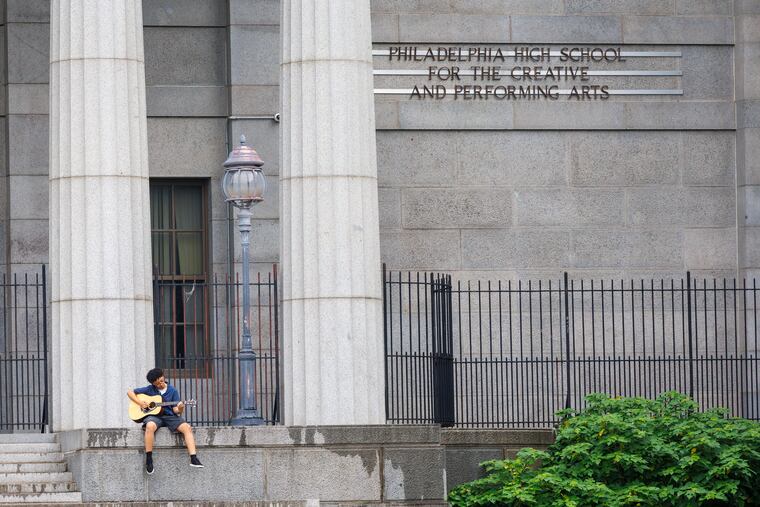
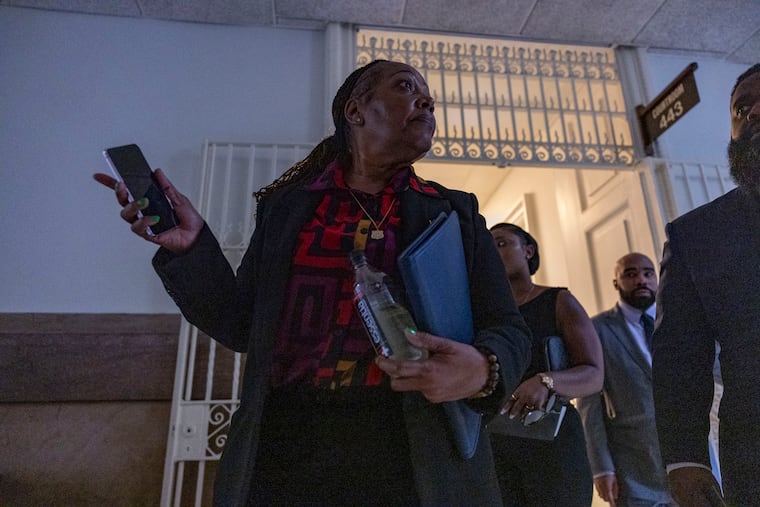
Dozens of female Philadelphia High School for the Creative and Performing Arts students were flagged for breaking dress code Thursday, sparking outrage among the students, who say they are being unfairly blamed for the behavior of men.
More than 30 teen girls — some deliberately flouting the dress code and others just wearing what they would normally wear to school on a hot day — were kept out of class for about an hour and sequestered in a room, several of them said, despite district policy stating students should not be excluded for dress code violations.
The furor started earlier this week, as the weather warmed and CAPA administrators sent families a letter warning consequences for breaking the dress code.
The aim is to keep CAPA “focused and professional,” administrators wrote in the letter, obtained by The Inquirer, but some students who were “dress coded” said administrators told them the crackdown was spurred by some female students being followed by men outside of school.
That reasoning infuriated a number of students — and highlighted the potential issues that can arise over regulating how kids dress at school.
“Why do we have to change what we wear because of what men are doing to women?” said one CAPA student who was excluded for a dress code violation and who spoke on the condition of anonymity because she is a minor without parental permission to speak to a reporter. “That set people off.”
Amelia Carnahan, 18, a CAPA senior, said the issue was bigger than just a dress code.
“The way that this is being handled reveals how deep rooted dress codes are in sexism,” said Carnahan. “We’re children, and it’s strange to still see our bodies being sexualized in 2026. Of course a basic dress code at school is needed. But in this day and age, it feels objectifying to be looked at and judged by the adults at my school while they decide whether or not I’m showing too much shoulder or my shorts are too short.”
Paige Joki, an Education Law Center attorney who doesn’t represent the students but reviewed the CAPA dress code, said the rules may be problematic.
“When students come to school to learn, and their bodies are being policed, that creates a negative school climate and may violate their rights,” Joki said.
An online petition protesting “the unjust dress code and detainment” of CAPA students had amassed nearly 1,000 signatures by late afternoon Thursday.
Naima DeBrest, a district spokesperson, said the school system was aware of the concerns, and that officials were reviewing CAPA’s policy “to ensure it is fair and inclusive for all students, while continuing to uphold expectations that reflect respect for both individuals and the CAPA school community.”
CAPA cites ‘safety risk’ as reason for dress code
In the letter sent this week, CAPA administrators warned of strict enforcement in the coming days, saying they believed “preparing our students for the professional world includes practicing the standards of dress expected in professional theaters, galleries, and corporate environments.”
Philadelphia School District policy allows individual schools to set their own dress codes; the vast majority of district schools require uniforms, though a handful, including magnets like Masterman, Science Leadership Academy, and CAPA, do not.
CAPA officials note that “inappropriate dress can pose a significant safety risk,” mentioning loose garments, inappropriate footwear, or dangling accessories.
See-through clothing, plunging tops, open backs, cut-outs, halter tops, crop tops, and tube tops are also banned. “Tops must completely cover the midriff, sides and back. They are required to meet a student’s bottom; an exposed midriff or belly button is not permitted,” the policy states.
The dress code also requires that shorts, skirts, and dresses must cover undergarments, reaching to the mid-thigh.
Joki, the Education Law Center lawyer, reviewed the CAPA correspondence and dress code and said “globally, there are some concerns with dressing and grooming rules that are vague and subjective, that may not pass muster if you were to face a legal challenge, as well as concerns about ways that was written.”
Dress codes, Joki said, “can’t include language that’s arbitrary and capricious, that’s vague and subjective, and based on the letter shared with us, [there] are terms that are vague and subjective and could lead to disparate and unequal enforcement based on students’ body shape and size.”
DeBrest, the district spokesperson, said the district’s dress codes “are intended to support a positive learning environment by ensuring that student attire does not disrupt instruction, cause offense, or interfere with the school day.”
But, she said, the district’s Office of Student Rights and Responsibilities “affirms that dress code policies should be applied equitably and must not disproportionately impact any group of students. Students also have the right to express concerns and engage in dialogue when they perceive policies to be unfair or unclear.”
Getting ‘dress coded’
Some students — female and male — said they decided to test the policy on Thursday, deliberately wearing short shirts, skirts, or shorts. Others did not set out to make a point, but wore clothes that violated the dress code as part of their normal warm-weather school clothes, students said.
When the CAPA students entered the school, several said, an administrator and multiple school safety officers pulled about 40 teen girls out of line. No boys were singled out, despite several wearing tank tops and crop tops.
“They would just look at you and tell you to go in,” said Carnahan. “There was no teacher in there, no nothing. We weren’t allowed to leave for an hour.”
The room students were held in, known as the “CAPA Cafe,” is typically used as an ancillary cafeteria. It is not air-conditioned. At times, the mood was joyous, with someone cranking up the song “Girls Just Wanna Have Fun” on their phone and some students dancing, students said.
But at other times, the teens said, the mood was tense. A video posted on Instagram shows a confrontation inside the room between principal Alonzo Fulton and a student who objected to being asked to provide their name.
“Watch your tone! Thank you. Like I said before, I was writing the names down of everyone who did not come to school properly dressed. Once I get your names down, you get to go to class,” Fulton said on the video.
The caption accompanying the video took issue with his response. “CAPA staff and administration yelling at all female students for asking why they were all locked in a room. For violating the dress code... a dress code that is sexist and they targeted African American females and girls with thicker bodies,” it read.
Some students who clashed with Fulton were threatened with suspension, students said. Others were told to go back to class but were not told what consequences they might face.
Whether girls got pulled out of line seemed arbitrary, students said. Veolla Bici, 18, another CAPA senior, wore sleep shorts and a tank top but she was not dress coded even after she deliberately tried to be flagged.
When Bici questioned why she wasn’t being cited, a school staffer “said my midriff wasn’t out,” so Bici hiked her shirt up higher, she said. “I said, ‘My midriff is out now.’ She said, ‘Go to class or there will be consequences.’”
Bici did go to class, but she and others remained confused as to why certain students were flagged and others weren’t.
Initially, students sent to the room were marked absent for first period, they said; later, those absences were reversed.
Joki said she was alarmed by the CAPA students’ accounts.
“Dress and grooming rules can be misused to police students’ bodies and to adultify them and to objectify them, and that is alarming,” she said, “and we know from research that that leads to conditions where students don’t feel safe or welcome in the school building where they are there to learn.”