Cherry Hill school board gets pushback on suggestion to drop African American history mandate
A Cherry Hill school board member suggested no longer requiring an African American history course for graduation amid a budget crunch.
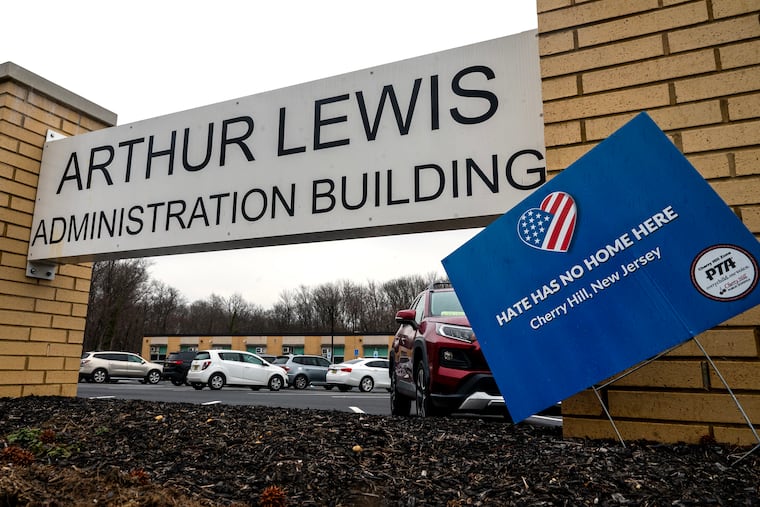
The Cherry Hill school board made national headlines when it became the first New Jersey school system to require students to take a course on African American history to graduate.
Five years later, the board debated whether the course should be dropped as a requirement in light of budget problems in South Jersey’s largest school system.
And while officials have assured the community that the course will remain part of the curriculum, the debate highlights the difficult choices that districts are facing during a tough budget year. In Cherry Hill, the board approved a budget that will cut 70 positions, increase class sizes, and raise property taxes to eliminate a $29 million deficit.
As that budget process played out this spring, board member Renee Cherfane suggested the district could reconsider African American history if future budget cuts are necessary. The idea drew pushback from students as well as community and civil rights leaders, who pledged to fight any attempt to roll back the requirement.
“Black history is an essential part of American history,” said Ma’isha Aziz, president of the Camden County East branch of the NAACP. “Teaching it helps ensure students gain a fuller understanding of the nation’s past and present.”
Cherry Hill High School East senior Skylar Adams, a member of the African American Cultural Club, said changing the course would send the wrong message. Black students make up about 10% of the district’s 11,000 students.
“In the world we live in today where the rights and voices of African Americans are constantly being challenged and minimized, now is not the time to make our history seem less important,” Adams told the board. “Making this course an elective instead of a requirement sends a message that learning about Black history is optional and not important enough for every student.”
» READ MORE: Cherry Hill School District becomes first in N.J. to mandate African American history course for graduation
Superintendent Kwame Morton, the district’s first Black schools chief, praised students who made passionate appeals to the board to keep the course. He reassured them that the course was not in jeopardy.
“The board is not at this point taking action on any recommendation to eliminate that course. That’s not what’s happening,” Morton said.
Here is what to know about the debate around the course:
How the issue unfolded
Cherfane sparked a heated discussion during a board meeting last month when she suggested making African American studies an elective instead of a required course. She cited the district’s $29 million deficit, which prompted layoffs and cuts.
In the event the board has to cut additional teaching positions in the future, having that class as a mandate limits options, she said. About 800 students are required to take the course every year, she said.
“It’s not about offering the class. It’s about requiring it,” Cherfane said. ”We wouldn’t be getting rid of it entirely."
Other board members asked Cherfane to explain why she targeted that class. The district offers other electives, such as multivariable calculus, a high-level math course that few students take, that are not required by the state as a graduation requirement, said board member Miriam Stern.
Board president Gina Winters said any review examining potential cost savings should not be specific to one class. The African American history class was pitched by students and supported by the community, she said.
“I understand that it’s a tight budget, but we also have a responsibility as a board to educate our children on the things that our community thinks are important,” Winters said.
Cherfane did not respond to messages seeking comment.
How did the class get started?
By an 8-0 vote, the board approved the course as a graduation requirement in February 2021. Students who organized Black Lives Matter protests sparked by the killing of George Floyd in 2020 in Minneapolis by a white police officer asked for the class. They said Black history was mostly taught only in February.
Cherry Hill became the first district in the state with the requirement, according to the New Jersey Department of Education. New Jersey and Pennsylvania require history to be taught, but districts decide the content of their courses. Philadelphia and Camden schools also mandate a course in African American history to graduate.
» READ MORE: Cherry Hill was the first N.J. district to mandate a Black history class. Here’s how it is done.
The district developed a curriculum for a semester course and began offering it for the 2021-22 school year for freshmen and sophomores at its two comprehensive high schools. The district hired two teachers.
Teacher Jennifer LaShure said the course tackles topics that previously received little attention in U.S. history classes. She has included units on early African culture, arts, systemic oppression of today, anti-racism, and activism.
“I worry about the message that it sends to the students that something as important as history can be taken away,” LaShure told the board. “We see it all over, but it’s scary to see it happening right here.”
Community pushback
Former board member Corrien Elmore-Stratton, who was the only Black member of the board that approved the course as a requirement, said the need for it remains.
“... We are already having spaces and places where our students are being erased, torn down, no longer heard, misunderstood, and DEI has become a dirty word,” she said, referencing President Donald Trump’s attacks on diversity, equity, and inclusion. “It really is disheartening to hear that anyone on this board of education to think of to do.”
Carole Roskoph, a retired educator and former Cherry Hill council member, said she was “perplexed” by the discussion.
“It doesn’t make sense to me,” she said.
Motion withdrawn
Following the discussion, Cherfane made a motion to refer the issue to the policy committee to review possibly adjusting the graduation requirement for African American history. She withdrew the motion midway through voting, after a board member expressed unreadiness, and the discussion abruptly ended.
Cherfane did not reintroduce the motion at the May 26 meeting and it was unclear if the matter would be addressed again.
Other cuts, however, are moving forward in Cherry Hill and will take effect next school year.

Inquirer Cherry Hill