Choosing a major can be hard. Here’s how colleges help students figure out what they want to do.
Bryn Mawr College, for example, offers an annual academic fair for students to explore their options. It’s common at small liberal arts schools to not choose a major immediately.
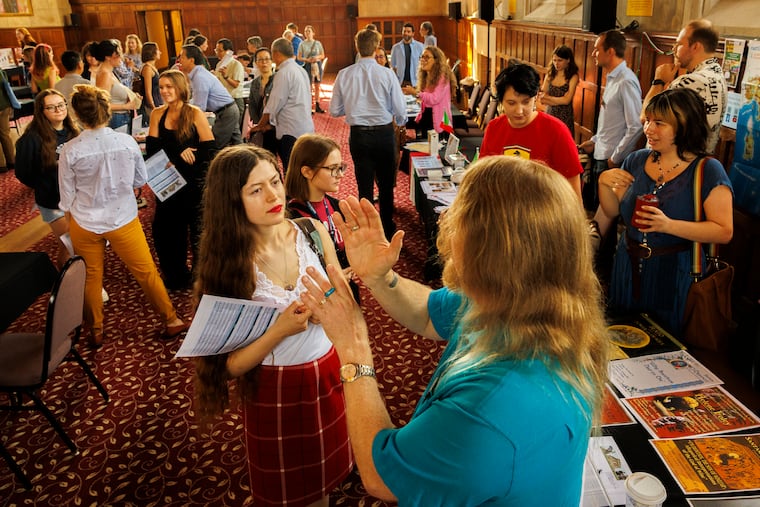
Fresh to campus last month, dozens of first-year students filled Bryn Mawr College’s Great Hall, where faculty offered information on the school’s diverse majors.
The annual academic fair is designed to help new students begin to figure out what they want to study over the next four years at the selective women’s college outside Philadelphia.
Roaming from table to table was Rewa Diaz-Asper, 18, a freshman from Washington, who said she had no idea what she wanted to major in.
“That’s why I came to a liberal arts college, so I could take classes” and figure that out, she said.
At Bryn Mawr, students do not declare a major until some time in their sophomore year.
“We want them to be really open-minded about exploring a variety of academic disciplines,” said Richie Gebauer, dean of student success. “We’re trying to help students recognize that really ultimately wherever they land … there’s going to be a multitude of career pathways.”
» READ MORE: An 8-year-old is studying neuroscience at Ursinus College. He’s the school’s youngest student ever.
Every year, tens of thousands of freshmen arrive at college campuses across the Philadelphia region to embark on an academic journey that will lead them to a career.
But some, like Diaz-Asper, are not sure what they want to study. A good number of college students — some estimate about half, others even higher — will change their major along the way.
Supporting students’ decisions
Colleges have different approaches and timelines for picking majors, but all aim to offer students support. At smaller, private liberal arts colleges, it’s general practice for students not to select a major at the start; at larger universities, they generally declare a major when they enter, but those schools have programs for students who are not quite ready.
“It doesn’t actually matter what model you have, provided that you’re providing students with flexibility,” said Ed Venit, managing director of the D.C.-based EAB, formerly the Education Advisory Board, which issued a 2016 report on choosing majors and student success. “The bad things happen when students get into a major and they can’t get out. They can’t switch to something else that they want or, in doing so, they lose a huge chunk of credits they earn.”
A best practice now is to offer “meta majors” in areas like STEM (science, technology, engineering, and math), business, and the humanities, he said, which allows students to choose an area of interest with related courses but not have to zero in on their primary field early on.
St. Joseph’s University allows students to enter under categories such as undecided business major or undecided humanities, letting them specify an interest but keeping some flexibility. Students also can come in undeclared — 11%, or 152 students, have done so this fall — and are asked to make a choice by the first semester of their sophomore year. Along with advising, the school offers undecided majors first-year seminars on varying topics that students can explore.
At Rowan, a large state university in New Jersey, about 95% of students declare majors when they enter as freshmen. For those who don’t, the college has a program designed to help them find the career or discipline that best suits them, and a recently launched academic home, University College, serves as their base.
“If you really are not sure, it’s good to keep an open mind,” said Rory McElwee, vice chancellor for student affairs and dean of University College. “And even people who are sure sometimes change their mind.”
Rowan’s exploratory studies program includes academic advisers who specialize in guiding students in selecting majors, the school said. Students take a first-year seminar course called Rowan 101 to further their exploration.
About 5% of Rowan students entered this fall as undeclared majors, a slightly smaller percentage than five years ago.
“There’s a lot of pressure on 17- and 18-year-olds when they are filling out the Common App [for college applications] to indicate a major,” McElwee said.
Parents can add to that, too, she said. During a panel of students who had changed their major, she said, someone noted the hardest part was “telling my parents.”
“I found that haunting, and I expect it is actually not unusual,” McElwee said.
Close to half of Rowan students change their major along the way, she said.
Being undeclared
St. Joseph’s, Temple, and Widener Universities also reported fewer students choosing an undeclared major.
Temple, which like Rowan has a special division for undeclared majors, estimates 15.3% this year, down from about 19% five years ago.
“Often, the first question from family and friends at Thanksgiving after ‘How do you like college?’ is ‘What’s your major?’” said Neal Conley, director of Temple’s academic resource center. “Some students have shared that they don’t like not having an answer to this question.
“It’s also harder to justify the value proposition of the increasingly expensive prospect of higher education when there isn’t a clear pathway to a specific career,” he said.
At the University of Delaware, the number of undeclared majors has grown. The school said nearly 1,000 first-year students, or 21.3%, are entering as undeclared majors, up 2.2% from last year. They are enrolled in the University Studies program, which provides academic advising, career explorations, and mentors who previously were in University Studies.
Choosing later is the preferred course at some schools — and is even highly celebrated. Students at Haverford College make their selection in the spring semester of their sophomore year, stepping to an outdoor microphone and sharing their choices to a chorus of ringing miniature cowbells.
Students at Ursinus College, a small liberal arts school, typically choose a major in the second semester of their freshman year, with about 80% declaring by the beginning of their sophomore year.
“Instead of routing students into specific majors or disciplinary pathways right away, we connect students with interdisciplinary innovation hubs where they work with a group of faculty and with other students on an issue or a problem they are passionate about,” said provost Gundolf Graml. “These hubs are supported by academic advisers and career coaches and double as career communities.”
Students also take an academic exploration course and a career exploration lab in their first year, he said.
‘A brand-new world’
At Bryn Mawr’s academic fair, Radcliffe G. Edmonds III, a professor of Greek, fielded questions from student after student.
“This moment,” he said, “is more about enthusiasm and sort of like here’s a brand-new world: What can you do here?”
He said students often ask what they can do with a classics major or a humanities major.
“Anything. Anything you want,” he tells them, citing cases of students who go on to medical school and law school.
Gabriela Pabon, 18, of Frederick, Md., said she already knows what she wants to major in: ancient Greek. A fan of Greek mythology and Greek tragedies, she has had her heart set on it since she was 13.
But Pabon, who wants to become a classics professor, came to the fair with lots of questions anyway.
“I want to try to get a combined undergrad and master’s degree in four years, and that’s going to require a lot of careful planning,” she said.
Some students’ career interests change dramatically after their freshman year. Sophianna Stricker, 19, of Schuykill Haven, entered Bryn Mawr last fall, taking biology and chemistry classes with plans to become a physician assistant.
“I realized it wasn’t my thing,” she said. “Second semester, I took a bunch of different classes … a history class, an education class, a sociology class, just like testing out a bunch of different things.”
Now, as she starts her sophomore year, she is leaning toward an education and psychology major, with plans to become an elementary teacher or a school psychologist.
Once students choose a major at Bryn Mawr, few change their minds. Over the last five years, the percentage ranged from 5% to 8%, Gebauer said.
Diaz-Asper, who came to the fair with no idea on a major, stopped by a table and picked up a pamphlet on the Growth and Structure of Cities major. Matt Ruben, a visiting assistant professor, said the multidisciplinary major delves into how Philadelphia developed and can be a choice for students with varying interests, including economics, political science, law, sociology, anthropology, English, art, and architecture.
“We tell them this is a field with many faces,” he said.
Students could go into careers such as urban planning, real estate development, and zoning law, he said.
“That looks pretty interesting,” Diaz-Asper said.