New Jersey will now require cursive writing for some elementary school students
Beginning in September, New Jersey public schools must teach cursive writing to students in grades three to five under a law signed by Gov. Phil Murphy.
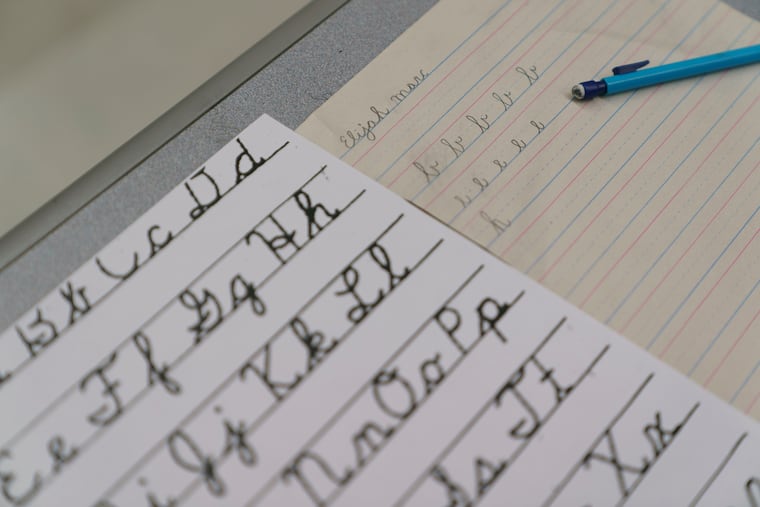
Beginning in September, New Jersey public schools must begin teaching cursive writing to students in grades three to five.
A bill signed by Gov. Phil Murphy on Monday makes cursive instruction mandatory for some elementary students. The requirements take effect immediately and apply to the 2026-27 school year.
New Jersey joins Delaware and at least two dozen other states that require cursive writing. Similar legislation proposed in Pennsylvania did not advance.
In pushing the mandate, New Jersey State Sens. Angela McKnight (D., Hudson) and Shirley Turner (D., Mercer), the bill’s sponsors, have said students should be able to write in cursive to sign legal documents and read personal keepsake letters and historic documents.
Murphy, who signed the bill on his last full day in office, also cited America’s 250th anniversary this year. Students should also be able to sign a check, he said.
“We owe it to our students to give them a well-rounded education that ensures they have the tools to fully understand our rich history and become competent leaders,” Murphy said in a statement.
Experts say cursive writing improves fine motor skill development and eye-hand coordination. It is also believed to boost spelling and writing skills and overall learning and to encourage discipline and patience.
However, in 2010, cursive writing was eliminated from the state’s common core standards and many districts stopped teaching it. Many Catholic schools in the region have kept the tradition to promote good penmanship.
Critics believe cursive writing is antiquated and learning should focus more on technology such as AI. They believe incorporating cursive lessons would take valuable time from other subjects.
» READ MORE: Can cursive writing make a comeback? A teacher and grammarian debate. | Pro/Con
Some South Jersey districts like Shamong, Cherry Hill and Winslow never stopped teaching cursive writing. .
“Handwriting is something that has always been important,” said Nicole Moore, principal of the Indian Mills School in Shamong. “We never got rid of it.”
Moore said students in her school in Burlington County learn cursive in third and fourth grades. She believes it will be easy to extend the instruction to fifth graders in the middle school.
The biggest challenge facing schools implementing the new mandate will be funding and finding time in the school day to add another subject, Moore said.
“You need resources to teach handwriting,” Moore said Tuesday. “That’s just one more thing as schools we have to figure out how to pay for it.”
Moore said teachers must find creative ways to make learning cursive writing engaging and not simply have students write the same passage several times.
At Indian Mills School, the school year begins with cursive writing instruction twice a week and then shifts to independent learning later in the year. A program called “Handwriting Without Tears” is used to teach students basic strokes and how to connect letters.
McKnight has said cursive could be incorporated during writing or spelling lessons. She first introduced the bill several years ago, but it didn’t get traction.
» READ MORE: A generation of Americans never learned cursive. So Philly historians are teaching AI to transcribe it.