Cyber charter reforms are coming to Pennsylvania. What does that mean?
School districts will pay less per student to cyber charter schools. Some are celebrating the reforms, but cyber charter operators say the legislation will hurt their ability to educate students.
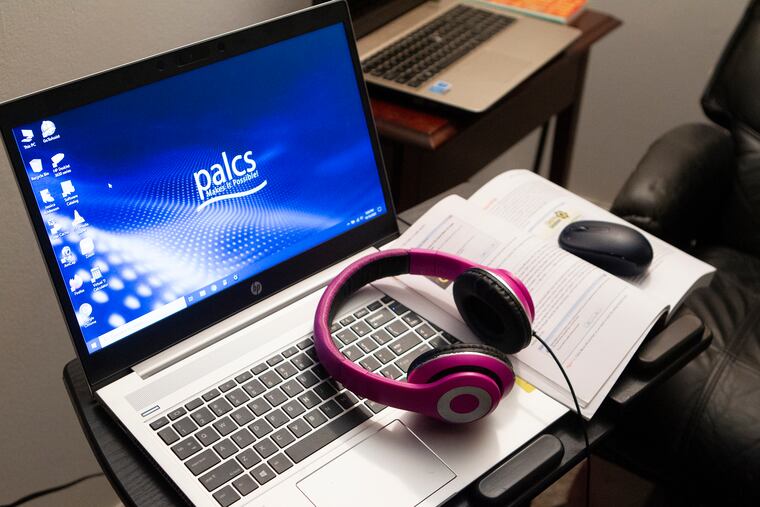
Pennsylvania public schools will save $175 million thanks to sweeping changes coming to cyber charters in the state budget deal reached this week.
“We finally reformed our cyber school system,” Gov. Josh Shapiro said to cheers just after he signed the budget Wednesday. “If parents want to send their children to a cyber school, that’s fine — but we shouldn’t be overfunding them at the expense of our public schools."
Pennsylvania’s cyber charters have drawn intense criticism for poor academic outcomes and financial practices, including some schools’ lavish spending on buildings even though they exist to educate students virtually. A report released earlier this year by state Auditor General Timothy DeFoor blasted cybers as sitting on too much taxpayer money; the old cyber charter formula paid them inflated per-student rates, he suggested.
But to those inside the sector, the cuts in payments to charters are devastating and will lead to larger class sizes, fewer programs, and, potentially, even some schools closing.
Here’s what to know about the changes.
What will change for cyber charter schools?
Cyber charter schools will get less money per student. Pennsylvania previously paid cybers the same per-student rate that brick-and-mortar charters received. (The rate depends on the amount the student’s home district spends per student; in Philadelphia, charters are paid $14,949.26 per regular education student, and $45,572.96 per special education student at brick-and-mortar charters, though cybers receive $38,104.17 per special education student.)
Now, cyber charters will receive less money per student — districts will be able to lower their payments to account for things cybers don’t need, like student transportation, building costs, and more. The state says the savings will amount to $175 million; the cybers believe that is an undercount and say they will take a $300 million hit. The new rates are not yet set.
The law changes mean that, going forward, students who are truant will not be able to enroll at a cyber school without a judge’s permission.
They also require students who are in synchronous, direct-instruction classes to have their cameras on to be marked present, and students in asynchronous classes to meet certain benchmarks, with results reported to the Pennsylvania Department of Education.
The changes also impose twice-yearly residency checks to ensure students’ correct home districts are billed for their education.
And the law mandates student wellness checks.
What do cyber charter operators say about it?
Cyber charter boosters say that two of the state’s 14 cybers will likely have to close within a year, and that within five years, an additional five virtual schools may be forced to close. They estimate that the cuts will lead to 2,000 layoffs of cyber charter teachers and staff.
Jon Marsh, CEO of Esperanza Cyber Charter, a Philadelphia-based school, said the legislation has given him sleepless nights. He worries about the ability to continue to serve his 1,000 students — virtually all of whom are students of color and living in poverty.
“We are going to survive, but we need to look at how to change our program,” Marsh, who has worked in cyber charters for more than 20 years, said of the deeply cut per-student payment rate.
Marsh envisions less direct-instruction time in synchronous virtual classes and bigger class sizes.
“I believe that I’m going to have to move more towards asynchronous,” Marsh said. “Then you can get the higher loads. The math I did before shows that if my school has below 1,400 kids, 1,300 kids, it’s very hard [to survive]. I’m at 1,000.”
Marsh said the changes mean cyber schools will need to enroll more students.
“I should be able to market into that population. I’ve never chased enrollment here; it’s always been word of mouth. We’re small. We service the neighborhood. We’ve even had some conversations: ‘Do you branch out and look at Reading and Allentown?’” Marsh said.
Jane Swan, CEO of Reach Cyber Charter, said in a statement that the changes were “disgraceful, and a direct attack on students who depend on public cyber charter schools as a lifeline. Public cyber charter schools, on average, educate a higher percentage of economically disadvantaged students, students experiencing homelessness, and students with special education needs than school districts. These are the students who need more support but decision-makers in Harrisburg are failing these vulnerable children.”
Michael Leitera, who leads PA Distance Learning Charter School, said the budget “singles out these 14 public schools and imposes punitive and burdensome mandates that will result in fewer opportunities for students.”
Don Asplen, CEO of Achievement House Cyber Charter, called the state budget “an attack on school choice, an attack on students, and an attack on public education in Pennsylvania.”
What do critics of cyber charters say about the changes?
The cyber charter changes were a long time coming, said Laura Boyce, executive director of Teach Plus Pennsylvania.
Tightening accountability is a “commonsense” step — not to make it tougher for charters to operate, but to protect kids, Boyce said. She pointed to the case of a Chester County girl enrolled at a cyber charter who was, authorities say, tortured and ultimately killed by her family.
On the financial side, “there has been some irrationality in the funding system in terms of these schools having enough excess reserves to be buying up real estate and spending money on gift cards,” Boyce said.
But mostly, cybers’ “student outcomes are abysmal,” she said. “There’s no way to look at the outcomes that are coming out of the cyber charter system and say, ‘The system is working as intended.’” (For instance, at Commonwealth Charter Academy, the state’s largest cyber, 9% of students met PSSA targets in reading and 4% met them in math.)
The nonprofit PA Schools Work agreed.
“The inclusion of cyber charter reform will help alleviate the financial burden on school districts that have been overpaying cyber charter schools and will ensure that taxpayer dollars are spent more effectively and equitably,” the organization said in a statement.
When do the changes take effect?
The changes will take effect this school year. Cyber charter operators say they will get guidance from the state education department in 30 days on the new per-student rate they will be paid by their districts.
Inquirer staff writer Gillian McGoldrick contributed to this article.