Florida shows how not to teach U.S. history on the republic’s 250th anniversary
What a new Florida history course misses about the founders and slavery—and about the complexity of history itself.
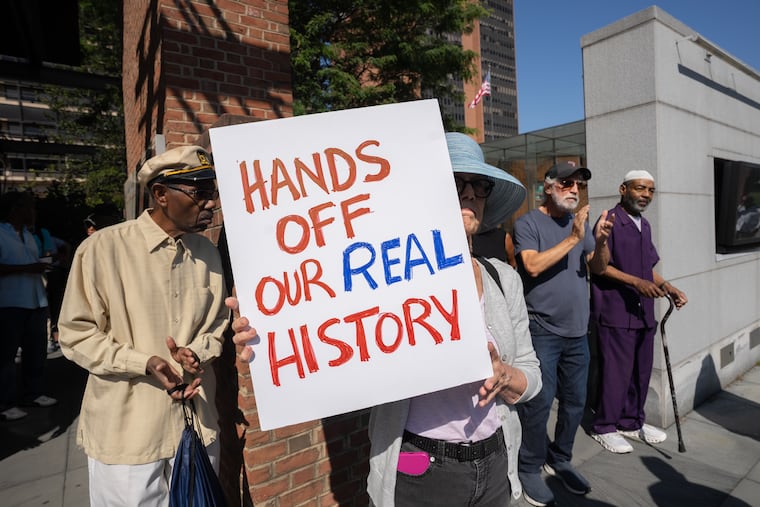
The state of Florida recently released a new American history high school course with a conservative tilt. Troublingly, it glosses over the relationship between the founders and slavery—a topic that should in 2026 promote a rich understanding of the U.S. past, but one that has also been a subject of controversy, including in Philadelphia at the site of the President’s House. In fact, slavery was central to the economic growth and expansion of the young republic, so much so that it would take a long and brutal war to get rid of it. As Abraham Lincoln, dealing with slavery during the Civil War, put it: “Fellow-citizens, we cannot escape history.”
On the 250th anniversary of the founding of the American republic, it bears repeating that the history of the United States is neither the linear, uninterrupted history of American exceptionalism that the Florida framework promotes nor is it solely an unremitting story of racism and reaction. Students benefit from learning about the brutality of slavery as well as the bravery of those ordinary Americans, men and women, Black and white, who resisted it. Emphasizing just one part of this equation is incomplete and bad history.
The Florida course framework portrays the founding generation of American revolutionists as unanimously antislavery. The truth is more complex. While most of the northern founders like Benjamin Franklin, Alexander Hamilton, and John Jay lent the prestige of their names to abolition societies, most southern founders did not. Their actions reflected the reality on the ground. Between 1779-1804, northern states gradually abolished slavery. But southern slavery not only persisted but expanded considerably in the early American republic. If the founders were unanimous, what explains this divergence?
While Jefferson and Madison professed to abhor slavery in their writings, like most southern enslavers they did not free their slaves. Jefferson made an exception for his own progeny, freeing select enslaved people. During his presidency, George Washington famously pursued his slave Ona Judge, who had escaped enslavement, with a relentless energy. However, New Hampshire authorities refused to render her back to the President—a signal of diverging attitudes and policies about slavery in the early republic.
Washington did become the only prominent member of the so-called Virginia dynasty of Presidents to free his slaves on his death. It was a belated gesture. As the Black abolitionist Reverend Richard Allen noted in his eulogy of Washington in 1799, “he dared to do his duty, and wipe off the only stain with which man could ever reproach him.” While Washington was lauded as the Father of the Nation, few southern slaveholders followed his example, as Allen had hoped.
The Florida history standards also present the U.S. Constitution, which was signed in 1787, ratified in 1788, and went into effect with the launch of the federal government in 1789, as an antislavery document rather than one that contained expedient compromises on the issue of slavery. One particularly egregious example of this relates to the three-fifths clause, which counted the enslaved population at a three-fifths proportion for representation and taxes. The Florida guidelines consider this an antislavery clause because the enslaved population was not counted fully. But this compromise led to southern domination over the federal government until Lincoln’s election as it gave the slave states disproportionate representation in Congress.
The framers of the Constitution were careful not to use the words slavery and slaves in the fundamental legal document of the republic. Instead, they employed euphemisms such as “persons held to service” or “all other persons.” But that did not prevent contemporary abolitionists from bemoaning its fugitive slave clause, a part of the Constitution that gave southern laws of slavery extraterritoriality in the free states—an endless source of political friction between the states—and the continuation of the African slave trade, an execrable commerce whose tortures were well known then, until 1808.
While Florida students under the new guidelines would learn about a debate among abolitionists like William Lloyd Garrison and Frederick Douglass on whether the Constitution was a proslavery or antislavery document, they would miss other important context. For example, the guidelines elide the equally important debate among abolitionists on the extent of the complicity of American churches in upholding slavery. Instead, abolition is framed as a Christian movement—with no mention of the schism over the issue of slavery leading to religious divisions that still exist today, including northern and southern Methodist and Baptist denominations.
The framework also includes words of praise for proslavery theorist John C. Calhoun, a planter politician from South Carolina, as a constitutional thinker. Confederate generals like Robert E. Lee and Thomas “Stonewall” Jackson are portrayed as “honorable,” pious, and militarily skilled with little mention of their cause of human bondage, which Ulysses Grant called “one of the worst for which a people ever fought.” Mississippi’s “Declaration of the Immediate Causes which induce and justify Secession” clearly stated: “Our position is thoroughly identified with the institution of slavery — the greatest material interest of the world.”
Indeed, Lee’s army enslaved free Black people in Pennsylvania while retreating from Gettysburg in 1863—not a very honorable thing to do and explicitly condemned in the Bible as man stealing. But this context is missing in the new Florida guidance.
The histories of Reconstruction and the Progressive era are not particularly well understood by the public. The Florida guidelines portray Lincoln as being at odds with Radical Republicans who implemented Reconstruction. He wasn’t. It also casts Andrew Johnson as continuing his “lenient” policy to the south, a canard that Johnson assiduously promoted to oppose Reconstruction. In fact, before his death, Lincoln became the first U.S. President to endorse Black citizenship and male suffrage, the cornerstone of Reconstruction. Radicals such as Thaddeus Stevens and Charles Sumner as well as moderate Republicans like Lincoln championed the constitutional amendments and federal laws that comprised Reconstruction.
Echoing a viewpoint espoused by white Southern elites at the time, Reconstruction gets short shrift and is deemed a failure in Florida’s new standards. Actually, the Reconstruction amendments and the first federal civil rights laws were tremendous achievements. We know the first 10 amendments to the Constitution as the “Bill of Rights” today because the author of the consequential Fourteenth Amendment that established national citizenship by birthright or naturalization, John Bingham, gave them that moniker and it eventually stuck. And Reconstruction didn’t fail; a systematic campaign of domestic racist terror in the south and reactionary judicial decisions by the United States Supreme Court overthrew it.
The Jim Crow era that followed became a cautionary tale of how quickly and completely a country can lose its democracy and rights gained. But the Florida guidelines casts more than half a century of Jim Crow as a blip or aberration from a national history otherwise committed to democratic ideals.
Students will be better prepared to be citizens of the republic when presented with differentiated historical narratives rather than having sanitized versions of the past served up to them. The Florida standards not only whitewash the past, they evoke an unchanging founding moment and pristine originalism—as though Americans in the founding era did not argue, debate, or change their thinking about slavery over time.
It also distorts how Americans continue to fight to expand—or curtail—access to rights and democracy more broadly. For instance, Progressive era reforms that included government regulation of the economy and working conditions are portrayed as “unbound by traditional constitutional restraints.”
Most historians argue that our modern democracy was founded during Reconstruction, whose seeds later grew in the 20th century and were expanded by the Civil Rights revolution of the 1960s. But, as in previous eras, the fundamental questions remain contested and unsettled. That is both clear in the historical record and the foundational knowledge students must understand to continue to expand or improve our democracy today.
Manisha Sinha is the Draper Chair in American History at the University of Connecticut and author most recently of The Rise and Fall of the Second American Republic: Reconstruction, 1860-1920.
Made by History takes readers beyond the headlines with articles written and edited by professional historians. Opinions expressed do not necessarily reflect the views of The Inquirer.