A car accident derailed his education 25 years ago. Now he’s returning to college alongside others with physical disabilities.
Five residents of Inglis House, a home for people with severe physical disabilities, are starting classes at Community College of Philadelphia. It's the largest group to start since the 1990s.
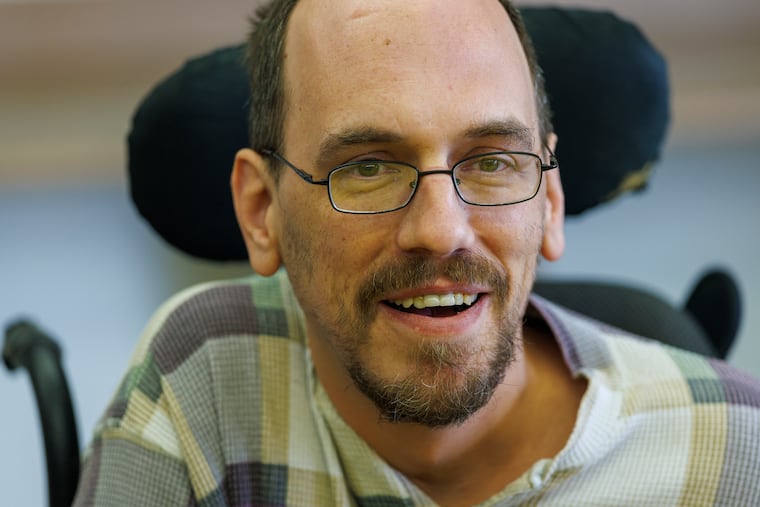
In 2000, Aaron Deede was an 18-year-old Delaware college student who enjoyed acting and had dreams of becoming a playwright.
But a car accident left him paraplegic with a traumatic brain injury that upended his plans.
“It was a little detour,” Deede said.
Now, at 43, he is returning to college along with four other residents of Inglis House, a nursing facility in Philadelphia’s Wynnefield section for people with severe physical disabilities who use wheelchairs and have conditions such as multiple sclerosis, cerebral palsy, spinal cord injuries, or challenges following strokes.
Deede and three other Inglis residents on Monday started online classes — some may go in person in subsequent semesters — at Community College of Philadelphia, with a fifth student scheduled to start this summer. Inglis pays for the students’ education from a donor-supported fund.
“I love it. I can’t wait,” Deede said Friday during a celebration Inglis held for the new students at its Belmont Avenue complex, giving each of them a backpack to start their journey.
Dozens of Inglis residents — who range in age from 18 to their 70s — have taken college classes over the years, and some have earned degrees. But this is the largest group to start together since the 1990s, said Jacklyn Monaco, Inglis’ director of therapeutic and life enrichment.
» READ MORE: ‘The choice should be there.’ More colleges enroll students with intellectual disabilities
“Things sort of ebb and flow as far as the types of resident who move in and their personal goals,” she said. “Sometimes they’re recreational goals. Sometimes they’re physical goals. Sometimes they’re educational goals. At this point in time we have a lot of younger folks who are really interested in pursuing higher education.”
Nikos Rapach, 21, had been planning to join either the Army or the Coast Guard when he was in a car accident and lost the use of his legs and the mobility of his fingers.
“I’m not going to be able to swing a hammer, so I have to start using my brain more,” said Rapach, who is from Hazleton.
He is taking English and trigonometry classes at CCP. He will use the computers at Inglis that have adaptive technology to assist with note-taking.
“Everything here is a stepping stone for me,” said Rapach, who moved to Inglis in May. “I want to go back home. I want to get a job. I basically want to get my life back on track.”
He aspires to become a history teacher, he said.
» READ MORE: West Chester University opens campus convenience store staffed by students with autism
“Like they say, if you don’t know your history, you are doomed to repeat it,” he said.
Deede, who came to Inglis in 2023, also would like to become a teacher, preferably at the elementary level.
Another resident who is taking classes at CCP aims to become a social worker at Children’s Hospital of Philadelphia, said Jeremy Ault, Inglis’ therapeutic education instructor. Another hopes to become an Urdu-to-English translator.
Stephanie Shea, 59, who is from Maryland and has a genetic neuromuscular condition, is taking liberal arts classes with the goal of getting a degree.
“It’s kind of a bucket-list thing,” said Shea, who recently got married to another resident. “It’s something I’ve always wanted to have.”
Founded in 1877, Inglis House currently serves about 180 residents, nearly 40% of whom are involved in educational activities — not just college. Classes are offered at Inglis in subjects such as history, law, science, poetry, and creative writing, as well as foundational skills like reading and personal finance.
Inglis staff accompanied the students to CCP’s campus to take their placement tests, register for classes, and visit’s CCP’s Center on Disability, the office that helps students with disabilities.
“We suggest accommodations based on their needs,” said Lisa Papurt, coordinator of disability services at the center, which typically serves 400 to 500 students with disabilities per semester.
Those services could include extra time for tests or technology to assist with note-taking or assistance in communicating with professors.
Papurt said she is excited to see the Inglis students start their educational journey.
“I hope to be able to support them through getting degrees, graduating, and moving on to a four-year institution,” she said.
When students entered their surprise celebration Friday, Ault, the therapeutic education instructor, told them it was time for them to celebrate.
“I’m so proud of you guys for doing so well this past year,” he said. “You guys have been such a pleasure to teach and be part of your lives really.”
Ault is helping students prepare for entry into college.
“I’m working on my writing skills and grammar,” Rapach said. “Jeremy has been giving me essay prompts to help me be a better writer so that when I get to college, I’m not trying to relearn everything.”
He said he’s excited to get started.
“I feel good,” he said. “I’m ready for it.”