$11M worth of trailer classrooms will relieve crowding at Lincoln High, but neighbors are fighting them
Some Northeast neighbors are challenging trailer classrooms at Lincoln High. Their zoning appeal calls into question whether 900 freshman will be able to use the classrooms when school starts Aug. 25.
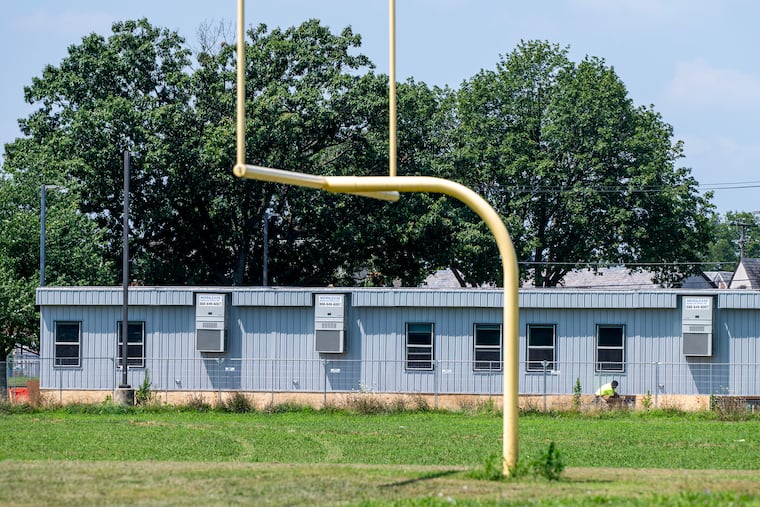
Overcrowding in Northeast Philadelphia schools has been cresting over the last few years.
At Lincoln High, built for 1,700 students, nearly 2,500 were jammed in last school year; those inside said the overflow compromised learning and safety.
In response, the Philadelphia School District’s plan was to erect trailers as “modular classrooms” on the Ryan Avenue campus in Mayfair. The school board signed off in March on purchasing 22 “classroom spaces, bathrooms, and office support space for the 2025-26 school year.“ The price tag was $11 million.
» READ MORE: What it’s like at Philly’s Lincoln High, where overcrowding has significant consequences
Some neighbors, however, say they are not pleased because the large trailers came as a surprise and they have concerns about safety and curb appeal. One neighbor filed an appeal of the district’s zoning variance; an Aug. 19 hearing is scheduled, with community members exploring chartering buses to Center City and showing up in person.
Oz Hill, the district’s deputy superintendent for operations, said he is hopeful that a resolution can be achieved before the hearing. But Hill acknowledged that the neighbors’ zoning challenge could jeopardize the district’s ability to use the trailers to accommodate 900 students — the entire freshman class — when the school year begins Aug. 25.
“It would be presumptuous to suggest that possibility doesn’t exist,” Hill said. He said that officials would do “everything in our power” to ensure community concerns were addressed and that the district works to “long-term be good neighbors and good partners.”
‘It couldn’t be too big’
The “new” Lincoln opened in 2009 with a significantly smaller footprint than the original school, but on the same campus.
Martin Bednarek, a former member of the School Reform Commission — then the district’s governing body — was privy to discussions about Lincoln’s optimal size when it was rebuilt. The idea was to make it an “academy” school, with students choosing different pathways of study, and to keep the size at about 1,200 students, he said.
“That’s the only way we thought the school would work — it couldn’t be too big,” said Bednarek, who lives close to Lincoln. “The deal was, they were supposed to turn students away if they didn’t have the room.”
But the school already enrolled 1,751 students in 2009-10, and that number has only climbed. In 2021-22, when many schools saw a pandemic dip, Lincoln’s enrollment was up to 2,051, and last school year, it was 2,439.
The growth in large part is driven by immigration; there has been an influx of immigrants from all over the world moving to Mayfair and the surrounding neighborhoods. (Forty percent of Lincoln’s students last year were English-language learners.)
The overcrowding has created chaotic conditions inside the school and outside — there are not enough lockers or cafeteria space, so many students have to carry all their belongings all day and some are assigned to eat lunch at 9 a.m. Hallways are often disorderly, and the district spent $400,000 to carve the library up into six classrooms with dividers — flimsy walls that don’t go up to the ceiling and allow noise to carry between rooms.
Trailers were the solution: The plan is to put Lincoln’s 900 ninth graders into the space, with the modular classrooms connected to the main building via an enclosed hallway, so students don’t have to travel outside to get to the cafeteria or gym.
Broken promises and a zoning challenge
Neighbor Peter McDermott filed the zoning challenge, charging that the Philadelphia Department of Licenses and Inspections erroneously issued a permit for the trailers without making the district go through the special exception process that would have required a zoning hearing and community notification.
McDermott, a former district teacher who is active in Mayfair civic organizations and Democratic politics, declined to comment until after the appeal hearing.
But Bednarek said he and other neighbors are upset because “the neighborhood was pretty much in the dark. It looks like the school district was trying to circumvent zoning. They were able to obtain a building permit over the counter, without going through a zoning hearing. They were trying to sneak this in.”
Bednarek said neighbors have concerns about safety, parking, and curb appeal — as well as what conditions will be like for students inside the trailers.
» READ MORE: Overcrowding in the Northeast puts schools in ‘crisis mode,’ staff says
And there are frustrations that the district failed to honor promises it made in a community benefits agreement with civic and political groups when a new school — now Northeast Community Propel Academy, a K-8 that shares Lincoln’s campus — was built in 2019.
Hill, who met with community members this week, said he understood the community’s frustrations over unkept promises. Some can be remedied — like the installation of a dog run — but others are trickier. The neighborhood was promised that Meehan Middle School, adjacent to Lincoln, would be demolished after its closure.
But plans pivoted; Meehan has become critical “swing space” in the Northeast for schools. Students from nearby Thomas Holme have been using the building while a new school is constructed for them. The site also has prekindergarten classrooms.
“The sacrifice that has been imposed upon them for the continued use of Austin Meehan, it serves a greater good in terms of serving some of the over-enrollment we have in the broader Northeast,” Hill said in an interview.
But, he said, “clearly, we could have done a better job communicating as priorities shifted. We should have let them know, quite frankly, and going forward, we’re going to do a better job of engaging with the community.”
Hill said he is optimistic a resolution can be reached before the appeal hearing. But Bednarek said plans are continuing to go forward with the hearing.
“We have to find a balance between what the students and families need and what the community desires,” Hill said. “It is my belief that we will work this out.”
What’s next for Lincoln
Sarah Caswell, a Lincoln High teacher who lives within walking distance of the school, said the staff is looking forward to a more manageable crowding situation with the use of the trailers.
“Teachers are thrilled — they’re getting their own classroom, they’re not going to have three teachers in one classroom. There’s positivity because they’re getting space. Some teachers will be able to decorate their classrooms for the first time,” she said.
Caswell is not thrilled about the neighbors’ challenge and believes there is suspicion in some quarters over the influx of immigrants and diverse students.
But the district’s records show that the vast majority of Lincoln students come from the neighborhood. Three-quarters are “catchment” students, eligible to attend based on where they live.
Lincoln also has specialized programs — career and technical education that allows for citywide admission, plus special education services not available elsewhere in the Northeast, and a program for students in the city who are deaf or hard of hearing.
If the trailers cannot be occupied when school opens, students suffer, Caswell said.
“As long as there’s buildings that have asbestos and lead and everything else in the district, Lincoln is not a priority,” Caswell said. “This is a balancing act. It’s an ugly one. Trailers are not ideal, but it’s better than people being stacked on top of each other.”
Should the appeal succeed and the district be blocked from putting students in the trailers, it’s not clear what would happen at Lincoln. No Plan B has been shared with teachers, Caswell said.