In Lower Merion, voters rule on school board race that divided the community
Democrats picked up most of the votes in a primary election where voters say they were motivated by antisemitism, toxic campaigns. and superintendent turnover.
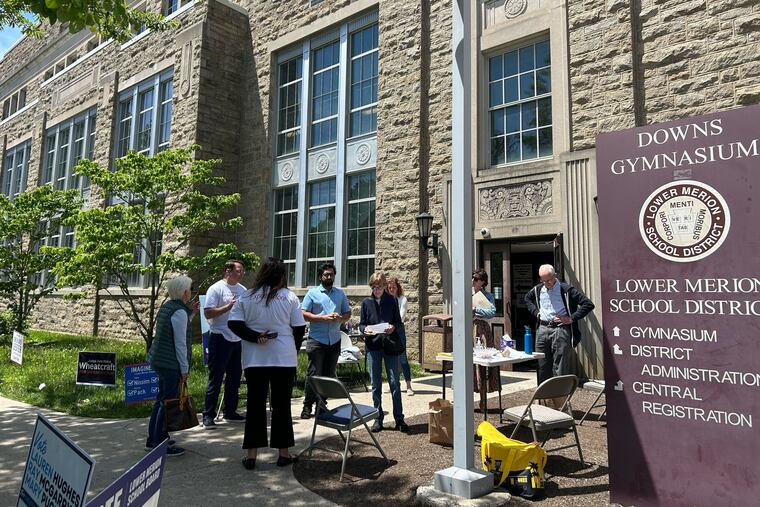
In a school board election that spurred Facebook fights, contentious mailers, and divides within the Democratic Party, Lower Merion voters on Tuesday supported a slate of Democrats led by the current school board president and another incumbent.
School board president Kerry Sautner, current member Anna Shurak, and newcomers Juanita Kerber and Jennifer Rivera each garnered between 7,800 and 8,400 votes, winning the Democratic primary.
» READ MORE: Lower Merion school board incumbents and their running mates win Democratic primary
Candidates with Imagine Better LMSD, a Republican-endorsed slate that listed combating antisemitism as a top priority, won the Republican primary. Talia Nissim, Jacob Rudolph, Omer Dekel, and Deena Pack each garnered between 1,000 and 1,250 votes and will appear on the GOP ballot in November.
At the polls, voters said concerns over antisemitism, high superintendent turnover, and toxicity during the election spurred their decision to support some candidates over others.
Dispatches from the polls
Throughout the day, candidates and canvassers camped out outside Lower Merion polling places, stuffing voters’ hands with literature and making the case for their campaigns.
Outside the Lower Merion School District administration building around noon, canvassers for Democratic candidate Rich Lester sparred with representatives from the Democratic Committee of Lower Merion and Narberth. As voters walked into the polling place, surrogates for Lester and the local Democratic committee interrupted one another as they made their pitch to prospective voters.
Amy and Jim Palmer, a married couple and longtime friends of Lester’s, said Lester had the “even-keeled personality” and business acumen to steer the district in the right direction.
Lester was one of nine candidates on the Democratic ballot for school board. He was not endorsed by the local Democratic committee, which backed the winning slate. Lester said the endorsement process was misleading and unfair, an allegation the committee denied.
At Temple Beth Hillel-Beth El in Wynnewood, Sarah Estey said she voted for Lester, Kerber, Rivera, and Rudolph.
Estey, who is 26, was excited to vote for Rudolph, a current Harriton High School senior.
“It meant a lot to see a young person on the ballot,” she said. “Young people are too often complacent, and I know too many people who don’t care.”
Greg Kasmer, a Lower Merion parent, said the high rate of superintendent turnover was a main concern as he cast his vote. Frank Ranelli, who was hired earlier this year, is the district’s third superintendent in three years.
Antisemitism a top issue
At the Lower Merion School District building, Nissim, a candidate on the Imagine Better LMSD slate, said she’d had productive conversations with Democrats who were open to crossing party lines to vote for her.
Nissim said people are beginning to notice a “lack of leadership in the district” and that “things have started to fall apart.”
Candidates across the political spectrum listed tackling antisemitism as a top priority, a concern reflected by voters.
Outside Harriton High School, Cynthia Gutowski said she voted for Lester because she knows his family and she believed he would address concerns that Jewish families feel underrepresented and unheard. While Gutowski is not Jewish, she said, she hoped her vote would support her Jewish friends.
» READ MORE: Students in a Middle Eastern club say Lower Merion parents wrongly accused them of antisemitism
Lower Merion has been embroiled in conflict in recent months as debates over the school district’s responsibility to define and fight antisemitism have divided the community.
Steven Haas, a resident of Bryn Mawr also voting at Harriton, said he believed candidates were using antisemitism as a “pretext” to push other, unrelated policy positions.
Haas, who is Jewish, likened certain candidates’ platforms to efforts by congressional Republicans to investigate colleges and universities over antisemitism.
“The whole thing is a pretext,” he said. “It’s being used as a pretext by Congress as an excuse to control education.”
Poll workers report a slow day
Despite the heated race, polling places in Lower Merion were quiet throughout the day Tuesday.
By around 2 p.m., 11 people had voted at the Lower Merion Baptist Church in Bryn Mawr.
“This is the slowest it’s been in the seven elections I’ve been here,” election judge Charles Davis said.
Between the two polling places set up at Harriton High School, 94 people had voted by around 2:30 p.m.

Want to get Inquirer Lower Merion straight to your inbox every week? Sign up here for our guide to the news, stories, and events shaping life in your community.
By 5:30 p.m., two precincts at Temple Beth Hillel-Beth El had seen 76 and 122 voters, respectively.
Unofficial school board results on Wednesday morning showed 37% turnout for Democrats and 33% turnout for Republicans.
Turnout in Lower Merion was higher than in Philadelphia, where, despite a high-profile district attorney race, officials expect turnout to come out between 15% and 17% once all ballots are accounted for.
Division in the community
Marc Steel, a canvasser for the Democratic committee, said he thinks the toxicity of the school board race may have turned people away from the polls.
Leading up to the election, accusations of antisemitism, corruption, and election misconduct saturated local Facebook groups. Some posters accused the local Democratic committee of running an unfair endorsement process while others dug up, and criticized, years-old videos of candidates.
Krishna Kahn, a canvasser for the Democratic committee, described “the tensions and divisions in this community that have been exacerbated by the overall national political situation.”
Amy Palmer described the conflict that tore through Lower Merion as “so sad” and “emblematic of our national discourse.”
