Two new ‘year-round’ public schools, with a special model and resources, are coming to Philadelphia
The schools in North Philadelphia will be the first in the country to replicate the Harlem Children’s Zone. Mayor Parker also emphasized the need for the city to take over abandoned school buildings.
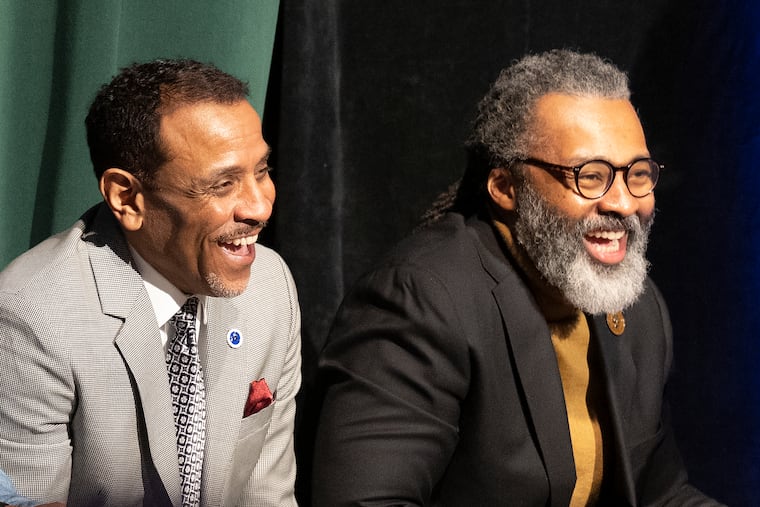
Two new schools are coming to the Philadelphia School District.
Both schools, a K-8 and a high school, district officials said Wednesday, will have resources to help eliminate long-standing achievement and opportunity gaps for kids from underresourced communities.
They’ll be part of the “North Philadelphia Promise Zone,” Superintendent Tony B. Watlington Sr. announced. Watlington said they would be the first schools in the United States to replicate the success of the acclaimed Harlem Children’s Zone, with the blessing of its founder, Geoffrey Canada,who pioneered a model that takes a birth-to-career approach to tackling generational poverty.
Watlington said the schools would be “true year-round schools.” They would bring a new approach to the new Philadelphia public schools, where prior attempts to replicate the Harlem Children’s Zone blueprint have shown mixed results.
Harlem Children’s Zone runs charters in New York City, but the proposed Philadelphia schools will be run by the district using the organization’s educational model, which includes extra resources and a longer school day and school year, as well as extensive social service supports.
“We’re going to be partners in opening these two state-of-the-art schools,” Watlington said at his state of the schools address, held Wednesday at Edison High School in North Philadelphia.
The district has big hopes for the schools, which officials said will be opened in existing Philadelphia school buildings — no new school structures will be involved.
“Not only will they get better, but get better faster than our district average. We’re going to make sure the school is staffed with the very best, most effective principals,” Watlington said. “We’re going to ensure that these schools are staffed with the very best, most effective teachers.”
They will be schools of choice, meaning parents can opt into having their children attend rather than basing enrollment on where students live.
The schools will also pull in Temple University; Watlington said that via the Temple Future Scholars program, “every single one of these graduates from this K-8 and high school” will be college-ready.
Many details were not clear Wednesday, including when the schools will open, what the year-round model will look like, the exact relationship with Harlem Children’s Zone, how the schools will be funded, and who will staff them. The district said it could not give more details immediately.
News of the new schools caught an important partner off guard. Arthur Steinberg, president of the Philadelphia Federation of Teachers, said Watlington’s speech was the first he heard of the initiative.
“Any changes in working conditions must be negotiated with the PFT,” Steinberg said. “We will not agree to anything that requires members to work additional days or hours.”
Watlington said the K-8 school will open first, and he has tapped Aliya Catanch-Bradley, the respected principal of Bethune Elementary in North Philadelphia, to lead the efforts to open the North Philadelphia Promise Zone schools.
Catanch-Bradley said it was too soon to discuss the particulars about the schools, which will be built with significant community involvement.
But, she said, North Philadelphia is a prime location for the cradle-to-career Harlem Children’s Zone model.
“We know that it’s not a food desert, because food... deserts are natural,” she said of North Philadelphia. “It is food insecure by design, right? And so, we now know that you have a resource drought there, to which it’s going to take an intentional pouring of all types of resources to wrap around a community, to help expand and become a very successful ecosystem.”
Philadelphia district officials will take time to study Harlem Children’s Zone, “but also to understand the landscape of Philadelphia, what needs to be augmented to echo the needs of this community,” Catanch-Bradley said.
Mayor Cherelle L. Parker campaigned on the promise of year-round schools, and her administration has put extended-day, extended-year programs into 40 district and charter schools. But those programs are essentially before- and after-care and summer camps, paid for with city funds and offered free to 12,000 students, rather than traditional year-round education.
Harlem Children’s Zone schools have longer school days and longer school years. It’s not clear what form the proposed North Philadelphia Promise Zone schools might take, and how these efforts would differ from prior attempts around the country to replicate the success of the Harlem Children’s Zone. Former President Barack Obama in 2010 highlighted the model and selected 20 communities, including Philadelphia, to start “Promise Neighborhood” programs that would improve access to housing, jobs, and education. Those efforts were met with varying degrees of success, and no schools opened in Philadelphia.
Watlington’s new-school announcement capped a two-plus-hour, pep-rally-style event where he and others underscored progress the district has made in the past year — and since the superintendent came to Philadelphia four years ago.
Other news from the state of Philadelphia schools event
Parker, who led off the event, said she was pleased with the state of schools.
“The school district has continued to make steady and meaningful progress,” Parker said. “Test scores are rising, attendance is rising. Dropout rates are declining, and those gains are real, and they reflect what happens when we invest in our students.”
Parker emphasized her desire to have the city take over a list of abandoned district buildings. The school board took the first step in December, voting to authorize Watlington and his administration to begin negotiating with the city to do just that.
Parker said that some of the buildings have been vacant for as long as 30 years. The district has not yet released a list of buildings to consider transferring, but the mayor said it includes at least 20 former schools.
“I want you to be clear about what my goal and objective is,” Parker said. “It’s not OK for me to have 20, 21 buildings consistently vacant, red on the school district’s balance sheet, generating no revenue and not at all working at their best and highest use. We’re going to find a way to do what has never been done in the city of Philadelphia before — develop a plan for those persistently vacant buildings.”
Watlington also ran down a laundry list of accomplishments, including ongoing fiscal stability and improvements on the National Assessment of Educational Progress, known as the nation’s report card.
He said the district would “retire” its structural deficit completely by 2029-30 though declined to give details.
He and Reginald Streater, president of the city’s school board, said the district still has a ways to go but has made strides. More than half of all district students still fail to meet grade-level standards in reading and math.
But, Watlington said, “I can assure you we’re making progress. We’re going to double down. More for our children, not less. More opportunities, more access, more exposure, more good things to come in 2026.”