A new Penn program is spending $8M to help underserved Philly kids. Here’s how its first summer is going.
Academy at Penn, currently serving 50 students from School of the Future and Furness High, includes a summer session and school-year programs.
Ja’Dore Hamilton-Thomas stood at a University of Pennsylvania lectern, looking out into a classroom full of his peers and the adults who supported them.
In a four-week span, he had stretched as a student, said Hamilton-Thomas, a rising 10th grader at School of the Future in Parkside. He grew to love math, ignited a passion for coding, toured multiple college campuses, explored nature, and connected with young people from other parts of the city. He saw himself in new ways and in new places.
“I’m just grateful, this is unreal,” Hamilton-Thomas said. “We’re just getting used to environments that we’ve never seen before.”
» READ MORE: Two Philly high schools were chosen for an $8M project to get more kids college and career ready
Hamilton-Thomas and 49 other students completed a summer program this year as part of the initial cohort of students at the brand-new Academy at Penn. The program is an $8 million project with a lofty goal: helping young people overcome obstacles that often keep first-generation college students and youth from economically disadvantaged families from achieving college and career success.
Launched by the nonprofit Foundations Inc. in partnership with Penn’s Graduate School of Education, the academy promises intense, year-round academics, including summer and Saturday programs, social and emotional supports, “possibility mentoring,” and more.
The first cohort includes students from two schools: Future, a citywide admissions school, and Furness High, a neighborhood school in South Philadelphia.
The first touchpoint
Rich Mitchell, the Academy at Penn’s executive director, spent the spring at Future and Furness, meeting families and students, recruiting the kids who’d benefit most from the program.
“We find traditionally in education that the top kids and those that need specialized services are the students that get the most support,” said Mitchell. “Often the kids in the middle are the ones who get overlooked.”
The first Academy at Penn touchpoint was a six-week summer program, with students based on Penn’s campus and earning a $650 paycheck for their time. (They get paid $25 for each Saturday session they attend during the school year.)
To build the summer program, staff looked at each student’s interests and their academic data. Each took two academic courses, taking into account their strengths and where they might need support. They also had a financial literacy course, career exposure — they met a city judge, spent time with the Philadelphia Police information technology department — and toured Penn, La Salle University, and Swarthmore College.
Mitchell is a former district principal. From that lens, having the access to Penn-level resources and targeted supports, including a social worker and counselor shared between the two schools and an Academy at Penn elective class on kids’ rosters during the school year, is “a game changer,” he said.
“I don’t know of anything in the country that’s this comprehensive and holistic,” said Mitchell. “We’re entrenched in the schools during the day. The level of exposure that they’re going to get is world-class.”
The program will evolve based on students’ interests and needs, officials said. Many Furness students are English language learners; some language support was available for them through the academy program, but staff found that language barriers made career exploration pieces difficult for some kids to access. Staff will work to address that going forward, they said.
‘A 10 out of 10′
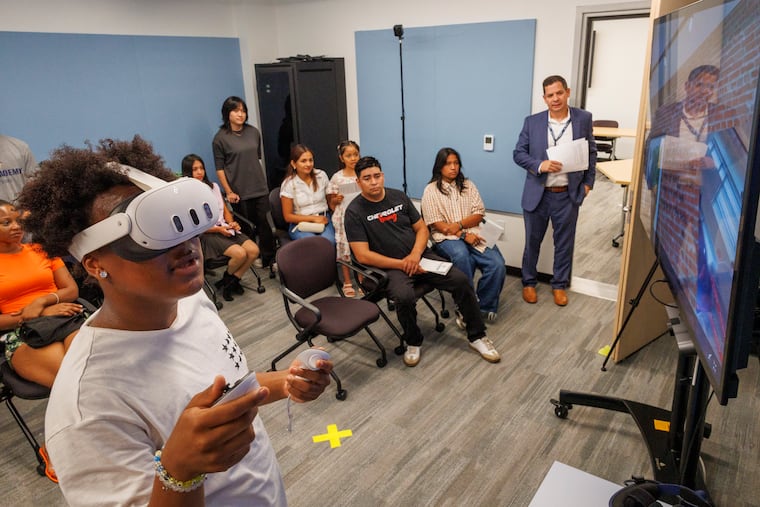
On a sweltering late-July Friday, the 50 Academy at Penn kids invited family members to campus to show off what they had learned over the summer experience.
Some students donned VR goggles, walking their classmates and loved ones through presentations, photos, and avatars, summing up their Academy at Penn time so far.
“I learned how to write better and give stronger opinions,” one student said.
“I made friends with all kinds of different people,” another said.
“We played an intense game of dodgeball against the teachers,” another chimed in.
Kayzan Badjiser, an Academy at Penn student from Furness High, said he was surprised to be chosen for the program.
Badjiser, who likes working with his hands and solving problems, was excited by the ways he was challenged and the approaches staff took.
“We don’t just get paper and do something in a classroom,” said Badjiser. “We have to express our ideas and work with others, building stuff. You do stuff out of the school environment. You have to have commitment, but it’s an awesome program.”
It wasn’t always easy for Hamilton-Thomas to get to Penn — he had to take two buses from his mom’s house in North Philadelphia every day. But it was important enough that one day, when a bus never showed up, he walked more than an hour to get to class.
“It was important, you know?” he said. He loved that there were no fights, and that he learned environmental science, as well as physics.
The paycheck was nice — an incentive, especially for kids who would otherwise be expected to fill their summer with paying work — but it was about more than the money, Hamilton-Thomas said.
“The Academy was a 10 out of 10,” said Hamilton-Thomas. “They gave us a lot of chances, and not many people get that.”