Penn says its finances are stronger than anticipated. More budget cuts are still coming.
Penn leaders cited Trump administration actions that threaten future funding and revenues, as well as rising legal and insurance expenses.
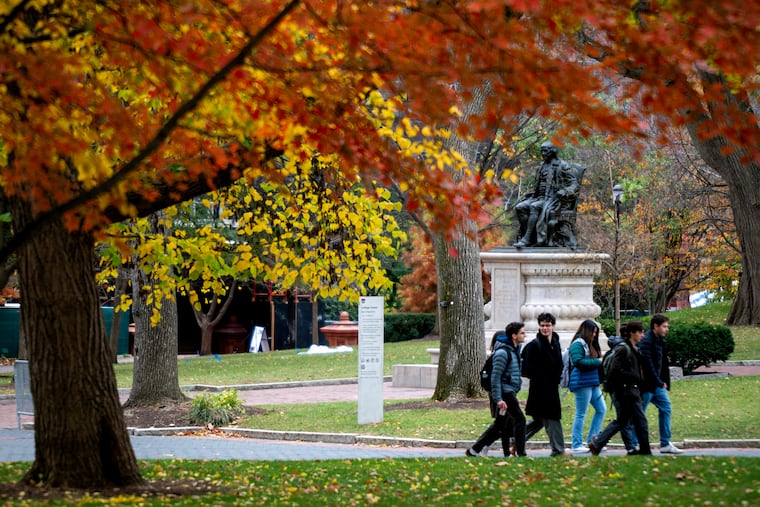
The University of Pennsylvania will institute another round of budget cuts in response to Trump administration actions that threaten future funding and revenues, and because of rising legal and insurance expenses.
That is even though officials said finances look better than they anticipated a year ago, though they did not provide specific numbers.
Penn’s schools and centers have been directed to cut 4% from certain expenses in the next fiscal year and keep in place financial cutbacks instituted last year, including a staff hiring freeze and freezes on midyear adjustments in staff salaries. Schools and centers also were asked last year to cut 5% of certain expenses, and the new 4% reduction would be on top of this.
The university did not detail which expenses would be cut, but it is likely that discretionary funds for things like travel and entertainment would be targeted.
» READ MORE: Penn, bracing for federal funding cuts, orders a hiring freeze and other changes
Penn leaders cited changes in student loan programs and visa policies, an increase in the endowment tax, and potential losses in research funding as reasons for continued financial restraint. Legal, insurance, and employee-benefit expenses also are rising faster than revenues, said Mark F. Dingfield, executive vice president, and John L. Jackson Jr., provost.
“Taken together, these conditions reinforce our responsibility to continue careful financial management to stabilize our finances for the long term,” the leaders wrote. “It is important to note that this planning effort is just that — an effort to plan deliberately and collaboratively against a changing financial landscape."
Penn, which is the city’s largest private employer, with about 53,000 employees across the university and its health system, is expected to set tuition and fees and discuss its budget at board of trustee meetings in March.
Penn’s legal expenses have increased as the university responds to the Trump administration’s demands and investigations, including an ongoing Equal Employment Opportunity Commission lawsuit seeking in effect personal contact information for Jewish faculty and staff. And the school faced additional costs related to a data breach in November.
School officials noted that Penn has not enacted some of the deeper cuts instituted by its peer schools. Columbia University in May laid off 180 people following the loss of government research grants. Stanford said in August it would lay off more than 360 staff as part of budget cuts. Duke also instituted voluntary buyouts and layoffs last year. And Brown University, amid a $30 million deficit last year, planned for dozens of layoffs.
» READ MORE: Penn’s endowment grows 12.2% to $24.8 billion
But Penn said it had to take steps to prepare for the ongoing impact of federal policies.
The tax on Penn’s endowment earnings will rise to 4% in 2027, up from the 1.4% the school has been paying since 2022. In 2024, Penn — which has a $24.8 billion endowment — paid $10.4 million in endowment tax. The increase is not as steep as the 14% to 21% that federal lawmakers had included in earlier budget versions, but it will still financially impact the school. The tax is applied to net investment income.
Penn also stands to lose about $250 million if President Donald Trump’s cap on indirect cost reimbursement from the National Institutes of Health, currently the subject of litigation, is allowed to proceed.
» READ MORE: Tensions rise on local campuses as Trump targets international students
Concerns, too, remain about Trump’s policies regarding international students. In the last year, the administration for a period paused student visa interviews, sought to bar international students from Harvard, and promised to “aggressively” scrutinize Chinese students over whether they will be permitted to study here.
It is unclear what long-term impact those policies may have on international enrollment. International student enrollment at U.S. colleges declined 1% from fall 2024 to fall 2025, according to the Institute of International Education. The number of international graduate students declined 12%.
Penn also is bracing for the effects of the federal government’s decision, among other policy changes, to place new caps on loans that graduate students can take out.