3,000 protested conditions for Philly’s Black students in 1967. Here’s how these city kids remembered it.
“Hey hey!” a group of students yelled, 58 years after thousands of Philadelphia students marched for rights for Black students. “Ho ho! Black history will never go!”
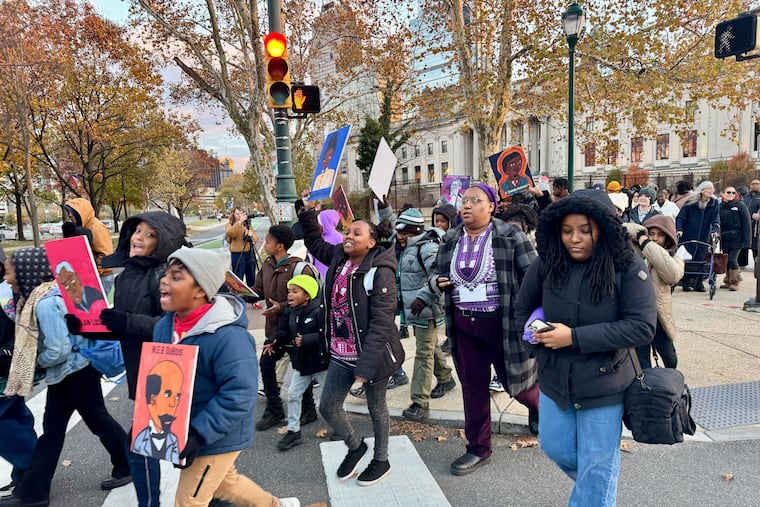
The students walked together, chanting over the hum of Center City traffic, holding a homemade sign and shouting into a chilly November sky.
“Hey hey!” they yelled. “Ho ho! Black history will never go!”
Fifty-eight years to the day after 3,000 youth and their supporters walked out of Philadelphia School District schools to protest conditions for Black students, a clutch of kids from the Jubilee School held a march Monday to commemorate that landmark action, which historians say was a seminal moment both for the city and school integration across the country.
Miles Matti, a fifth grader at Jubilee, a private school in West Philadelphia, walked with his brother, Theo, a third grader.
“We’re doing it because those kids had every right to be heard,” said Miles, 10.
The timing of the celebration was important, organizers said — not just on the anniversary of the demonstration, but 20 years after Philadelphia became the first district in the United States to implement African American history as a graduation requirement.
For months, Jubilee students studied the walkout. They conducted research, wrote poetry, made plans for honoring participants in the demonstration, and mapped a route — from the old School District of Philadelphia headquarters at 21st and the Benjamin Franklin Parkway, to the Free Library’s central branch, where there would be music and stories.
The group honored four former Masterman students who, in 2020, won approval from the city’s Historical Commission to have a marker permanently erected outside the old district building noting the 1967 walkouts.
Khaseem Bailey, a sixth grader with a strong voice and energy to spare, led the chants as the group, flanked by teachers, parents, and supporters, made its way down the Parkway.
It was important to remember, Khaseem said.
“They were marching for Black rights and student rights,” he said. “And so are we.”
‘It was not a flash mob’
The Nov. 17, 1967, walkout took 10 years to plan, said Walter Palmer, now 91, and one of the chief architects of the event — a decade spent organizing, teaching nonviolent strategies, training students, pairing them with elders.
The time seemed right that November. By that point, Black students made up the majority of the district’s pupils, and they attended integrated schools, but conditions were unequal.
“Black students were harmed for using African names, wearing African clothing,” said Palmer.
Organizers came up with a list of 25 demands — from allowing students to wear their hair in Afros to infusing Black history in the district curriculum.
“It was not a mistake,” said Palmer. “It was not a flash mob. There were no cell phones; there were no microphones. These young people, they were just hungry.”
Students pulled fire alarms and poured out of their schools, with many meeting at the School District of Philadelphia headquarters. Representatives were chosen to speak to then-Superintendent Mark Shedd, who took their requests seriously.
Newspaper accounts described the demonstration as being like a “picnic,” but then-Police Commissioner Frank Rizzo called in 100 officers in riot gear. They began swinging at students and releasing police dogs.
Fifty-seven people were arrested, and dozens injured, some seriously. The event made national headlines.
Marilyn Kai Jewett, another walkout participant, told the students their celebration was especially timely.
“We cannot let anyone whitewash our history,” Jewett said. “We are under attack. We cannot stop — we’ve got to fight until we die. The evil will not prevail. Goodness always prevails. Just keep doing what you’re doing.”