Philly’s school board heard pleas to halt school closings and reconsider Watlington’s facilities plan
“Closing schools ruins families and neighborhoods, especially Black, brown, immigrant and working class communities," a longtime district teacher said.
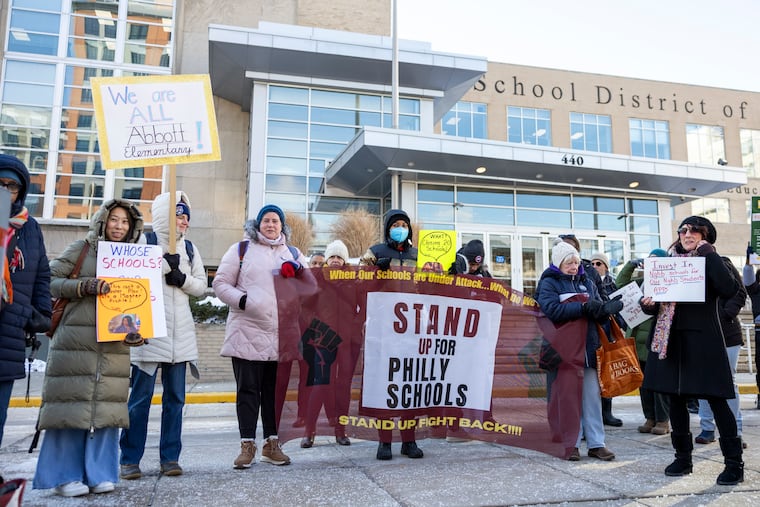
Meeting for the first time since Superintendent Tony B. Watlington presented his sweeping facilities plan, Philadelphia’s school board heard an outpouring of angst Thursday night from community members upset over 20 proposed school closures.
“Closing schools ruins families and neighborhoods, especially Black, brown, immigrant and working-class communities,” said Caren Bennicoff, a veteran teacher at Ludlow Elementary in North Philadelphia, one of the schools targeted for closure. “A facilities dashboard can’t measure what a school means to children.”
Watlington said the plan represented a “once in a lifetime, significant opportunity” for the city to modernize schools.
Prior to the meeting, more than 50 people gathered in the bitter cold outside Philadelphia School District headquarters, waving signs and shouting into bullhorns to show their displeasure with Watlington’s proposal.
Some of the demonstrators warned that removing children from their neighborhood schools would be traumatizing to already vulnerable kids.
» READ MORE: Philly’s building plan would close this high-performing magnet. Lankenau is fighting back.
“These schools are another home for these families,” said Margarita Davis-Boyer, president of the Lankenau High School Home & School Association. She said schools are a place where kids can get a meal, see a friendly face, and feel safe, especially when home may not offer the same reprieve.
“It’s just an injustice,” she said. Lankenau, the city’s environmental magnet school, would close under the plan, becoming an honors program inside Roxborough High School.
A strong Lankenau contingent packed both the rally and the board meeting, which happened immediately afterward.
LeeShaun Lucas, a Lankenau senior, is upset the school might close.
“To me, closing Lankenau doesn’t make sense,” Lucas said.
Lankenau’s campus is unique in the city — set against a wildlife preserve and a farm, a stream, and a forest.
Lucas has studied how to make the Schuylkill healthier by studying mussels, he said. He’s taking a dual enrollment GIS class — the only such high school in the city to offer such an opportunity, school officials believe.
That exposure has shaped Lucas, he said.
“I truly believe that voting to close Lankenau Environmental would be a mistake,” Lucas said. “Please vote to save Lank so that others may benefit from the type of learning that is only possible at Lankenau Environmental.”
Disparate impact
Ryan Pfleger, an education researcher, said if underutilization and facility condition truly shaped Watlington’s recommendation, the burden of closure would fall roughly evenly across racial groups.
But that’s not the case with Watlington’s plan.
“Black students are overrepresented, roughly 1.6 times more likely to be enrolled in schools slated for closure,” Pfleger said. “Fifteen of 20 schools proposed for closure are majority Black. White students are underrepresented, about four times less exposed than expected. The schools slated for closure are also disproportionately low income.”
Pfleger’s conclusions match an Inquirer analysis of the closure data.
The plan, Pfleger concluded, “does not rectify educational injustice.”
Conwell shows up
A strong contingent of Conwell supporters also told the board they were unhappy with the plan to close their school, a magnet middle school in Kensington.
Conwell has just over 100 students in a building that can hold 500. But Erica Green, the school’s principal, said it’s worth saving.
“Conwell for many years has been the cornerstone in the Kensington community, a place where students flourish, where leaders are born; alumni included leaders in government, education, law, media, public safety, and professional sports: Living proof that diamonds truly are in our backyard,” Green said. “Times have changed, but excellence at Conwell has remained the same.”
Conwell is celebrating its 100th anniversary and has been the recipient of public and private donations to advance its building conditions and program offerings.
“Do not let the almighty dollar drive a choice to remove a beautifully designated historic school and beautifully gifted young people,” an impassioned Green said. “The essence, prestige and impact of Conwell Magnet Middle School cannot be duplicated.”
Priscilla Rodriguez, whose two sons attended Conwell, worries about the implications for families that rely on it for stability.
“When a school closes, families don’t just adjust. They struggle,” Rodriguez said. Conwell families “are already dealing with a lot. You won’t make it any better by closing Conwell.”
An incomplete plan?
Katy Egan came to the board with a long list of questions, none of which were addressed in Watlington’s plan: Which schools will be modernized? When? How? How will displaced students get to their new schools? What’s happening to students with special education plans forced to leave their schools? How do you plan to keep kids safe while merging schools?
Egan, a member of Stand Up for Philly Schools, called the blueprint “a 25% plan.”
But, she said, “we deserve more than 25%, and our students deserve everything.”
Community members can weigh in on the plan in the coming weeks at meetings around the city, and Watlington is scheduled to formally present it to the board on Feb. 26.
No vote will happen in February though, said board president Reginald Streater, who declined to weigh in on the merits of the plan until it’s handed over to the board.
In other board news
In other board matters, Watlington said he would soon ask to eliminate half days from the district’s calendar entirely.
The news came as he detailed a slip in year-over-year student attendance: in December, 54% of students attended school 90% of the time, compared to 66% in December 2024. That’s the largest drop in Watlington’s superintendency, he said.
He attributed the challenges to a two-hour delay for snow, light attendance prior to winter break — and light attendance during a half day called for professional development.
Watlington said at next month’s board meeting, he’ll propose amending the 2026-27 schedule to remove half days entirely.
“Half days in the calendar do not serve us well,” he said.
The board also installed three new student board representatives.
The non-voting members are: Brianni Carter, from the Philadelphia High School for Girls; Ramisha Karim, from Northeast High; and Semira Reyes, from the Philadelphia High School for Creative and Performing Arts.