Philly school bathrooms often sit broken, as the average repair takes more than a month
Philly school bathrooms are getting fixed faster — it used to take an average of 50 days for the average broken bathroom to get attention.
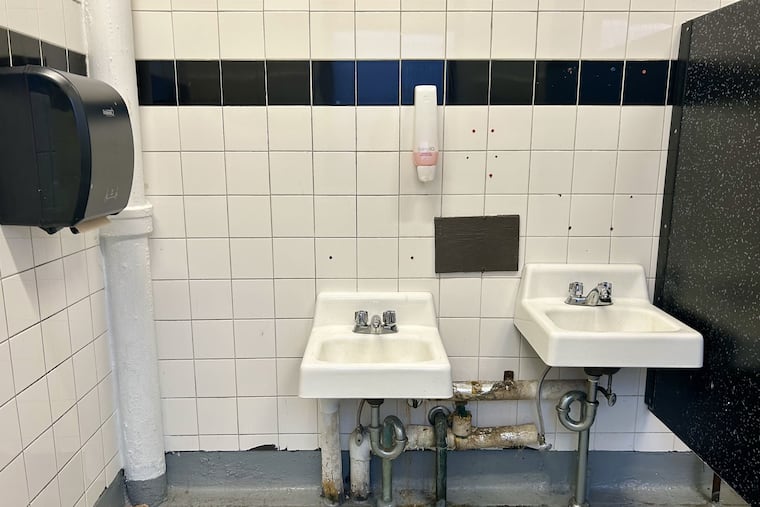
Three years ago, it took the district on average 50 days to fix a broken bathroom.
That was down to 34 days in the 2024-25 school year. But the figure for the 2024-25 school year still lags the national median, according to the Council for Great City Schools — 17 days for all districts, 27 for large urban districts.
It’s an important metric, district officials acknowledged.
“Students cited broken stalls and toilets, as well as a lack of adequate soap and toilet paper, as a factor in how comfortable they feel in their school buildings,” said Tonya Wolford, the district’s chief of evaluation, research and accountability, told the school board at a meeting last week.
» READ MORE: Parents say some Philly students wear diapers because they don’t get bathroom breaks. They’re pushing for change.
One key holdup for bathroom repair? The district is authorized to have 21 plumbers on staff. It currently has nine. (It does contract with other companies to fill gaps, but in general, the district has thousands of open work orders across the system.)
“Staffing and funding are essential to being able to complete work orders on a timely basis,” Wolford said.
The board examined bathroom repair and water bottle filling stations as part of a deep-dive on data that measure how the school system is faring. At last week’s meeting, members also heard about emergency-certified teacher rates.
Last school year, the district closed 91% of bathroom repair requests within a single fiscal year. That’s up from a low of 76% fixed within a year in the 2019-20 school year.
“While the number of work orders for restrooms has increased over the last several years, we’re closing a larger percentage of them and at a faster rate,” said Oz Hill, the district’s deputy superintendent of operations.
Officials said the district has prioritized bathroom work orders over other kinds of requests, and created a task force to hone in on how to further improve and expedite repairs.
The district is also faring better on maintaining “hydration stations” — water bottle filling stations that dispense filtered water, which have replaced water fountains.
The city required the school system to have one hydration station per every 100 students by June 2025 — a requirement of 1,180 stations. It’s exceeded that goal, with 2,447 water-bottle filling spots in schools.