This Philly charter is starting its own college so kids can graduate with high school diplomas and college credits — for free
Going forward, every 11th and 12th grade honors and AP course at Philadelphia Performing Arts Charter's high school will be a college-level course. The school will give associate's degrees.
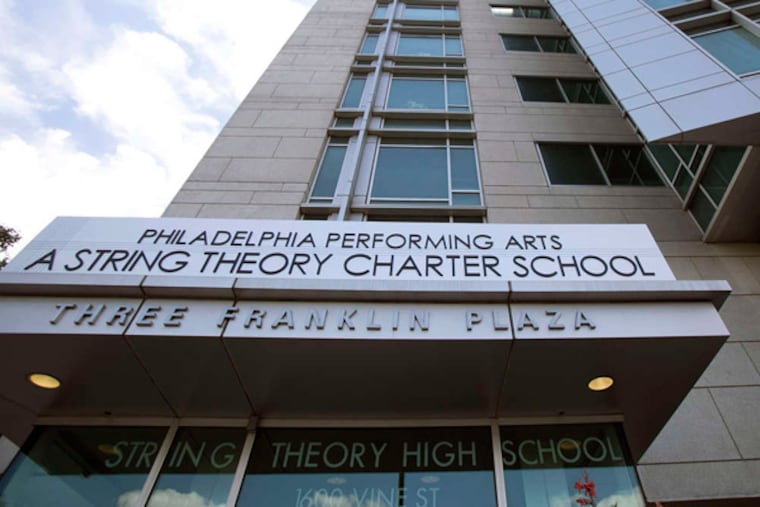
A Philadelphia charter school is building its own college.
Students at the Philadelphia Performing Arts Charter School, a K-12 facility of about 2,500 with campuses in South Philadelphia and Center City, should soon be able to graduate with high school diplomas and 60 college credits — for free.
PPACS is not the only early college in the city — the Philadelphia School District has Parkway Center City Middle College, and other schools allow students to take college courses while in high school. Some schools offer dual enrollment, and a new early college charter will open in the city in the fall.
But instead of partnering with existing colleges, String Theory, the education management organization that runs PPACS, is in the process of opening its own degree-granting institution.
String Theory College will focus on design, technology, and entrepreneurship, offering PPACS students more flexibility than prior dual-enrollment partners had, said Jason Corosanite, the college president. Students won’t have to leave the school’s Vine Street campus to attend classes, either.
“The whole goal is to get all kids prepared for college, with as many college credits as possible,” Corosanite said.
The college already has Pennsylvania Department of Education approval, and its Middle States Commission on Higher Education accreditation vote is scheduled for March, commission officials said. Once schools are candidates for accreditation, that opens up college transferability, student loans, and Pell grant opportunities, though PPACS students pay no tuition because the school is a publicly funded charter.
Corosanite said he is confident the school will gain Middle States approval and ultimately be able to offer students associate’s degrees.
With Philadelphia’s crowded higher education market and a looming college enrollment cliff, it’s fair to question whether the city needs more degree-granting institutions, said Shaun Harper, a professor of education, public policy, and business at the University of Southern California. Some would say it does not.
But, Harper said, “if this new creation is going to expand access and make higher ed more affordable, I think that is a spectacular thing. We need more innovative models in education that create more seamless pipelines from high school to college.”
Harper’s research once centered on the experiences of high-achieving Black and Latino boys in New York schools who, once in college, “suddenly they realized that they were not as prepared for college as they had been led to believe by their high school teachers and by the grades they received in high school.”
That makes Harper consider whether String Theory students “are really going to be pushed to do college-level work, and perform like college students would otherwise be able to perform? I think that is a thing to be concerned about.”
Ultimately, Harper said, he is intrigued by the model.
“There’s a real opportunity for [String Theory] to ensure that they are providing the right kinds of professional learning and professional development experiences for these educators, so they amass the skills that will be able to make the curriculum much more complex, much more college-level,” Harper said. “They may have a real shot here at teaching the rest of the nation something that ultimately becomes replicable.”
High school and college in one stop
The seeds of the idea trace back to PPACS’ first high school graduates — the Class of 2017.
When Corosanite and other String Theory officials tracked those students, “some of our best and brightest kids were dropping out of college because of cost,” he said. “It wasn’t because they couldn’t do it. They were looking at the value proposition of these schools and dropping out. I felt the burden of, ‘We’re telling all these kids, yeah, you have to go to college,’ and then they graduate and can’t afford life. How do we solve for that?”
Enter String Theory College.
The program is already underway — about 40 students who participated in a pilot program are on track to graduate with college credits in June, and about 40 more are in 11th grade now.
The college will initially be open only to students enrolled in PPACS. Going forward, every 11th- and 12th-grade honors and Advanced Placement course at the school will be a college-level course, and the PPACS faculty who teach the courses are college faculty.
Course offerings include multivariable calculus, linear algebra, biotechnology, entrepreneurship, and design.
Students still have access to the trappings of high school: All non-honors classes are still within the PPACS confines. And students must still meet state requirements for their high school diplomas — they are learning math, but it might be a design-focused math class, for instance.
“Kids still have their high school experience — they still come to school on time, they still go to the lunchroom with everybody they go to school with,” Corosanite said. “They still see their friends, they still have prom, but they also have college. It makes it a lot easier.”
There is no budget impact for PPACS, Corosanite said. The school, which as a charter is independently run and publicly funded, pays the college a per-credit hour rate that is roughly equivalent to community college, and that money covers teachers’ salaries and benefits.
“We’re trying to be as efficient as possible with the classes the teachers have, and the college is in our building,” he said. “We’ve designed it to be cost-neutral. This is not a moneymaker — it’s mission-driven.”
Going forward, Corosanite dreams of a graduate school of education — String Theory already offers continuing education for teachers — and offering college courses to other schools and districts.
‘This is a good opportunity’
Hasim Smith, a PPACS senior, was pitched on the idea of taking college classes in high school when he was a 10th grader.
Smith’s dad had heard about the pilot program and urged his son to go for it.
“He said, ‘This is a good opportunity. I don’t want you to miss out on it,’” Smith said. “I like to challenge myself and do things that other people see as hard. And I like that it’s free — it helps with college costs.”
Smith was game and now, at age 18, he’s looking forward to collecting his high school diploma and transferring dozens of credits to another college. (He’s already been accepted to 10 and is awaiting more decisions.)
The courses are challenging, he said, but manageable, especially with his teachers’ support. He’s enjoyed the design challenges in particular, Smith said.
“We had to learn a lot — it gets really deep. We have to learn about design, and different theories, and entrepreneurship,” Smith said.
He had always thought he might want to pursue nursing as a career, but his String Theory college experience has him also considering architecture, he said.
How to apply
The college-in-a-high-school program has a limited number of slots for students who will be in 10th through 12th grade for the 2026-27 school year, and is accepting applications for those seats and for its incoming ninth-grade class.
The school’s application deadline is Jan. 30.