Disabled children are being kicked out of preschools at alarming rates, report finds
While excluding a child from preschool due to developmental delays or disabilities is forbidden under Pennsylvania and federal law, a report said it's still a common practice that is often hidden.
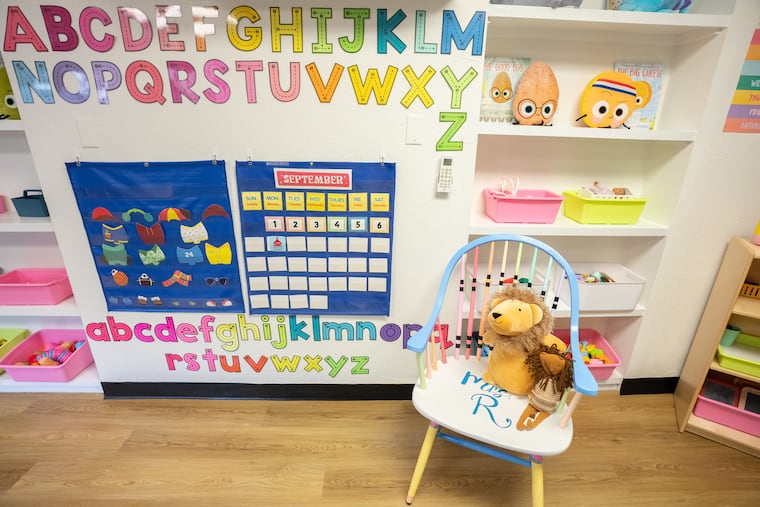
One preschooler with autism and ADHD was excluded from a Philadelphia early childhood program two hours after her parents dropped her off for her first day because the school did not have adequate supports, according to a new report from the Education Law Center-PA.
Another was told he was “no longer a good fit” shortly after starting a program where directors had said they would have no trouble working with the boy, who has autism. He was 2.
At another school, a young boy with autism was not fed if certain staff were not present; the school suggested the child attend on a restricted schedule, and often did not allow him to use the electronic device the nonverbal boy needed to communicate his needs.
Pennsylvania’s youngest learners are expelled or excluded from preschools at alarming rates — often because of student disabilities — an illegal practice that challenges families and can cause children long-term harm, according to the report, which was released Tuesday.
The report examined the impact of exclusionary early childhood discipline and highlighted the prevalence of preschool pushouts. It said the practice must be prohibited and called on lawmakers to take steps to curb it.
The Pennsylvania Office of Child Development and Early Learning has, for the last several years, directed all programs, including private schools, to work to eliminate exclusion. Because most exclusions happen due to kids’ developmental delays or disabilities, they are forbidden by state and federal law.
Still, the extent of the problem is often hidden, and more protections are necessary, the report said. Though the federal government does track some preschool suspensions, the full picture is unclear because many early childhood centers are private and not required to report expulsions, and informal exclusions are not logged at all.
It is clear from parent accounts that preschool pushout is a frustratingly common practice, said Rose Wehrman, an Education Law Center fellow whose work centers on preventing the exclusion of underserved children in Philadelphia.
Sometimes, the expulsion is formal. But more often, it is less official — repeated calls to pick up a child early that force parents to miss work and remove their children from the school, conversations that label children with disabilities a safety hazard, or suggestions that the child would find more help elsewhere.
The practice disproportionately affects kids of color, according to the Education Law Center’s report.
“Research is clear that, despite no difference in young children’s behaviors, preschools choose to exclude Black children through suspensions and expulsions at a rate 3.6 times higher than is imposed on their white peers for similar behaviors, and at three times the rate of K-12 exclusion,” the report said.
“Regardless of the program, this is something that shouldn’t be happening,” Wehrman said. “Clearly, Pennsylvania needs clearer protections for children.”
No solutions or supports
Suspensions and expulsions have a significant impact on young learners, according to families who shared their children’s experiences with the Education Law Center.
Among the children highlighted is 5-year-old who is a bright boy and has taught himself multiple languages via YouTube. The report did not include the real names of the children or their parents.
He has autism, a fact his mother disclosed when he started school at age 2, according to the report. The first center he attended offered the supports he needed, and he thrived.
But after his family moved, he enrolled in a new school and had a very different experience.
“I was called in and told that he was ‘no longer a good fit,’” his mother told the Education Law Center. “There were no solutions offered. No supports discussed. No conversation about what could be done differently.”
Families often do not know what their children’s rights are, Education Law Center officials said.
“We should not have to fight this hard for basic inclusion,” the mother said. “No child should be pushed out because they learn differently. No parent should have to question whether their child will be accepted or rejected.”
Another Philadelphia child with autism was excluded from preschool for more than a month because school staff said he could not attend if his one-on-one aide had not shown up for work. He missed out on physical therapy, occupational therapy, behavioral therapy, and speech, as well as socialization.
The boy’s skills regressed because of the exclusion, his mom said. She and her husband missed work time and lost income.
“It was not until I got a lawyer involved that [my son] started to get the supports he needs, and it should not be that way,” the mother said. “We really need pathways that show us what our children are entitled to and how to get those services.”
The family of one 4-year-old boy, who has feeding difficulties and is nonverbal, told the Education Law Center he was deprived of food, water, and access to the electronic communication device he needs to convey his needs. Eventually, the school’s director told his mom they wanted to put him on a restricted schedule, attending only when certain employees were present.
“The school’s refusal to accept free training, lack of structure, and disregard for his needs amounted to an indirect expulsion,” the mother said. “I ultimately had no choice but to withdraw him for his safety and well-being.”
The mother said her son “experienced regression, emotional shutdown, and a loss of trust in school routines. He spent long days hungry, thirsty, overwhelmed, and unable to communicate.”
The parents and the Education Law Center are calling on Pennsylvania lawmakers to make investments, approve law and policy changes, and impose new reporting requirements.
“Decision-makers everywhere must center parent experts’ wisdom in devising solutions to the racist, ableist practice of preschool pushout, and in helping shape the programs and resources to which every child is entitled,” the report concludes.