Rosemont College enrollment fell by 45%, but many students and professors want to stay until school closes in 2028
The college is preparing to close the Main Line campus in 2028. Its campus will be purchased by Villanova University.
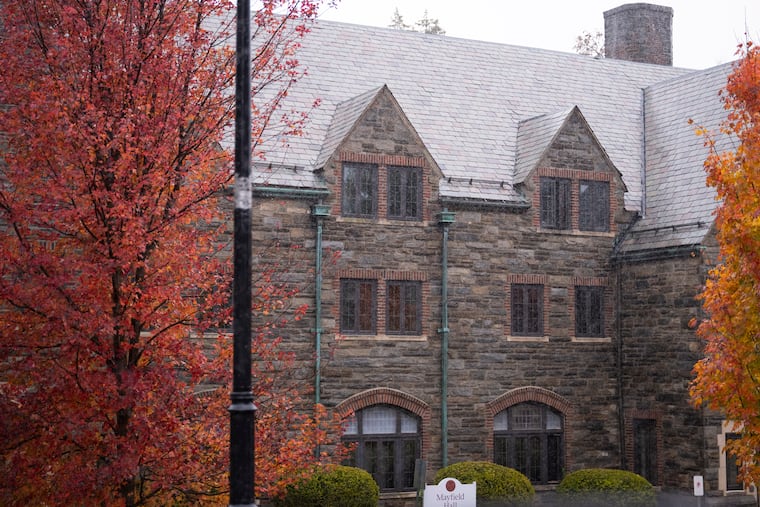
At Rosemont College last month, signs hung in elevators about campus trick-or-treating and an art exhibit in the cultural heritage gallery.
Students studying sustainability discussed their grant-funded project to restore the campus greenhouse. Others, rushing to and from classes on the leafy Main Line campus with neo-Gothic architecture, stopped in the cafeteria to grab a bite.
“Classes are the most active, lively ones I’ve taught anywhere,” said Frank Klose, an associate professor, who chairs the communication and theology and religious studies departments. “There’s a lot of great discussion. The students that are here really want to be here.”
But this year, there are a lot fewer of them.
Rosemont, which announced last spring it would close in 2028 and its campus was being purchased by Villanova University, opened this fall with about half as many students as last year. Fall enrollment stands at 428, down about 45% from last year’s student body of 783.
» READ MORE: Financially strapped Rosemont College will merge with Villanova University
The freshman class of 21 students is just a quarter of the size of last year’s first-year enrollment. And it will be the last freshman class to enter the 104-year old Catholic college.
“On weekends, it’s like a ghost town here,” said Sal Galloway, 21, a sophomore English major from Ardmore. “I think the merger kind of pushed a lot of people away and kind of killed it for them.”
While many remaining students are happy to still be at Rosemont, it could becoming increasingly difficult for the school to hang on as it enrolls fewer students each year. Another hit could come next year, when NCAA sports are discontinued and more athletes may transfer. Under the merger agreement, Rosemont is expected to receive some financial support from Villanova through 2028.
“When I’m in meetings, I know the administration has been unwavering in saying, ‘We will make it,’” said Glenn Siniscalchi, a professor of theology and religious studies. “‘We will adjust.’ If we have to teach another course or volunteer elsewhere on campus, they’ve asked us to be flexible, and we all want to see the place go to the very end.”
Galloway is staying. He transferred to Rosemont from Drexel University.
“I’m not transferring again,” he said.
‘Where I still want to be’
Students who remain said despite having fewer classmates, they didn’t want to give up the small class sizes and close relationships they have with their professors.
“I love this school so much,” said senior Mia Hoppel, 21, a sustainability and history major who received Rosemont’s full-tuition Cornelian scholarship. “I love the professors. I love the campus. I love the community and the attitude that everyone has toward learning. It’s where I wanted to be and it’s where I still want to be.”
For some upperclassmen, the potential loss of credits and longer runway to graduation made transferring unattractive.
Other students said they returned this year, but are unsure they will stay.
“The idea of transferring has crossed my mind like so much this year,” said Barbara Feiler, 19, a sophomore media and communication major from Fort Washington, who is on track to graduate the year the college closes. “Last year, there were so many more campus events. Now, there aren’t that many.”
She is conflicted about the idea of being part of the last graduating class.
“It will be kind of historic but also kind of weird and sad at the same time,” she said.
Maya Lonjuin, 18, a sophomore English and communication major from Upper Darby, came back because of all the friends she made, but she is also on the fence about transferring as enrollment grows smaller.
“I get my energy from people,” she said.
First-year student Matthew Hauser said he came to Rosemont because of the prowess of philosophy professor Alan Preti. He is in a three-year accelerated program that will allow him to graduate in 2028.
“I really have no intentions of transferring unless I absolutely need to,” said Hauser, 19, a philosophy major from Malvern.
Rosemont’s financial troubles
For Rosemont, founded in 1921 as a women’s college, the struggles have been longstanding. In 2009, the year it became coed, the school had a $1 million deficit in what was then a $20 million budget.
In 2015, the college reset its tuition, a tactic in which colleges lower the sticker price to attract more families but simultaneously reduce financial aid. Rosemont officials found the move had not sustained success and went back to discounting.
As its financial challenges grew, Rosemont started borrowing restricted funds from its endowment to cover operational needs.
Rosemont was one of 13 colleges The Inquirer examined last fall and found it was in poor financial health, using an index developed by a finance executive at a small college in Illinois. The school had reported operating losses for five straight years through June 2023.
Facing mounting debt, the school started looking for a merger partner, and Villanova, which had just completed the purchase of the shuttered Cabrini University’s campus, stepped up. Villanova is less than a mile from Rosemont, which will become Villanova University, Rosemont Campus in 2028.
The college was able to continue several NCAA Division III sports teams this year, including women’s volleyball, basketball, and baseball, and potentially others. But lacrosse, softball, and some other teams could not field enough athletes.
Mark Laywhyee, 20, a junior communications and political science major from Philadelphia and editor of the student newspaper, said he plans to stay until graduation and keep the paper going.
“There’s a lot less momentum behind certain things, but we are still trying,” he said.
Samantha Ferrari, a junior English and communication major from Lancaster, said the dorms feel empty, but it’s easier to do laundry and find campus parking. She enjoys the academic atmosphere, too.
“I really like the ability to work closely with my professors and customize what I’m studying,” she said.
She plans to study abroad in Ireland in the spring — another opportunity that attracted her to Rosemont — and graduate next fall.
Hoppel, the Cornelian scholar from Philadelphia, was involved in the greenhouse restoration project. Students painted the outside of the greenhouse pink with roses, an homage to Rosemont’s days as a women’s college. They hope Villanova will keep it.
“There’s a lot of momentum, I feel, to try and preserve our history and our culture and the community we have here,” she said.
» READ MORE: At Cabrini University, there will be no next year: A chronicling of its final semester
Faculty and students also are collaborating on a book, Spirit and Stone: The Architecture and Heritage of Rosemont College.
“The students are working together to capture our history as we finish and grow smaller,” said Joanne Campbell, assistant professor of sociology. “All our students are future alums, so they are thinking about how do we merge together with Villanova in a way that honors our heritage and our legacy.”
Klose, the communication professor, has worked at Rosemont since 2018. He previously taught at Cabrini for two decades, mostly part-time, which he continued to do until the school closed in 2024. He had been full-time for a few years, but got caught in a layoff at Cabrini when it was experiencing financial struggles.
Now, he will face another new chapter when Rosemont closes.
But for now, he said, he is committed to Rosemont.
“There’s a lot of opportunity,” he said, noting the benefits of working with six to 10 students in each of his classes. “One of our hallmarks always was small classes. This is still a wonderful experience with our students.”