The Philadelphia School District will eliminate positions and make school-based cuts as it faces a $300 million deficit
No layoffs are planned, but the Philadelphia School District will reassign 340 school-based employees.
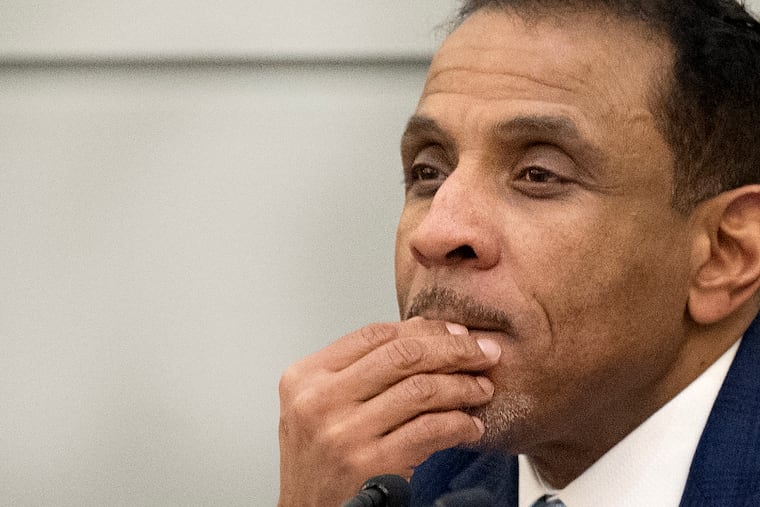
With a $300 million deficit looming, Superintendent Tony B. Watlington Sr. plans to propose a budget with $225 million in belt tightening — including significant classroom and central office cuts.
No layoffs are planned, but the Philadelphia School District will eliminate 340 school-based positions and move those employees into other open jobs.
The school system will also eliminate the positions of more than 200 building substitutes, who are permanently assigned to cover absences within a school.
Contracts will be slashed, with “low return-on-investment programs” cut by $36 million, Watlington said. And his central office will also take a major hit, with vacancies frozen, open positions eliminated, and further budget reductions worth over $100 million.
The proposed cutbacks, which officials announced Friday as Watlington prepares to present his annual budget to the school board, amount to the most sweeping austerity measures the district has had in years — and advocates and union leaders are sounding the alarm about far-reaching effects in schools. The budget news also comes as the school board considers a separate plan to close 18 schools and co-locate and modernize others in the coming years.
The school system, which is prevented by Pennsylvania law from raising its own funds, has long forecast a budget deficit as expenses — mostly rising salaries, benefit costs, and mandated payments to charter schools — are outpacing revenue from the state and city.
It’s also historically underfunded, a point underscored by a landmark 2023 Pennsylvania Commonwealth Court case, which ordered the state legislature to significantly increase funding to low-wealth districts like Philadelphia. While Democratic Gov. Josh Shapiro and the state legislature have started to implement those increases, it will take years to reach their goal.
The superintendent knew about the structural deficit when he came to Philadelphia in 2022. He always knew cuts were needed, but chose not to make them in his first few budgets. For the current fiscal year, the district is spending $300 million in reserves just to make ends meet.
Watlington said he chose not to cut in prior years because he believed that if his administration made wise choices about how to spend COVID-relief money, academic outcomes would improve. And under his watch, test scores have risen incrementally. Student and teacher attendance and the graduation rate have improved, the dropout rate has decreased, and the district’s credit rating is in its strongest position ever.
“We wanted teachers, principals, school-based staff, support staff, and the district staff to believe and know and have confidence — we know what to do to improve education,” Watlington said at a briefing with reporters this week.
Watlington will present his budget later this month to the school board, which is expected to approve a spending plan at the end of May.
Here are some takeaways from the first glimpse at Watlington’s 2026-27 budget, released Friday morning.
300-plus school-based positions will be cut
Districtwide, roughly 340 school-based positions will be cut for a savings of $43 million, Watlington said.
Which positions get axed has not yet been determined. Schools will still get classroom teachers allocated based on projected enrollment, but supplemental positions — which could include teachers, student climate staff, and other jobs — are likely to be affected, too.
Employees in impacted positions will be moved into other jobs via vacancies and attrition.
Principals received parameters of their individual school budgets Thursday, and “there is a lot of discretion in what they actually will be able to keep,” said Mike Herbstman, the district’s chief financial officer.
Still, those decisions are likely to be tough, as schools came to rely on extra counselors, climate staff, and teachers.
Watlington said the positions being eliminated had been paid for with federal COVID-19 relief funds that had expired and money that had previously been earmarked for a group of struggling schools with intense support needs.
“We have a lot of hardworking employees who stood by us, and we’re going to stand by our hardworking employees,” said Watlington.
Class sizes are likely to grow in some schools
Class sizes are likely to get bigger in some places if the proposed cuts take effect.
Watlington said the district would “not exceed the class sizes called for in the PFT’s collective bargaining agreement” — 30 in grades K through 3 and 33 in grades 4 through 12.
Watlington said he’s been in Philadelphia classrooms with 10 children in them.
“Some of that, we’re just going to have to shore up,” Watlington said. “We just don’t have the luxury to have class sizes that are extraordinarily small.”
Watlington in 2024 retired the old Acceleration Network, a group of 14 schools that needed intense supports and got more resources and structure, along with extra funding to spur improvement. Class sizes were capped at 22 in kindergarten, first, and second grades in acceleration schools.
The extra funding for those schools stayed even when the network was retired, but it’s now going away, Watlington said — meaning the guaranteed smaller class sizes are gone, too.
Other schools in the district have used COVID-19 or other discretionary funds to keep class sizes smaller, and they could also see bigger classes with the budget cuts. The COVID relief money is now fully spent.
Schools proposed for closure will be held harmless
Watlington, separately, has proposed closing 18 schools in a facilities master plan that now awaits school board consideration.
Those schools won’t be subject to budget or position cuts, the superintendent said.
If the board votes to shut down those schools, the closures would not begin to take effect until the 2027-2028 school year.
The sub situation could be tougher next year
Every district school currently has what’s known as a “building sub” — a district teacher permanently assigned to a school to cover staff absences.
Watlington is proposing eliminating roughly 220 building substitute jobs. Those substitutes will also be moved into other positions.
The district has had trouble filling substitute jobs in the past.
“We’re always concerned about making sure we have the appropriate coverage when teachers are out,” said Watlington, who said schools will have to rely on the district’s substitute service for all requests, instead of having a built-in sub in every school.
Leveling isn’t coming back
Preventing leveling — the district’s former process of shifting teachers around more than a month into the school year based on actual enrollment — is expensive.
But Watlington’s cuts won’t resurrect the practice.
“We sunsetted the leveling process, which cost us millions of dollars, but the leveling was so chaotic,” especially for schools with large numbers of vulnerable students, the superintendent said.
Contracts will be squeezed
Watlington is ordering $36 million in contract cuts.
The district will be changing its vendor process and reducing contracts that don’t serve the district’s larger goals, he said.
Watlington said he’ll target cutting “expenditures that we can’t see a through line to improve student attendance, teacher attendance, reading and math, test scores, graduation rates, dropout rates, school accreditation rates, etc. We’re going to take a hard look at how to reduce some of those expenditures.”
$169 million worth of central office changes are coming
Watlington said he will freeze some central office vacancies, cut about 130 vacant central office jobs, and enact more central office cuts — for a savings of $30 million.
He’s also planning for “budget efficiencies” to save $103 million. Herbstman said that includes enhanced budget forecasting, including spending on utilities and insurance, and changing some processes, including how staff travel is reviewed and approved.
That the district can cut $169 million from its central office speaks to the severity of the situation, the superintendent said.
“It is not because, as some would say, that somehow this is a big district, it’s bureaucratic, we waste money, or none of that. That is patently, absolutely false,” said Watlington.
Philadelphia’s central office is already smaller than its peers of a similar size and scope, Watlington said.
He vowed that the cuts would not affect his plans to launch a transition office reporting directly to him to support schools affected by coming school closures.
Philly will have to do more with less
Other districts are also feeling the pinch; in Florida, the Broward County school system, which is larger than Philadelphia’s, recently approved a plan to cut 1,000 jobs over three years. The Los Angeles Unified School District could send layoff notices to over 3,000 people.
Still, Philadelphia’s cuts are significant, Watlington said.
“I don’t want to hide or obscure the fact that it will have some impact because we’ll have to do more with less in some areas,” he said. “That said, we will not take our foot off the gas in terms of our expectation and how we do the work.”
Unions and advocates call the cuts ‘devastating’
Robin Cooper, president of the district’s principals’ union, said she had sleepless nights worrying that layoffs were coming; she was relieved Watlington did not order a reduction in force.
But that does not change the fact that the district is now in “some difficult times,” Cooper said. “The gains we’re seeing are because of the money that had been poured into the district, and you can’t ignore that. I am worried about how the cuts will impact the trajectory of the district.”
Arthur Steinberg, president of the Philadelphia Federation of Teachers, said because the district’s baseline is underresourced, “any cuts are really going to have a drastic effect on the individual schools, have a tendency to slow down any progress they’ve made.”
Steinberg said he believed no positions that directly impact students should be cut.
Officials from several education advocacy organizations called on City Council to find funding to cover the cuts as Philadelphia’s budget process plays out over the next several months.
“For Philadelphia students who already do not have enough educators working with them each day, these cuts will be devastating. Philadelphia’s elected officials must do everything they can to make sure this will not happen,” a statement from Children First, the Education Law Center, The Public Interest Law Center, and Teach Plus said.
The budget will be laid out publicly soon
Watlington will formally present the broad outlines of the 2026-27 budget at a March 26 school board meeting.
The public will have multiple opportunities to weigh in on the spending plan before the school board adopts a final budget.