SEPTA is planning a school fare evasion crackdown — with criminal charges possible for fare evaders
SEPTA is supposed to get state reimbursement for student fares. But over the years, many Philly students stopped swiping their free fare cards, and SEPTA is losing millions.
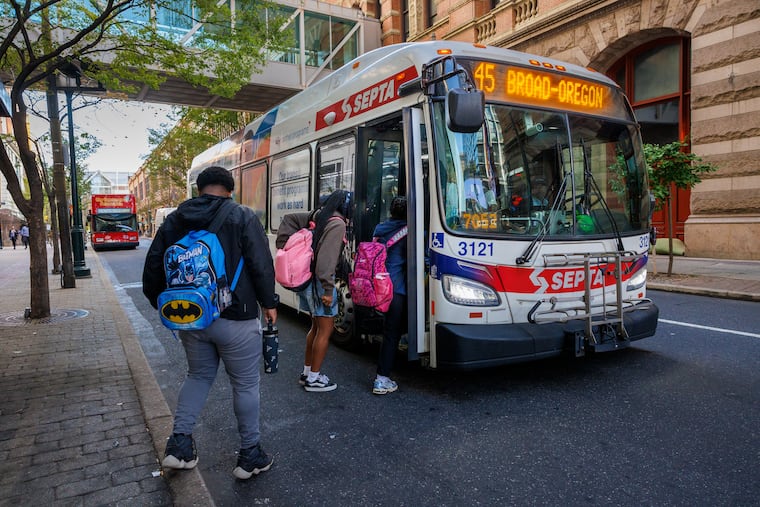
SEPTA is launching a student compliance initiative that could eventually escalate to criminal charges for teens who are repeat fare evaders.
Philadelphia School District, charter, and private school students who are caught not swiping their student fare cards — technically a theft of service offense — will begin receiving formal warnings.
The initiative is happening among a broader crackdown on fare evasion across SEPTA. Erik Johanson, SEPTA’s chief financial officer, said he believes the system is losing about $11 million annually on students not using fare cards. Those cards are free for students, but the state reimburses SEPTA for their rides.
“Many, many, many students are not swiping cards,” Johanson said. “Simultaneously, we do have a broader fare evasion problem on our system — this is not a student-only phenomenon, but we believe we’ve observed this phenomenon where it has become almost cool to not swipe.”
Warnings will be given via a student contact report issued by a SEPTA officer. Those warnings will also be given to a school staffer designated as the transportation liaison for follow-up.
A pilot program, developed in conjunction with the district, will launch Friday; the initiative will begin citywide in the fall.
Big drops in student swipes
Since 2007, the state has subsidized free SEPTA rides on buses, trains, trolleys, and Regional Rail for Philadelphia students in grades 7 through 12 who live more than 1.5 miles from their district, charter, or private school.
For years, eligible students received weekly passes from their schools. There was a strong school accounting component, Johanson said, allowing SEPTA a clear way to get reimbursement through the Pennsylvania Department of Education.
At the high-water mark, SEPTA received more than $36 million from the state for Philadelphia student rides.
But in 2021, as students returned back to in-person school during the pandemic, the transit agency shifted to student fare cards issued once per school year. The student fare cards are good from 5:30 a.m. to 8 p.m. on days school is in session — no weekends, school holidays, or summers — for up to eight rides per day.
The revenue SEPTA generated via state reimbursement from student card swipes has declined steadily — from $36.4 million in fiscal 2022 to a projected $23 million this year.
And while the pandemic brought an ongoing student attendance crisis, officials said the decline in swipes doesn’t match actual ridership.
Some students don’t know they’re fare-evading
Over the past year, Johanson said he and other SEPTA personnel have been working with the district, which administers the fare program, “really trying to understand this problem, because we don’t get paid unless those cards are swiped, and this is an enormous loss of revenue for us.”
Anecdotal evidence suggests that because fare cards are now distributed so infrequently, program administration became less rigorous, Johanson said.
Students sometimes lose cards that are not replaced, and “we’re hearing that some kids don’t even realize that they need a card; they actually think SEPTA and the school district have some sort of deal where kids ride free,” said Johanson. “Some of them may not even realize that they’re fare-evading."
Students — some of whom have fare cards, some who don’t — are jumping turnstiles and otherwise skipping swipes, and they’re generally not being penalized for doing so.
Enter the fare diversion program, announced in a message from Superintendent Tony B. Watlington Sr. this week. Watlington, who has made strengthening student attendance a hallmark of his administration, said the program “aims to encourage students to safely and responsibly use SEPTA to travel to and from school, and to follow the rules while doing so.”
The initiative is important, the superintendent said.
“Removing barriers to responsible ridership will help increase student attendance, which in turn will help us become the fastest-improving, large urban public school district in the nation,” Watlington wrote.
Recouping money, not criminalizing students
SEPTA didn’t want to deny rides to students trying to get to school, said James Zuggi, deputy transit police chief.
“We had to develop a way to enforce the students tapping — in the beginning, we were doing things that were turning students away,” Zuggi said. “If the student couldn’t pay their fare, they weren’t allowed on the system. We wouldn’t issue them a citation, but they just couldn’t ride, and we didn’t feel real comfortable with that.”
So a working group made up of district and SEPTA officials arrived at the fare diversion program, Zuggi said. Any student who skips a fare — either because they lost their card, left it in their locker, or it’s being used by a family member or friend who’s not eligible for a free student card — will get the student contact report, if caught.
SEPTA is also shifting to full-length gates at many high-volume stations that will make it physically tougher for students to get around turnstiles without tapping a fare card.
Any fare evaders who can’t produce a valid school ID or prove that they’re current students some other way could skip the student contact report and receive a citation for theft of service.
After a student’s third warning, they would move on to the citation and court referral.
Student records will reset every school year.
District officials plan an education campaign on the initiative — there will be parent sessions, and information will be available at the back-to-school tour that hits various points around the city every summer.
The aim, Zuggi said, is not to criminalize students.
But “we have to develop ways to make sure that we’re recouping that money.”