Tony Watlington talked about Philly’s ‘groundbreaking academic improvements’ on a national stage. Here are 3 takeaways.
Top education leaders from big-city districts around the U.S. are gathered in Philadelphia this week. On Thursday, they heard from Tony B. Watlington Sr. about "groundbreaking academic improvements."
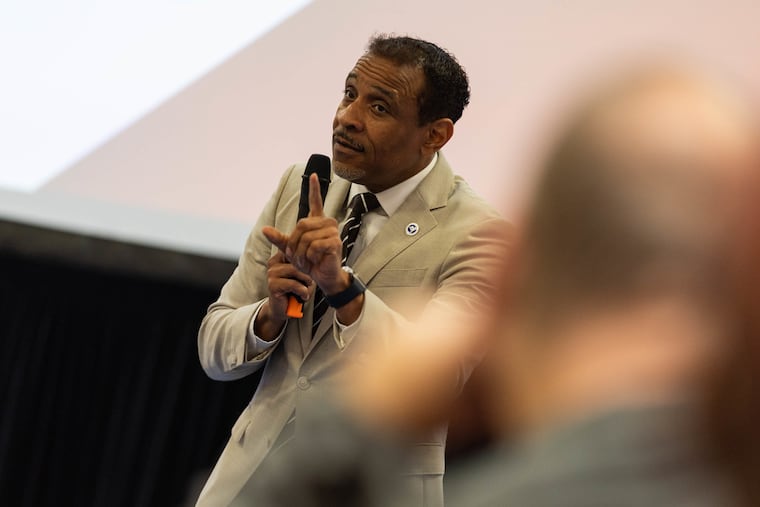
On Thursday, a roomful of leaders from the nation’s largest and most complex school systems stood, sat, and spilled into aisles to hear Superintendent Tony B. Watlington Sr. talk about how the Philadelphia School District has pulled off “groundbreaking academic improvements” in the eighth-largest school system in the country.
“The nation’s historic biggest poor city for many decades is getting better,” Watlington said. “We are so proud to be accelerating performance, and we are going to put our foot on the gas, and our goal … is to get to the top of the food chain.”
The discussion came as part of the Council of Great City Schools’ annual conference, held this year in Philadelphia. In addition to the hometown district, the Baltimore, Detroit, and Los Angeles Unified districts were also highlighted.
Here are some takeaways from the panel that featured Watlington, Sonja Santelises of Baltimore, Nikolai Vitti of Detroit, and Alberto Carvalho of Los Angeles.
The Philadelphia story: It’s getting better
Watlington trumpeted the progress made since he arrived in Philadelphia in 2022: improvement in most metrics — fewer dropouts, better graduation rate, better student and teacher attendance, forward motion in most areas as benchmarked against big-city peers on the test known as the “Nation’s Report Card.”
» READ MORE: Philly students made significant progress in math, but posted lower reading scores, according to new data
“We’ve been really drilling down on fourth- and eighth-grade reading and math, and in three of these areas, we’ve seen significant improvement, besting the national average, our peer districts, and, certainly, outperforming the Commonwealth of Pennsylvania,” Watlington said.
Still, Philadelphia’s students — a diverse group, mostly from economically disadvantaged homes and mostly kids of color — have a long ways to go.
According to preliminary data recently released by the district, 25% of district students met state standards in reading and 33% in math. (Math scores have been a particular strength of late — fourth-graders’ math scores have jumped 13 percentage points in the last three years.)
“It’s ebbing and flowing, but over time we ought to see some appreciable improvement in student outcomes, and, yes, it ought to show up on some standardized assessments, even if those assessments are rife with cultural and racial bias,” Watlington said.
Despite the fact that most city students do not meet the state’s standards in literacy and numeracy, there are more than just glimmers of hope in what the district has been able to accomplish in recent years, Watlington said.
For years, Philadelphia’s performance was near the bottom of all large urban districts’. But the most recent stats from the National Assessment of Educational Progress show that the district has vaulted from near the bottom to closer to the top.
And after years of declining enrollment amid a robust charter school ecosystem, the traditional public school system added more than 1,000 students to its rolls last year. About 117,000 children are now enrolled in district schools.
How did the district make gains? Watlington cited several factors: new, standardized curriculum, professional development for teachers, supporting principals, strengthening family partnerships, and improving instruction.
“We’re not just trying to serve the middle,” Watlington said. “We’re serving all students, including students who qualify for special education services.”
Baltimore found literacy leaders in its own backyard
Funds are scarce and needs are great in Baltimore, as they are in large urban school districts across the country.
But Santelises, who has been superintendent of the district of 70,000 for nearly 10 years, wanted to focus on building leadership, even without a built-in infrastructure.
“What we did was we doubled down on leadership is not a title. Leadership is a state of being. Leadership is a focus, so that means leadership is not just who gets to sit the closest to the CEO. Leadership is not who has three letters in his or her name, but leadership is actually what is your ability to identify a problem,” Santelises said.
Empowering people in schools to see themselves as leaders worked beautifully, Santelises said. Among the strongest leaders?
“We found actually that our paraprofessionals — majority women of color, majority from low-income neighborhoods — were actually our best literacy tutors when we looked at the data,” Santelises said. “With all due respect to any companies in the room, it wasn’t the new AI technology that got the best results. It wasn’t the newest program you’re going to put on the software. It was actually the women who were closest to our young people and their communities were then viewed as leaders, and frankly got 30 to 40% greater improvement with our first and second graders than any program we purchased.”
LA super thinks 10% of schools should get 90% of district attention
Alberto Carvalho, the superintendent of the Los Angeles Unified School District, said that 90% of districts’ time should be spent on 10% of its schools — the lowest performers.
Leaders must have “the courage to say not every student shall get the same level of funding, the same level of support … they need disproportionately higher levels of funding based on equity indices.”
(Philadelphia used to have a separate learning network for its lowest performers, with higher amounts of funding and more supports. The district broke up that network in a recent reorganization.)
When he started in LAUSD in 2022, that school system, the nation’s second-largest, had 800 teaching vacancies. He reduced that number to zero quickly.
Central office staffers who met Carvalho always told him how much they loved children, he said.
“During spring break, I asked them to go love children closer to where children were,” Carvalho said. The employees who had teaching credentials were sent into schools to teach. “Yes, there are teacher shortages, but we have more of a talent-distribution problem than a talent problem, always.”
Carvalho — a former undocumented immigrant who spent 15 years as Miami’s schools leader and had accepted the New York public school chancellor’s job but reneged, he said Thursday, “because I would have killed the mayor” — suggested that incremental progress is not nearly enough.
“We’re not done, we can’t be done,” Carvalho said. “We have grade levels where reading performance is at 30, 40, 50%, and that means the vast majority of our kids are not learning and reading at grade level — the same for numeracy. Unfortunately, across our country, we often hide ugly truths about our own performance. And as they all said, ‘The first step in true educational reform is critical awareness of where we are.’”