This teen fled war in Ukraine for a new life in Philly. Now she’s at the top of her class.
Living and learning in the U.S. has changed Kateryna Sobolevska, who fled Ukraine at age 14. She's now a senior at George Washington High School in Northeast Philadelphia.
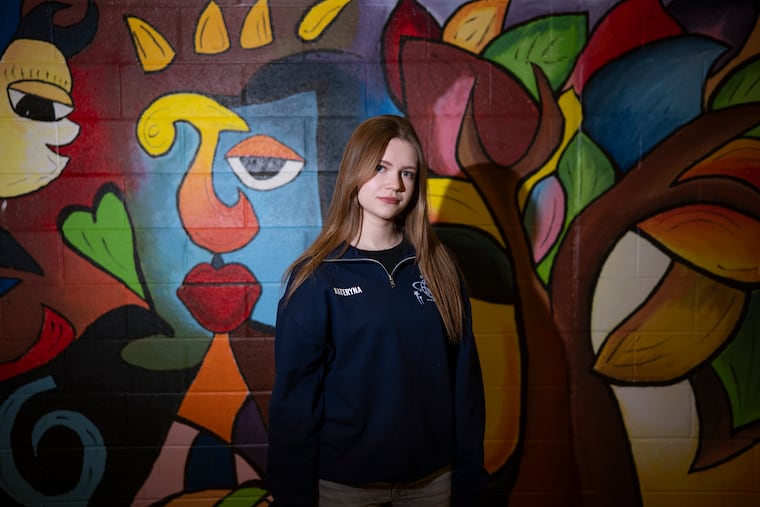
Kateryna Sobolevska’s life is full: classes, homework, and activities at George Washington High School, managing an ambitious college search, serving as her mother’s English translator, sometimes picking her younger brother up from school.
But part of the 17-year-old’s mind is often 4,500 miles from Philadelphia — in her former home along the Stryi River in Western Ukraine, in Zhydachiv, where Sobolevska’s father and extended family still cope with the realities of a yearslong war.
She speaks to her father daily.
“He’s at risk every single day,” said Sobolevska, now a 12th grader. “They keep bombing the power plant, so he doesn’t have electricity all the time. He has to do laundry at a certain time. He has difficulties with work; it’s really overwhelming. There’s sirens every day.”
Still, Sobolevska is more than managing in her new home.
Less than four years after arriving in the United States, Sobolevska is at the top of her class at George Washington, with an Ivy League summer program under her belt, waiting to hear from a bevy of stellar colleges — and recently named to a select list of Philadelphia School District students.
When Sobolevska arrived in the U.S. at 14, American traditions were unfamiliar — something from a story or a book. She had never celebrated Thanksgiving.
This year, she’ll be sitting down to a turkey dinner with family, a little incredulous at the recognition that is beginning to come her way.
“But,” she said, “I am very thankful.”
‘Everything is so different’
In 2022, as war closed in, Sobolevska’s parents made a quick decision: Things were too dangerous in Ukraine. Sobolevska, her mother, Oleksandra, and her brother, Oleh, had to flee.
Her father, Rostyslav, could not join them — men between the ages of 18 and 60 were forbidden from leaving the country.
“All of us hoped that it would only be a couple of months,” Sobolevska said.
The three traveled first to Prague, then to New York, then on to Philadelphia. Every move felt unsettling, Sobolevska said.
Sobolevska had been a strong student in Zhydachiv — class president three times, a member of her student government, chosen to represent her school at language competitions.
But she had to start over at age 14. She began ninth grade at George Washington High in sheltered English classes, learning the language with other newcomers.
With more than 1,800 students, George Washington is imposing; it felt forbidding. It was tough to navigate, and her class schedule was changed three times.
“Everything is so different here,” Sobolevska said. “In ninth grade, it was really hard to get used to the language, to expectations, to all those processes. Ninth and 10th grade were really difficult for me.”
One of her teachers flagged Sobolevska to Billy Marchio, the coordinator of George Washington’s International Baccalaureate program, a rigorous academic course of study.
“She told me, ‘She’s really bright, she’s really improved her English. Give her a shot, I think she can do it,’” said Marchio, who agreed.
Making an impression
Entering IB in her 11th-grade year was a revelation for Sobolevska.
“I was excited,” she said. “IB is more close to what is expected from students in my country. It just gives me more stability — it’s very difficult courses, and a lot of expectations.”
Sobolevska met the expectations and then some. She was one of just 14 students nationwide — chosen from a pool of hundreds — who won a place in a summer journalism program at Princeton University.
Living on a college campus and learning from top professionals and peers from around the country provided more challenges that Sobolevska slayed. She published two stories, one about her frustration with comparisons between the conflicts in Ukraine and Gaza, a call for global solidarity. She felt at home in the Ivy League environment.
Senior year has been a blur — applying to a laundry list of colleges, including Harvard, a top choice, and, most recently, being honored as one of the district’s seniors of the month, singled out for her “courage, perseverance, and quiet strength” as well as for her academic skills.
Marchio has been wowed by Sobolevska — both as a student and as a leader, serving as an IB officer, tutoring peers in the National Honor Society.
“Through all of her anxieties and all of her stress, she produces spectacular work,” Marchio said. “She’s so critical and analytical. She makes an impression on everyone.”
Shouldering significant responsibility
Sobolevska is quiet, unassuming. When she talks about her college search, she mentions that she’s applying to schools in “Boston, Connecticut, New York,” not Harvard, Yale, and Columbia.
She grows more animated when she talks about her family: her father, who works in sales management, her mother, who works at a grocery store, and even her brother — they argue, as siblings do, but are still very close.
“We’re really close with my mom, especially since she moved here,” said Sobolevska, who has significant responsibility on her shoulders. “I’m the main translator in the family. I help her with English; all the doctor’s appointments are on me.”
When she won the district’s Senior of the Month honor, her mother bragged to relatives and coworkers. Thousands of miles away, her father “was really excited. He was just so proud. But it was weird for him, difficult to understand because I’m very far away.”
Sobolevska, who now goes by Kate, longs to be reunited with her father, the rest of her family, and the friends she left behind, but living and learning in the U.S. have changed her, she said.
Here, “I think people here are not as stressed,” Sobolevska said. “They’re just more easygoing. It’s really warming to see how people can listen to music outside or talk loudly outside, or just say hi to everyone. In Ukraine, we don’t really have that. It’s nice to see how people are really friendly here.”
Her father “doesn’t want us to go back” home now, she said. “It’s not safe; it’s really stressful.”
Looking ahead to her future, “I would like to visit” Ukraine, Sobolevska said. “I’m not sure if I would want to live there. When I grow up, I would love to travel a lot — I don’t want to stay in place.”
Sobolevska’s rise is remarkable, but that’s who she is, Marchio said.
“She’s just trying to make her father proud, to make her father’s sacrifice worth it,” Marchio said. “She’s putting a lot on her plate to make everyone happy and proud of her, and I couldn’t respect that more.”