New University of Delaware president runs with staff and students and wants better relationships with state and local governments
Laura Carlson is also focused on plugging holes from terminated federal grants, recruiting students in new national markets, and having "a life with purpose."
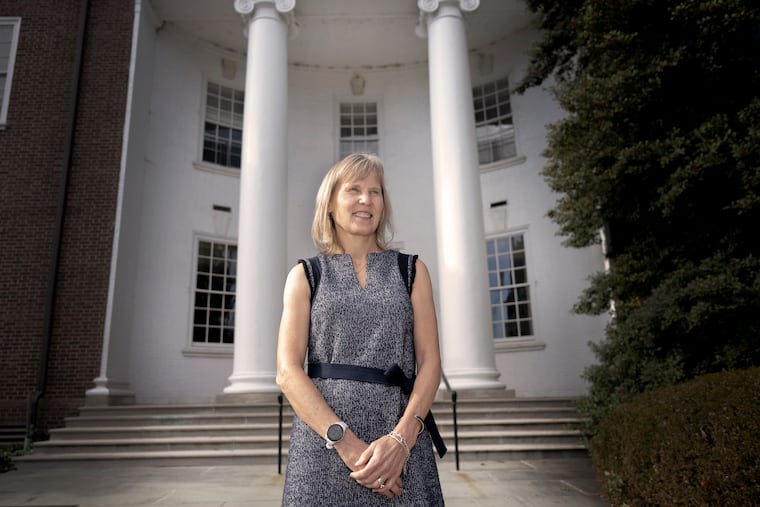
On Thursdays at 7 a.m., Laura Carlson is by the iconic granite and bronze sculpture of an open book on University of Delaware’s Mentor’s Circle.
As the new university president, she invites faculty, staff, students and community members to join her there and run a five-kilometer loop through campus. Typically 10 to 20 people show.
“Rain or shine, we run down to the track on South Campus, loop the track and come back,” said Carlson, 60, who began the treks as interim president last summer and is continuing them in her permanent role, which started earlier this month.
The “Prez Run” is just one way the psychology scholar — who plans to run her 15th Boston Marathon in April — is building relationships on campus, with alumni and with the community and state. She also runs with alumni, employees, and students during events in other cities.
» READ MORE: University of Delaware appoints interim president to the permanent post
“I’ve heard that the alumni association is going to put it on their bucket list of 10 things to do before you graduate,” she said.
Carlson, a Dartmouth alumna who got her doctorate in cognitive psychology from the University of Illinois Urbana-Champaign, is focused on strengthening relationships with state and local governments and internally with faculty. Finding new revenue streams to plug holes from terminated federal grants and recruiting students in new national markets also are on her list.
The Massachusetts native previously served as provost for three years, having come to Delaware after 28 years as a faculty member and administrator at the University of Notre Dame in Indiana. She’s the first internal candidate to get the presidential appointment in about 50 years.
She follows Dennis Assanis, who resigned in June and is now chancellor of the University of California at Santa Barbara.
Carlson is visiting classes each semester, including elementary organic chemistry and mechanical engineering.
“I want to make sure I don’t feel distant from the rhythm of the academic year,” she said. “Anything we value, we should put attention on it.”
When building a team, she asks participants to pick their top 10 values, such as family, world peace, humor, and authenticity, and rank them. Her top value is always purpose.
“I want to live a life of purpose,” she said.
Partnering with state and local government
She’s attempting to change the way the partnership with the state is viewed.
“We lead with what does the state need from us, as opposed to what do we need from the state,” she said.
Southern Delaware, where the university has a campus in Lewes and Georgetown, has housing, healthcare, education and workforce development needs, and the university can help, Carlson said.
She said she can envision a public-private partnership for new housing in Lewes, she said, or a classroom building with event space for the community.
“If we are a university for the whole state, we need to show up in the whole state, and we need to be responsive to the needs across the state,” she said.
She’s also looking at the possibility of more residential space for the main campus in Newark — possibly a “sophomore village” — through a public-private partnership. The university has about 7,100 residential beds in Newark.
“That would take some of the pressure off the city,” she said, noting the tight rental market, and adding that parents and students may prefer on-campus housing options.
She also wants to help Delaware Gov. Matt Meyer with his plan to bring medical education to the state. Delaware remains one of few states without a medical school. The idea is not to build one from scratch but to partner with an existing medical university, she said.
“We’ve been in conversations with Thomas Jefferson” in Philadelphia, which has a nonexclusive memorandum of understanding with the state to explore a partnership, she said. “What we offer is the classrooms, the lab space, and so on to do kind of the first part of that medical school type of training.”
» READ MORE: Penn cut doctoral student admissions by 20%, citing Trump’s threats to federal research funding
Federal government
Dealing with the federal government could be more challenging. The university has lost 41 grants worth $33.9 million since President Donald Trump took office last year. Those span engineering, biological sciences, arts, and sustainability, she said, and impact 117 graduate students and 27 postdoctoral students.
In total, $1.1 million in salaries and $2.1 million in stipends have been lost, though the university has been working to find other funding through foundations and industry, she said. No one has lost their job, she said.
“I’ve been really working hard on … kind of strengthening those relationships with our business community,” she said.
The school also has experienced a 19% decline in international graduate students following Trump’s pause on student visas and other policies, and the school lowered its doctoral admissions by 19.5% last year amid concerns over federal funding. What will happen with doctoral admissions this year is unclear.
“Each college is sort of looking strategically program by program and trying to figure out what is the right size for their doctoral programs,” she said. “If they’re compressing their number of students coming in, it’s because they’re trying to prioritize funding for their existing students.”
» READ MORE: La Salle University saw a 40% jump in first-year students, as schools across the region see enrollments trending up
The school’s overall enrollment of more than 24,000 rose last fall and applications are up 10%, she said. But as another drop in high school graduates begins this year, the university has found success in new recruiting areas such as Colorado and Wake Forest, N.C., where the football team played as part of the school’s entry into Conference USA, she said.
“We’ve been very strategic about putting marketing in there, convening alumni and really using that as a way to establish ourselves more nationally,” she said.
Biden Institute — and a conservative counterpart
She said the university is on course to build Biden Hall, an academic building named for former President Joe Biden, a Delaware native. It will house the school’s Biden School of Public Policy and Administration and the Biden Institute on government theory and practice. The design phase likely will begin this spring.
Fundraising is also continuing for Siegfried Hall, which will include the Institute for Free Leadership and Enterprise. The donors, Robert L. Siegfried Jr., a certified public accountant and his wife, Kathleen Marie (Horgan) Siegfried, have said they wanted to bring a “conservative” vision and offer a balance to the Biden Institute.
Carlson said she doesn’t view the halls as conservative and liberal, but rather places where ideas can be vetted. She noted the Biden Institute is nonpartisan.
“Siegfried is a think tank on conservative economics, but part of that building will be also to sort of question the limits of those policies,” she said. “That’s what we do in any discipline.”
Personal life
Here are a few fun facts about Carlson, whose husband, Robert West, is a professor of psychological and brain sciences at the university.
Last book read: Chris Whitaker’s All the Colors of the Dark.
Favorite band or musical group: Bruce Springsteen.
Favorite food: Indian. Greek.
Favorite vacation spot: “I spend so little time at my house. Some of my best days on break are if you don’t even get out of your pajamas.”