Penn has a symphony orchestra that’s older than the Philadelphia Orchestra. Few members are music majors
The majority of performers are undergraduates, many having grown up playing in youth orchestras or other groups. About 10% are graduate students, alumni, professors, and even high school students.
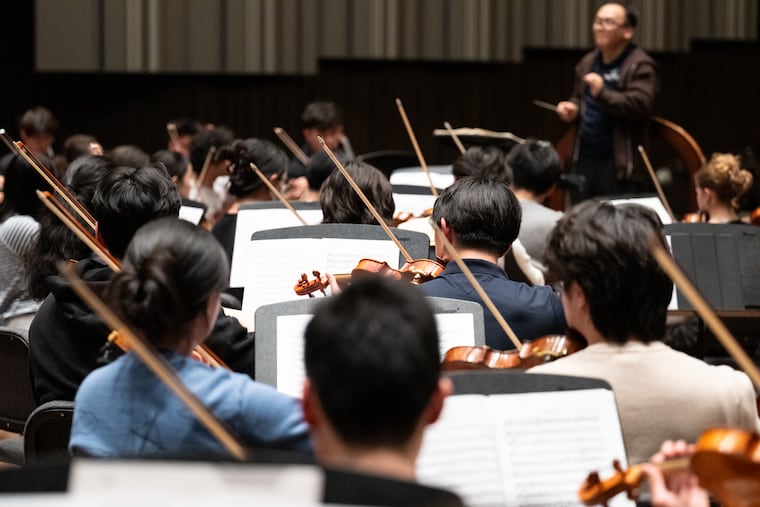
Adee Sonnino, 21, a freshman international relations major, arrived at the University of Pennsylvania’s Irvine Auditorium early Friday evening.
Joining her were Quinn Haverstick, 22, a doctoral student in electrical and systems engineering, who had spent his day in a lab working on “quantum dot synthesis” and Michael Huang, a senior finance and economics major. There were dozens of others, too, from disciplines across the Ivy League university, even a Wharton professor.
They grabbed their instruments and took the stage.
The group of 114 musicians comprises the Penn Symphony Orchestra. Founded in 1878, it’s even older than the Philadelphia Orchestra, whose archives Penn acquired in 2022.
» READ MORE: Philadelphia Orchestra donates its entire archive to Penn
And very few of the musicians are actually music majors, which Michael Ketner, Penn music department’s director of performance, said is not unusual. There are only about 20 music majors at Penn.
“One of the real strengths of these programs is the students who are part of them are from all these other schools and departments,” Ketner said. “We are lucky enough that many of them could have chosen to go to a conservatory or school of music and they have taken a different academic approach. They came here and we benefit, and hopefully they do, too.”
One of 11 ensembles at Penn, the orchestra on Saturday performed one of two concerts it is offering this semester. It featured the central movement and “Love Song” movement of Austrian composer Gustav Mahler’s Symphony No. 5, Hector Berlioz’s Roman Carnival overture, and other works. The performance was free and open to the public.
In its culminating performance next month, the orchestra — which does work from the 18th, 19th, and 20th centuries — will perform the entire Mahler symphony.
“Great solos, everyone,” Thomas Hong, orchestra conductor and artistic director, told the musicians during practice.
Students stamped their feet — a musician’s applause.
The orchestra has grown in recent years, said Hong, who previously worked at the Pittsburgh, Dallas, and Seattle symphony orchestras before returning to Philadelphia, where his wife is a violinist for Philadelphia’s orchestra. Penn had about 60 members when he started in 2014, Hong said, and that has almost doubled.
The majority of performers are undergraduates, many having grown up playing in youth orchestras or other musical groups. About 10% are graduate students, alumni, professors, and even high school students, Hong said.
Sydney Vance, 16, of Lower Gwynedd, plays the timpani, a percussion instrument. She is a home-schooled high school student who met Hong at the Philadelphia International Music Festival when she was 11 and they stayed in contact. He invited her to join the orchestra last year when he needed more percussionists, she said.
Vance, who takes one Penn class per semester as part of its Young Scholars program, is one of few orchestra members who does want to pursue music as a career. She plans to attend a music conservatory with the goal of playing for an orchestra.
Student performers say the orchestra allows them to continue their musical passion and provides a welcome outlet from demanding studies.
“It’s sort of an escape from a lot of the work I’m doing in classes or the lab,” said Haverstick, the engineering doctoral student who plays oboe.
The orchestra, which practices several hours twice a week, requires the use of another part of the brain, Haverstick said.
Huang, the finance student, agreed.
“Being in the finance and business community at Penn is very intense,” he said. “People are often worried about finding jobs, finding internships. Having space in the week where you can just step out of that and enjoy the music that you like to play, it’s very rewarding.”
Other colleges have similar orchestras, Hong said. Penn pointed to orchestras at Harvard, Yale, and Cornell when deciding to start one nearly 150 years ago.
“Our students have, without doubt, as much musical ability and education as the students of these colleges, and besides this have advantages given to them which are rarely given to any college,” according to an 1877 edition of Penn’s University Magazine. “Our university is situated in a city known for its fine musicians and keen appreciation of good, and hatred of bad music.”
The first orchestra was organized in the spring of 1877, at first combining its concerts with the glee club, according to Jim Duffin, assistant university archivist. Its first annual concert was held in January 1878 in the chapel, now Room 200 of College Hall, he said.
Some orchestra members have continued to play for decades. Nancy Drye, who worked in Penn’s music department, started in 1973, only leaving a few years ago because of arthritis.
“The group has gotten really, really good over the years,” said Drye, a viola player. “I hope Penn realizes how fortunate they are to have someone of [Hong’s] caliber conducting this group.”
Students said they admire Hong’s passion for the work.
“It’s just really great to see him on the podium,” Haverstick said. “It’s very clear that he loves the job ... and he really cares about the music and cares that we’re getting the most out of our experience.”
Orchestra members say they’ve made great friends, too.
“It’s really good to have an outlet and have friends outside of engineering,” said Phoebe Vallapureddy, 22, a senior viola player from Doylestown, who is majoring in chemical and biomolecular engineering. “We do a lot of social events outside of orchestra.”
Barry Slaff, 37, a doctoral student in computer science, said he used to play in the orchestra in 2007-08 when he was a Penn undergraduate. The trombone player decided to rejoin when Hong told him the group would play Mahler this year.
Sonnino, who was born in Princeton but has lived in Israel most of her life, said playing the flute as part of the orchestra gives her a “euphoria” that’s hard to describe.
“Everyone in this orchestra really does have music in some place in their heart,” Huang said. “It means a lot to them and that’s why we’re all here.”