Once a precocious theater kid from West Philly, Hollywood production designer Wynn Thomas has won an overdue Oscar at 72
“My journey to storytelling began as a poor Black kid in one of the worst slums in Philadelphia," said the designer who has worked with the likes of Spike Lee, Robert DeNiro, and Ron Howard.
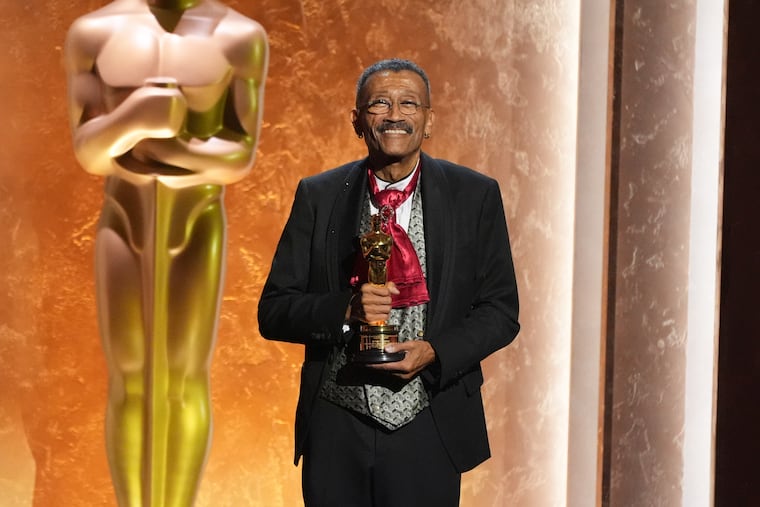
When famed production designer Wynn Thomas prepared an acceptance speech for his long-awaited Oscar at the age of 72, he wanted to highlight his own Philadelphia story.
“My journey to storytelling began as a poor Black kid in one of the worst slums in Philadelphia. There were street gangs and poverty everywhere. And to escape that world, I immersed myself in books,” Thomas told the Hollywood audience at the Governor’s Awards ceremony in November. “I would sit on my front stoop and I would travel around the world. Now, the local gangs looked down on me and called me ‘sissy.’ But that sissy grew up to work with some great filmmakers and great storytellers.”
It was a significant moment for an artist who has spent nearly 50 years behind the camera to finally step into the spotlight himself. The honorary Oscar — which also went to Tom Cruise and Debbie Allen — recognizes “legendary individuals whose extraordinary careers and commitment to our filmmaking community continue to leave a lasting impact.”
During his extensive film career, Thomas has designed epic, comedic, and dramatic worlds for filmmakers like Spike Lee (Do The Right Thing, Malcolm X), Ron Howard (A Beautiful Mind, Cinderella Man), Robert DeNiro (A Bronx Tale), Tim Burton (Mars Attacks), and Peter Segal (Get Smart).
And while at it, he broke several barriers along the way: Thomas is considered the first Black production designer in Hollywood history.
No matter how far his work took him, though, he was always proud to discuss his Philadelphia roots.
The theater kid from West Philly
Long before he worked on major feature films, Thomas grew up as one of six kids in West Philadelphia, living primarily near 35th and Spring Garden Streets. Avid reading kept him out of trouble. His mother, Ethel Thomas, wrote a permission letter to the local library so he could access the adult section, and he immersed himself in the worlds of Harper Lee, James Baldwin, William Shakespeare, and Lillian Hellman.
The young Thomas always looked forward to Saturdays, when he could spend nearly all day at a movie theater on Haverford Avenue. Occasionally, he took classes at Fleisher Art Memorial, too.
The 1961 movie Summer and Smoke, written by Tennessee Williams, he said, inspired him to pursue theater.
“I absolutely said, ‘My God, what is this?’ I think it was just the nature of the story that really affected me,” Thomas, who now lives in New York, said in a recent interview. “I couldn’t believe what I had just seen, what I had just experienced. So I went to my library and got as many Tennessee Williams plays as I could.”
A couple of years later, Thomas heard that Society Hill Playhouse was holding open auditions. He was too young to audition himself, so he persuaded his older sister Monica to try out.
“I remember saying to her, ‘You need to do a scene from Who’s Afraid of Virginia Woolf,’” he recalled, chuckling. “Now, can you imagine being a 14-year-old kid who knows Who’s Afraid of Virginia Woolf? That’s a geek!”
She earned a spot in the company for a season and Thomas frequently tagged along, volunteering as an usher and eventually forming a close relationship with the owners, legendary Philadelphia theater couple Jay and Deen Kogan.
Throughout high school, the Overbrook High art student spent most of his after-school time across town at the playhouse. He acted, painted scenery, and served as a stage manager.
One of the final productions he stage-managed was The Great White Hope, loosely based on boxing champion Jack Johnson, who was played by Richard Roundtree — the soon-to-be Hollywood star who went on to lead the 1971 classic Shaft. While he was performing at Society Hill Playhouse, Roundtree was auditioning for the life-changing role.
“Shaft was a very important and very pivotal film for that time period,” said Thomas. “It was about a strong Black male who lived in the world under his own terms. That was not a character that was portrayed often in films.”
It was a glimpse into the worlds Thomas would help create in the future — with Black characters who had agency at the center.
Some four decades later, he worked with Roundtree once more for the 2019 remake of Shaft and they had an “incredible reunion.”
From Philly to Boston to New York
Thomas received his bachelor of fine arts in theater design from Boston University. After graduating in 1975, he returned to Philadelphia and worked as a window dresser at the Strawbridge & Clothier department store on Market Street for a few months before landing his next theater job.
For about four years, Thomas was a painter for the Philadelphia Drama Guild, operating out of the Walnut Street Theatre. He also returned to Society Hill Playhouse as a production designer.
“It was a huge learning phase for my career, because I was painting all these different kinds of shows,” Thomas said.
By his mid-20s, Thomas had moved to New York and soon became the resident set designer for the legendary Negro Ensemble Company, where he worked with not-yet-famous actors from Denzel Washington to Phylicia Rashad.
“There was an actor who had auditioned for the company but did not get in. He was looking for a job and it turns out that he had carpentry skills, so I ended up hiring this actor who built my sets for my very first season at NEC,” Thomas recalled.
“That actor was Samuel L. Jackson.”
Breaking into film
Thomas loved theater but sought higher-paying work in film. After multiple job rejections, he joined the United Scenic Artists Local 829.
In an event the union organized with renowned production designer Richard Sylbert, who was working on Francis Ford Coppola’s The Cotton Club, Thomas was the sole Black person in attendance.
The next day, he called Sylbert and introduced himself: “I’m the Black guy that was in the room last night. Do you remember seeing me?”
He convinced Sylbert to hire him to build model sets, and Sylbert became a crucial reference that helped Thomas secure art director jobs, like on 1984’s Beat Street (directed by fellow Philly native Stan Lathan). That’s where he met Spike Lee, who interviewed “for the coffee-fetching position of assistant to the director,” Thomas recalled. When Lee stopped by the art department to greet a friend, the aspiring filmmaker was surprised to see Thomas.
“He said he didn’t know there were any Black people doing this [work],” Thomas said.
A storied career of firsts
That Beat Street encounter led to one of the most fruitful collaborative relationships of Thomas’ career: He went on to make 11 films with Lee, from She’s Gotta Have It to School Daze to Jungle Fever. Lee regularly worked with the same collaborators (“the family”) including Thomas, costume designer Ruth Carter, and cinematographer Ernest Dickerson.
“We wanted to present images of Black and brown folks that had not been seen before on the screen. We did not want to present any negative images. If you look at those films, there’s no drugs, there’s no alcohol, there’s no domestic abuse — none of that trauma that people used to associate with our communities,” said Thomas. “That was the artistic link, the journey for all of us …[and] that has been a criteria for me.”
Meanwhile, he continued to find mainstream success on commercial films, fueled by a relentless work ethic and a commitment to hiring a diverse crew of artists on his team. Later in his career, he was elected to the Academy’s Board of Governors where he pushed for expanding educational programs nationwide.
Thomas’ films showcase a breadth of world-building talent across genres like comedy (To Wong Foo, Thanks for Everything! Julie Newmar, Get Smart), romance (The Sun Is Also a Star), and dramas about other Black barrier-breakers, like King Richard (starring fellow Overbrook alum Will Smith), Hidden Figures, and the miniseries Lawmen: Bass Reeves.
It’s rare that he returns to his hometown for a job, but in 2014, he was thrilled to work on the pilot of the Philadelphia-set show How to Get Away with Murder.
Thomas believes the city holds countless rich, untold stories that he hopes will one day receive a bigger spotlight.
For now, he’s enjoying seeing the Oscar statue grace his living room.
“It really means a great deal to me, after 40-plus years of working in the business, to have my work recognized by this organization,” said Thomas. “I’ve worked on a lot of films that should have been recognized by the Academy, [for which] I should have been nominated, and it never happened. So I think this was a way for the Academy to correct that oversight.”
