Lily Allen’s brilliantly staged Met Philly stop felt more like a play than a concert. In a great, playful way.
The British pop star brought "West End Girl," her breakup album for the ages to North Broad Street in a one-woman show.
Just how big is the potential audience for Lily Allen’s West End Girl?
Look at it this way. According to the World Population Clock, just under 8.3 billion people are currently alive on the planet.
And what percentage has been in a relationship with a man proven to be so deceitful, duplicitous, and dishonorable that he led a romantic partner to pose the question Allen asked herself at the Met Philly on Friday: “Why would I trust anything that comes out of his mouth?”
Slightly less than half, maybe? That still makes for a target audience of 4 billion.
OK, maybe that’s a slight exaggeration. The point is that Allen has struck a universal nerve with West End Girl, her 2025 auto-fiction song cycle believed to be inspired by the dissolution of her marriage to Stranger Things and DTF St. Louis actor David Harbour.
(They sold their featured-in-Architectural Digest Brooklyn brownstone for $7 million last week, $1 million under original asking price, sadly.)
Allen is only 40, but the British songwriter has been a cutting and clever pop presence for two decades, dating back to her first two terrific albums, Alright, Still in 2006 and It’s Not Me, It’s You in 2009.
Those albums won her deserved acclaim, a loyal audience, and plenty of next-generation fans like Olivia Rodrigo and recent two-night Met headliner Pink Pantheress, whose witty, percolating sound is imprinted with Allen’s influence.
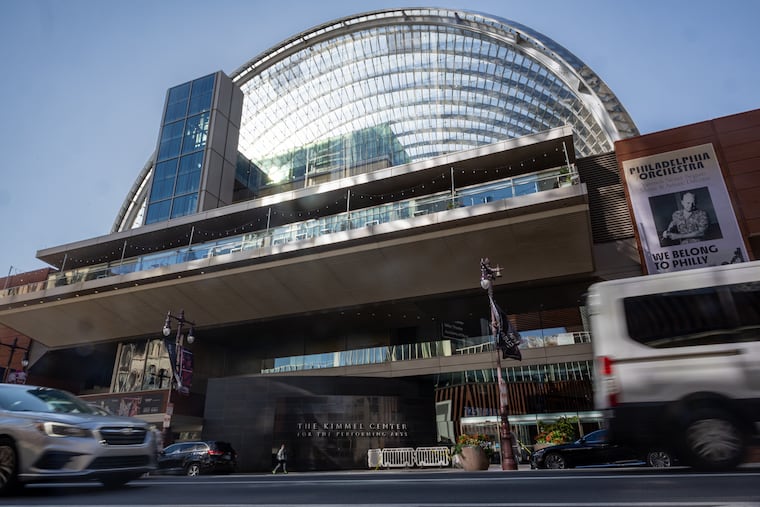
Until now though, Allen has never had a huge U.S. audience. In Philadelphia venue terms, she was always more of a TLA- or Union Transfer-size artist, rooms roughly one-fourth the size of the 3,500-capacity Met.
But Allen not only sold out the North Broad Street opera house on Saturday, she’s also ballooned in popularity to the point that she has a return date Sept. 6 at Xfinity Mobile Arena, a venue more than five times the size of the Met.
And bully for her. The one-woman show Allen put on Friday, tellingly billed “Lily Allen Performs West End Girl,” is a unique pop presentation of songs that don’t skimp on titillating, salacious detail but are also expertly crafted, uncannily catchy, and packed with deeply personal emotional impact.
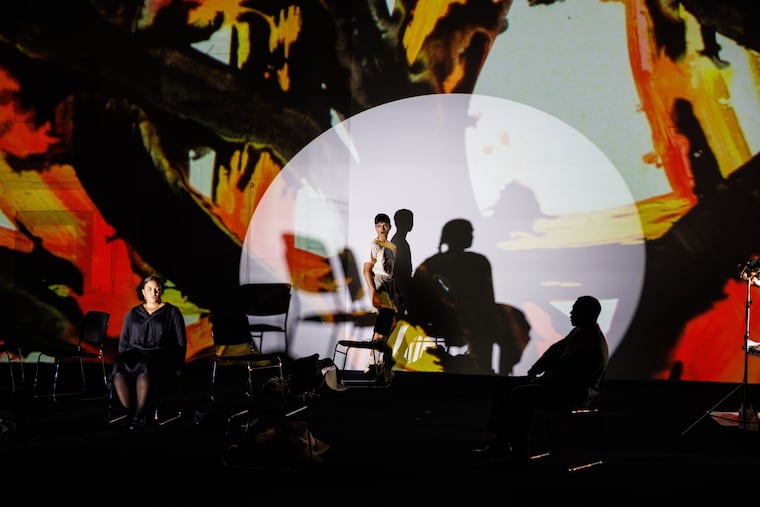
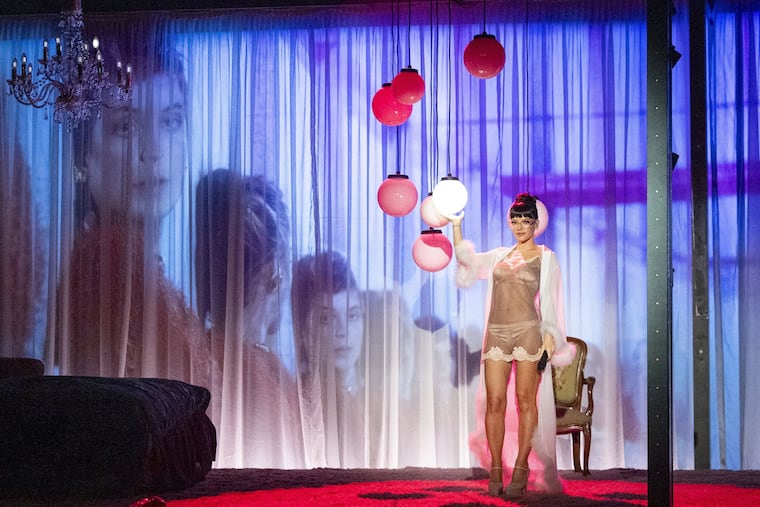
They’re also smartly and imaginatively staged, with Allen performing the album’s 14 songs in order, in an intentionally theatrical performance that felt more like a play than a conventional pop concert.
Of course, all pop performances have an element of theatricality, even those that present themselves as soul-baring displays entirely without artifice.
But Allen’s front-to-back showcase of West End Girl was different. Other than Allen and stagehands who maneuvered props in the dark between acts during the show, no one was visible on the stage set designed by Anna Fleischle — which included a bed, a settee, and a refrigerator — except Allen herself.
There was no stage patter, no “How you doing, Philly?” or cheesesteak mentions.
The fourth wall was never broken except for a few Allen smiles of what appeared to be delight at how well she was going over with an adoring crowd made up mostly of groups of women ranging from their 20s to 40s, plenty of gay men, and the occasional date-night straight man.
At the start of the show — which lasted 58 minutes and included no encore nor songs from her back catalog (more on that in a minute) — Allen emerged from behind a green curtain in a short tweed pink pencil skirt and jacket.
The title cut dramatizes the period when Allen made her West End debut in London in the play 2:22 A Ghost Story in 2021. She acted out taking a disturbing phone call on stage which ultimately leads to revelations that her open marriage was full of lots of not-so-open secrets and sneaking around.
The show — in which Allen seemed to sing and talk/rap over prerecorded music, unless there were musicians hidden under the stage — hit its first emotional peak with “Ruminating,” in which she sang “I can’t shake the image of her on top of you, and I’m dissociated.”
In “Madeline,” Allen amusingly spoke in an American accent, giving voice to the woman she suspects is her husband’s paramour. Her name was emblazoned on a merch shirt asking the accusatory question: “Who The F— Is Madeline?”
Allen’s trademark wit and flair with language was ever evident, but often delivered with blunt force. In “Relapse,” Allen sang, “I need a drink, I need a Valium / You pushed me this far, and I just need to be numb.”
And in the crowd favorite “Pussy Palace,” the singer reeled from the realization about her husband’s apartment, which she thought was a dojo used for mediation. “Hundreds of Trojans, you’re so f— broken,” she sang, emptying out a Duane Reade drugstore plastic bag on a bed. “How’d I get caught up in your double life?”
West End Girl is heavy but hardly a downer. On stage, it was frequently playful. At one point, Allen opened the fridge and a woman’s legs popped out in surprise.
During “Dallas Major,” in which Allen inhabited the role of the alias she used on the celebrity dating site Raya (where she met Harbour), she strutted around in bondage vinyl with a feather duster.
The song was light-hearted but didn’t hide its midlife desperation: “I’m nearly 40, I’m just shy of 5 foot 2 / I’m mum to teenage children, does that sound like fun to you?”
West End Girl doesn’t exactly wind up in a happy place, but it does arrive at a level of livable self-awareness, as well as the satisfaction that comes from creating a banger of a breakup album that is at once one for the ages and utterly of its swipe-right, swipe-left time.
“’Cause it’s not me, it’s you,” Allen sang on the closing “Fruityloop,” wise enough to not blame herself. “It’s what you’ve always done, it’s what you’ll do.”
Then she made her exit in her evening gown, offering a little wave goodbye to the crowd before returning to collect a bouquet of roses.
Allen didn’t perform any of her pre-West End Girl material but, in another novel touch, found somebody else to do it for her.
The Dallas Minor Trio — cellists Gita Langley, Jess Murphy, and Marianne — opened the show with instrumental versions of Allen’s songs, with the lyrics flashing on a screen.
Her fans were all in on the karaoke-ish opening exercise, priming themselves for the main event by singing along to nearly two-decades-old songs that sometimes seemed to prefigure Allen’s angst.
“I don’t know what’s right and what’s real anymore, and I don’t know what to feel anymore,” the crowd sang along to a chamber music version of “The Fear.” “When do you think it will all become clear? Because I’m being taken over by the fear.”