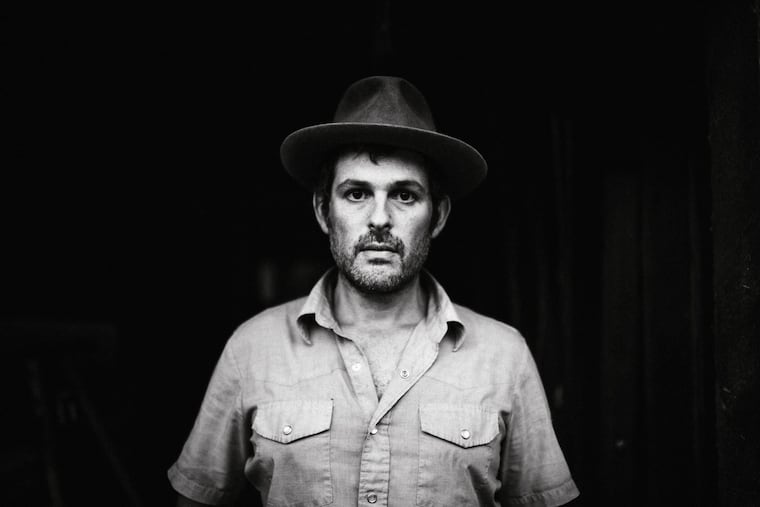
A new composer in residence comes to Opera Philadelphia with a toolbox of dizzying talent
Nathalie Joachim plays the electronic flute, composes operas, sings, and weaves stories from Philly, Haiti, Brooklyn, and beyond.

Whether Nathalie Joachim is playing electronic flute, composing an opera, or singing in Creole at World Cafe Live, she is always drawing on a cultivated worldview that’s not typical of her fellow Juilliard School graduates.
With a mile-long resume that includes an assistant professorship at Princeton University, a Grammy Award nomination, and now, Opera Philadelphia’s 2025-2026 composer-in-residence position, she indeed has her layers but seems remarkably rooted in a single place.
Growing up in Brooklyn, now living near the Italian Market in Philadelphia, the 41-year-old Joachim resides spiritually in her Haitian heritage. An all-around artist with an assured identity, she introduced her songs at last year’s World Cafe Live concert talking about the world‘s interpersonal complexities, almost like a nurturing psychotherapist.
“I think my own therapist would disagree with that,” she said, laughing.
Compared to some therapists, Joachim is succinct and nonconfrontational.
Undeniably therapeutic, her music is basically poetic storytelling. In many pieces, her voice and/or flute is accompanied by clouds of electronic sound that couldn’t be more modern, though she sees herself in the tradition of a griot, a revered figure in many West African communities.
“They collect the stories of the community and reflect them back so that they’re able to see pieces of themselves in it,” she said.
It doesn’t matter that details in her songs may be lost on listeners who don’t speak Creole.
Gift of storytelling
“The experience of opera is not that we should be tracking each word, but hearing a story in sound,” said Opera Philadelphia general director and president Anthony Roth Costanzo. “She has so much command of color in the sounds that she makes,” he said of Joachim.
Also, her storytelling gift was one of the main factors in her becoming composer in residence. It also falls in line with Roth Costanzo’s “Opera, but different” philosophy.
What form her sensibility could take in her opera in progress — working title is Le présent éternel after a painting of the same name by Afro Cuban surrealist painter Wifredo Lam — has dizzying possibilities.
Lam’s imagery has the density of a rainforest with strange semi-animalistic figures that are loaded with mystical symbolism. Parts of the opera will be heard in Philadelphia in a to-be-announced date this fall following workshop performances on Nov. 16 at New York’s Museum of Modern Art (where Joachim was scholar in residence 2024-2025) and Nov. 18 at nearby Zankel Hall.
Expect something more in the neighborhood of Philip Glass’ free-flowing, abstract Einstein on the Beach than Verdi’s Aida.
“[Traditional] opera tends to default into a base level of human understanding,” Joachim said, “instead of trusting the listener with something greater than the most basic tropes.”
No less unpredictable is Complications in Sue, to be performed Feb. 4-8, at the Academy of Music — about a split-personality woman, with each of the 10 decades of her life dramatized by a different composer, all of them major names in the field: Missy Mazzoli, Nico Muhly, Rene Orth, Errollyn Wallen, and Joachim.
She enjoys being a team composer — and taking a break from her deep immersion in surrealism. The different compositional voices appeal to her appreciation of collage techniques. “That’s something that speaks deeply to my spirit,” she said.
Embracing Haiti’s energy
In her Feb. 25 Philadelphia Chamber Music Society recital with violinist Yvonne Lam, she will return to more familiar ground with a preview of her already-finished but unreleased third solo album. The concert is titled “Solitude + S P A C E,” and “explores this idea of what it means to be isolated in a hyperconnected world.”
With such awareness of modern paradoxes, it’s no wonder Joachim has sought deep connections with her ancestral home in Haiti — specifically, land that has been in her family for seven generations.
“Almost everybody is migratory. I know very few people who have that long a connection to any piece of land — anywhere,” she said.
“Very few Black people had ownership in that way for that long. It’s a special, protected place that my family has been tending to almost as long as Haiti has been Haiti … There’s an energy there that’s quite magical … something I sense and cherish.”
Inevitably, she crosses paths with Haitian voodoo, traditional melodies that have found their way into her songs — not the black magic voodoo portrayed in Hollywood films, but a rich benevolent network of cultural mythology.
“Its connection with the natural world, the connection with the earth … is very real,” Joachim said. “It’s something I engaged with, [but] I’m not in the practice formally.”
‘A toolbox of expression’
A catalyst in her overall cultural exploration was her grandmother Ipheta Fortuma (1918-2015) and not just philosophically. She showed Joachim how her voice could be used in the act of storytelling. That kind of contact with her voice is something Joachim says she almost lost during her years at Juilliard, where she started at age 10, cycling through the prep department and college division program, from 1996 to 2005.
That training took her to the acclaimed ultra-new-music ensemble, eighth blackbird, with whom she played for seven years. Now, Juilliard is something she pushes back on. Not that such training was wrong. It’s just not central to what she now does.
“That training wasn’t about music making as much as becoming an athlete … and performing at a very high level,” she said. “I’ve kind of closed that chapter of my life. I’m less excited about perfection and more about using it as a tool in a toolbox of expression. It’s one facet of the tool but not the facet of the toolbox.”