The house where ‘American hero’ Paul Robeson lived until 1976 is reopening
A ribbon cutting ceremony is set for the Walnut Hill house and museum that tells the story of the Black Renaissance man who was born in Princeton and died in Philadelphia.
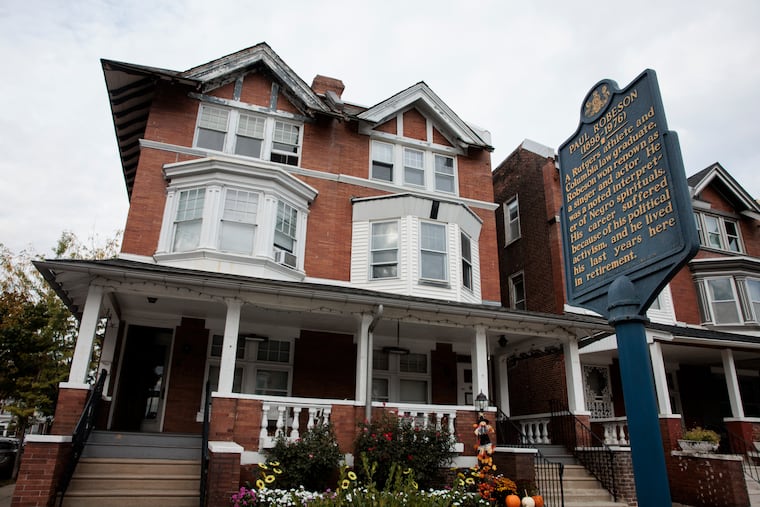
The Paul Robeson House and Museum is back in business.
The museum and educational institution, located in twin brick homes on a corner in West Philly’s Walnut Hill neighborhood, has been closed to the public since August 2024. Meanwhile, half the building, known as the annex, underwent renovations.
That work is now complete, and the house where the towering cultural and political figure in 20th-century America spent the last decade of his life is set to celebrate a grand reopening.
On Friday, the Robeson House, which is owned by the West Philadelphia Cultural Alliance, will celebrate its new 150-capacity event and artist-in-residence space with a ribbon-cutting ceremony.
The Tyehimba African Drum Ensemble will kick off an 11 a.m. event that will include words by Philadelphia City Councilperson Jamie Gauthier, Pennsylvania State Sen. Vincent Hughes, and State Reps. Rick Krajewski and Amen Brown.
On reopening day, admission to the museum — normally $12 — will be free. Visitors will be welcomed to the rooms where Robeson — who was born in Princeton in 1898, and moved to the city after the death of his wife, Eslanda, in 1966 — lived with his sister, Marian R. Forsythe, until his death in 1976.
The upgrading of the Robeson House annex was funded by a $1 million grant from the Mellon Foundation, said Azsherae Gary, interim executive director of the Paul Robeson House.
The grant was divided evenly between the Philadelphia Robeson House and the Paul Robeson House of Princeton, located in the home where the actor, lawyer, athlete, activist, and singer was raised by his father, William Drew Robeson I, a formerly enslaved man who became a Presbyterian Church pastor.
The renovations have transformed what Gary said were previously the “dark, dingy rooms” of the Robeson annex to a bright, inviting space. That is where visual and movement artist Shanina Dionna presented her work earlier this year, when the Robeson House presented programming events but was not yet open for tours.
With a new working kitchen, the annex is also a more attractive space that can be rented out for events as the Cultural Alliance prepares for both the 50th anniversary of Robeson’s death and the U.S. semiquincentennial in 2026.
» READ MORE: Philly musician Jamaaladeen Tacuma on why ‘Renaissance Man’ Paul Robeson is more relevant than ever
“You have to care for your institutions and steward them properly,” Gary said. “This is a person who played a significant role in American history. He was only living here for a short time, but he had a big impact.”
At 4951 Walnut St., Robeson was visited by socially conscious Black entertainers to whom he had been an inspiration, such as Harry Belafonte, Ossie Davis, and Ruby Dee.
Robeson, who was renowned for his sonorous versions of “Ol’ Man River” from Showboat and spirituals such as “Go Down Moses” and “Didn’t My Lord Deliver Daniel,” is said to have often sung in the Walnut Street house parlor, and waved to passersby from the porch.
The rooms inside tell of the achievements of a multi-hyphenate of the highest order, before the term was invented, who regularly broke down racial barriers.
Philadelphia musician Jamaaladeen Tacuma, who performed a tribute to Roberson at the house in 2022 told The Inquirer that he grew angry when, as an adult, he first learned about the Black Renaissance man’s life.
“I was mad because I didn’t know anything about him, because his story had been erased and I hadn’t been taught about him in school,” Tacuma said. “I mean, goodness gracious, everything he put his hands on, he was unbelievable at.”
The Robeson House’s mission is to tell that story, from when he was the third Black student and first Black football player at Rutgers University, where he graduated Phi Beta Kappa, and won a dozen varsity letters. Coach and sports writer Walter Camp called him “the greatest defensive end to ever trod the gridiron.”
Highlights of the house include a stained glass image of Robeson standing tall in the front door, by Los Angeles artist Ramsess. A quilt by Philadelphia crochet artist Frances Conwell called Paul Robeson’s Hats wryly comments on his wide-ranging talents.
Upstairs, a cardboard cutout depicts the 6-foot-3 Robeson in costume as the titular character of the 1933 film The Emperor Jones. There are photos of Robeson during the 1943 Broadway run of Othello, when he became the first Black actor to play the role in an American production of Shakespeare’s play.
Panels tell of his friendship with Marian Anderson, and his outspoken criticism of the U.S. government, and sympathetic stance toward the Soviet Union, which led to his passport being revoked in 1950. Robeson was also blacklisted because of his left-wing views.
He was frequently called before congressional committees in the 1950s, where he invoked the Fifth Amendment and refused to state whether he was a member of the Communist Party.
“The question is whether American citizens, regardless of their political beliefs or sympathies, may enjoy their constitutional rights,” he said, telling the House Un-American Activities Committee in 1956: “My father was a slave, and my people died to build this country, and I am going to stay here and have a part of it just like you. And no fascist-minded people will drive me from it.”
When Frances P. Aulston founded the West Philadelphia Cultural Alliance in 1984, the Robeson House was abandoned and in disarray. “Squatters lived here,” Gary said.
By 2020, the mortgage was entirely paid off. Now, the new renovations will aid the House and Museum in acting as a cultural hub in the West Philly community and tell Robeson’s story to visitors from Philadelphia and around the world.
Robeson “is relevant today because of what he believed in,” said Gary. “He’s an American hero who was a humanitarian at heart. He cared about social justice. He cared about workers and their rights. He stood up and sacrificed his livelihood, because he had a basic moral compass and belief in doing the right thing. We want people to bring people here to learn about the history.”
The Paul Robeson House and Museum grand reopening ceremony at 4951 Walnut St. at 11 a.m. Friday. Admission is free. PaulRobesonHouse.org.