There were many distractions at Interlochen Center for the Arts centenary celebration. A Wynton Marsalis concerto debut stood out.
The Philadelphia Orchestra joined the Interlochen choir in a program that also included Yo-Yo Ma, who proved to be "a fine Marsalis interpreter."
Cellist Yo-Yo Ma, a new concerto by jazz trumpeter Wynton Marsalis, and a rare performance of Charles Ives’ sprawling Symphony No 4 were the red-letter attractions at the Interlochen Center for the Arts celebration at the Kimmel Center on Friday.
Though with so much else on hand, one overwhelmed listener asked: “What WAS that?”
This high-caliber Michigan-based training center for music, theater, dance, and visual arts can be expected to commemorate its forthcoming centennial (as well as America at 250) comprehensively. So many ancillary elements were packed into the meticulously produced evening that one had to tune out some of it to focus on the core experience.
Interlochen’s talent was apparent at every turn, with work that was all fully realized on its own terms. No cut corners.
Also in rich supply was the student idealism, starting with the Sydney Lea Kassekert song “Imagine,” in keeping with the program’s title, “Imagine US.”
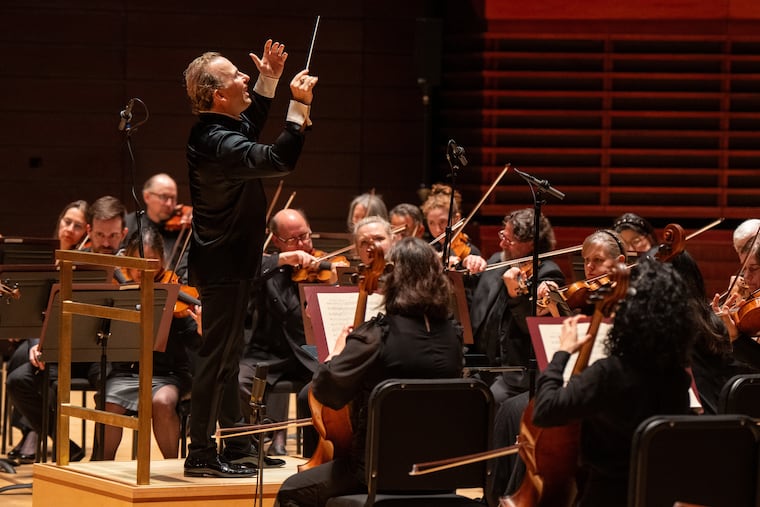
The concert was the first in a tour with orchestra (conducted by Cristian Mӑcelaru) playing side by side with professionals, the Philadelphia Orchestra at this date and the Boston and Detroit orchestras in later performances.
That may be the most important aspect for the 100-or-so instrumentalists. It allowed them to hear at proximity what the music can be and ways to get it done. And the Ives symphony gives orchestras more to do than perhaps anything else in the repertoire.
Written between 1910 and the mid-1920s, the four recklessly innovative movements are separate worlds that collectively create an almost geological cross section of America at that time, with simultaneous parade music, hymns, and songs, often juxtaposed against one another.
There’s also a strong industrial element: The symphony opens with stark, emphatic chords that stand like massive pylons, with “Home Sweet Home” heard in the background. Other moments are like tornadoes, but ones swirling with random debris.
The new Thomas Brodhead edition heard here declutters some of the symphony, better allowing one to hear what Ives was after. Also, thanks partly to Interlochen principal conductor Mӑcelaru (formerly of the Philadelphia Orchestra and now Cincinnati Symphony music director), the sleek string tone revealed Ives’ third-movement fugue with more clarity than I’ve ever heard.
The Interlochen Arts Academy Choir was on hand for atmospheric vocal moments.
Between movement, student actors delivered spoken context and commentary — dressed in period costumes. Quite appreciated.
Staging elements during the music were less appreciated. The large video screen dominating the Marian Anderson Hall stage was busy with visuals, some abstract shapes, some Americana collages, all well done and all significantly distracting from the music.
The Marsalis concerto, heard in its premiere, is typically atypical.
Marsalis follows few of the concerto traditions — such as the heroic battle between soloist and orchestra — preferring thematically connected suites, all hugely eventful in their musical imagery, like an inner travelogue with the soloist as a tour guide (and sometimes the brunt of musical jokes).
This concerto started casually, disarmingly so, including a first-movement cadenza dominated by thoughtful pizzicato. It ended with orchestra members urging Ma on with fun, rhythmic clapping. In between, Marsalis was at his most graphic, notably with a police whistle, and then a cello solo figure that was a pale, downward exhalation.
Has George Floyd been more eloquently memorialized?
Marsalis built each movement with a series of high-density modules, each with its own character but often with a pensive pause recalling Aaron Copland’s more serene movements.
Marsalis loves historic dance forms — the final movement was titled Cakewalk — always made new by witty instrumentation, sometimes with piccolos making birdlike effects.
Demands on Yo-Yo Ma include all manner of un-classical effects, most obviously bluesy pitch bending. Ma gave everything its due. The resources of articulation and color that make him a great classical cellist also make him a fine Marsalis interpreter, aided by his having no great attachment to classical poise.