Jon Batiste brings his ‘Circus of Love’ to the Met Philly, and out onto Poplar Street
“This is not a concert, it’s a spiritual practice!,” the Louisiana bandleader announced while performing under a canopy that read "Under Our Tent There Is Revival And Joy."
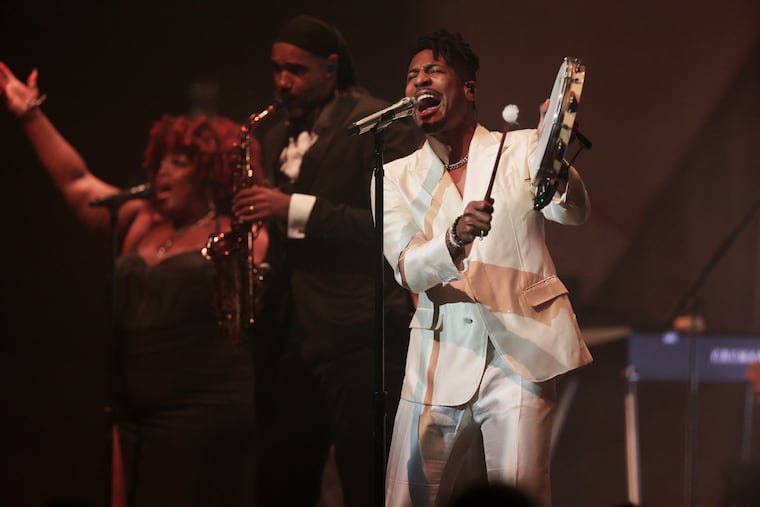
On Thursday night, an old school revival meeting stomped up and down the aisles and gathered under a big tent on stage at the Met Philly.
Jon Batiste and his 15-piece band were in town. The Kenner, La.-raised multi-instrumentalist and incandescent spirit, who’s a scion of one of New Orleans music’s foremost musical families, calls the tour behind his new and best album Big Money, “Jon Batiste Playa America.”
That’s an appropriate moniker. Batiste and his boisterous ensemble have made their way through the U.S. this fall on a tour whose penultimate stop was in Philadelphia. They wrap up in Washington, D.C. on Halloween.
The name is appropriate also because it’s a 2 hour, free-flowing, frequently improvised, and highly entertaining show. It ended with Batiste tooting on his melodica leading a Crescent City-style parade through the lobby onto Poplar Street, making it a mission to weave the multifarious strains of American music into one exuberant tapestry.
“Hello Philly!,” the former Late Show with Stephen Colbert bandleader — who played piano, guitar, saxophone and drums, in addition to the aforementioned hooter — said at the start of the show. “This is not a concert. This is a spiritual practice!”
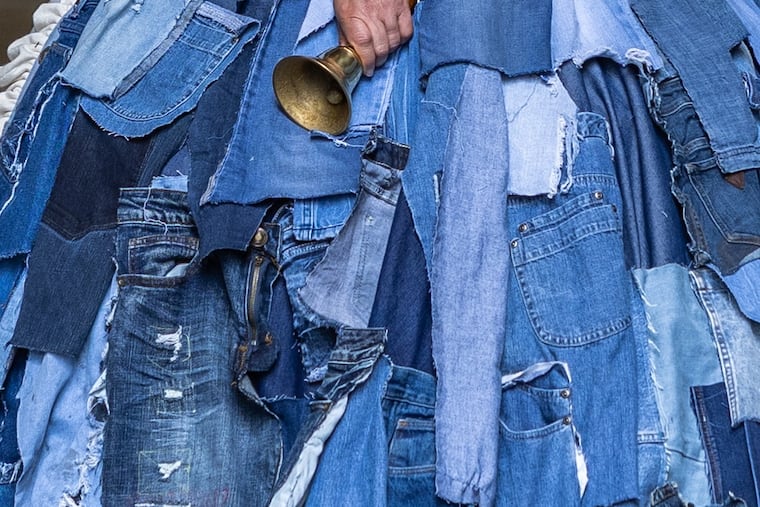
Performing under a canopy that announced its intent with a banner that read “This Is The Circus of Love” and “Under Our Tent There Is Revival And Joy,” Batiste drew heavily from the joyfully unpolished Big Money, which was recorded in two weeks. The album benefits greatly from off-the-cuff charm, as well as Batiste’s 2021 Grammy winning We Are.
His feel-good humanism can come across as non-specific and polyanna-ish. But Batiste is nothing if not diligent in his pursuit of euphoria, and the evidence of his progress as a songwriter is all over the tunes on Big Money, most of which were written on guitar rather than piano.
In stressful times, Batiste has been wise to ground his music in blues and gospel. The execution of both was aided immeasurably on Thursday by powerhouse vocalist Desiree “Desz” Washington, who thunderously let loose on the R&B standard “The Night Time Is The Right Time” and Batiste’s own “Cry.”
By visiting dark places in songs of struggle — with an unpredictable selection of covers that draw on the full range of American vernacular music, varying from night to night — Batiste worked his way toward the light, with a sense of release that felt fully earned.
With guest vocalist Andra Day, who featured prominently on Big Money, paired off on a patient and soulful take on the Doc Pomus-penned Ray Charles hit “Lonely Avenue.” Day proved to be a more mellifluous duet partner than Randy Newman, whose satisfyingly froggy team-up with Batiste is on Big Money.
That song, in turn, led to a Batiste and Day version of “It’s All Right,” the 1963 hit by Curtis Mayfield and the Impressions, which brightened the mood considerably with a timeless pithy lyric that grants permission tonot let worry rule your world: “It’s all right, to have a good time / Yeah, it’s all right.”
Batiste took that cue to heart. As Day exited the stage, Batiste who was resplendent in a white suit, while the rest of the band was dressed in black, found himself taken over with twitchy dance moves and an urge to get funky for James Brown’s “I Got The Feelin.”
It was clearly an unplanned audible, but the band, which included guitarists Brandon “Taz” Niederaur and Nick Waterhouse, and percussionist Pedrito Martinez, fell right in step with Batiste, who impressed as a vocalist all night long, grunted and wailed, Godfather of Soul-style, one JB doing justice to another.
Other highlights included a stark and haunting take on Blind Willie Johnson’s searing blues “Nobody’s Fault But Mine,” with Batiste taking the lead while flanked by three other guitarists. On “Fifth Symphony in Congo Square” which found him alone at the piano, he mashed up Beethoven with the New Orleans rhythms that gave birth to jazz.
In “Cry,” which he began alone at the piano before moving on to full on soul revue catharsis, Batiste was cheered on as he made music that expressed compassion for “the loss of the innocence” and “the struggle of the immigrants.”
Batiste is a crowd pleaser, blessedly unconcerned with presenting himself as too cool for school. He went for the sad-but-sweet spot with a subtle rendering of Leonard Cohen’s over-covered “Hallelujah” at the piano, and also sang and rapped snippets from Bruce Hornsby’s signature hit “The Way It Is.”
And he couldn’t leave without a snappy, melodica-led ramble through New Orleans’ national anthem with “When the Saints Go Marching In.”
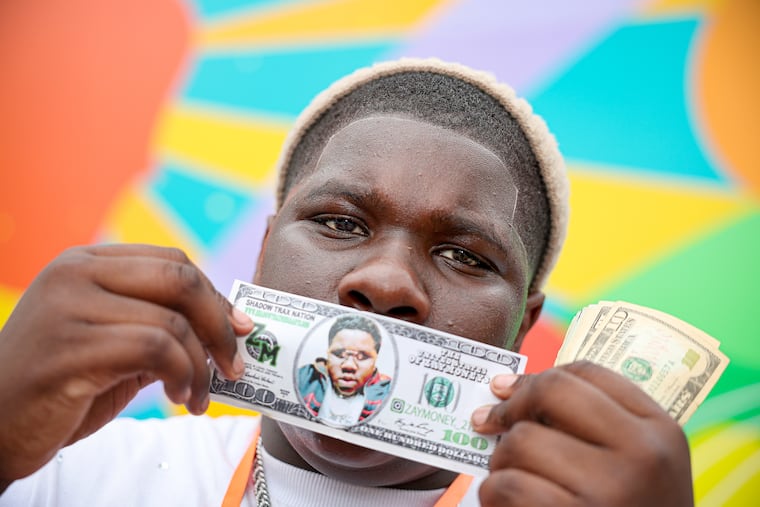
Before “Big Money,” Batiste told the crowd — which was considerably older and whiter than the diverse band on stage — that the song doesn’t endorse seeking a life of material riches, but rather is “about never selling your soul to silver and gold.”
Like many songs throughout the evening, “Big Money” mixed quiet moments with stand up and clap along ones, while referencing other songs essential to Batiste’s (and America’s) musical DNA. In this case, the nod was to Hank Williams’ “Hey, Good Lookin’.”
“Big Money” also contained a Batiste family life lesson: “You can be livin’ the life but not living the dream, it seems / Mama said ‘Don’t you be no dummy! Don’t go chasin’ that big money.”
And the song also contained a mantra that coursed throughout the terrific, spirit-lifting show: “Might as well live for something you can feel,” Batiste sang. “Might as well live for something real.”