Is falling asleep in a sound bath the hottest Philly health trend right now?
The practice traces its roots to ancient cultures but has seen a post-COVID uptick, driven by research that shows its health benefits.
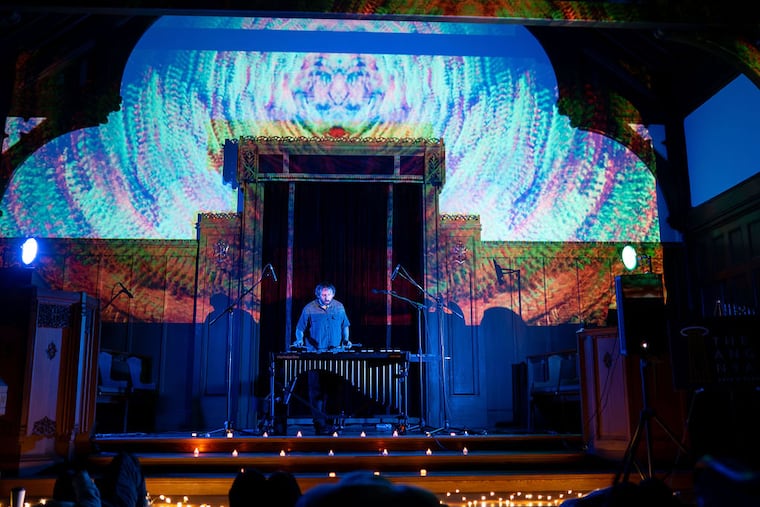
The crowd at Kensington’s Maas Building last weekend looked like a preschool class at nap time: about 30 people, shoeless and stretched out on mats and blankets arranged in neat rows on the floor.
Electronic musician C. Lavender performed for an hour to an audience that barely stirred. No dancing or moshing or grinding or rhythmic swaying. At any given time during the set of crashing gongs and throbbing synth drones, at least a few people were asleep.
It was an improvised piece, but it went exactly as planned.
Sound baths are a fast riser among recent health trends in Philadelphia, outgrowing the confines of yoga studios and wellness centers and now happening at performance venues, hospitals, public schools — even cat cafes.
The term describes a range of different ways a performer can immerse a person or group of people in sound for its medicinal properties, often (but not always) with acoustic instruments like gongs and singing bowls.
The practice traces its roots to ancient cultures around the world (including didgeridoos in Australia, musical arrangements in Greece, and vocal chants in China, Egypt, and India thousands of years ago) but modern science and experimental music have expanded the modes of presentation in recent years.
“Our bodies are mostly water. Those vibrations actually shake up what we are made of and can change the way we feel,” said Pete Angevine, who programs “Liminal States,” an ongoing series of concerts inspired by sound baths to foster deep listening and relaxation, for experimental music presenter Bowerbird.
What started off as an online series to help people fall asleep in the early days of COVID reemerged with an in-person performance by Hudson Valley-based vibraphonist Chris Dingman last December.
“A good friend of mine was there,” Angevine, a Fishtown resident, said. “A grown man who was weeping the entire time.”
Dingman picked up vibraphone as a music student at Wesleyan and got into sound healing while studying abroad in India. In 2018, during the last few months of his father’s homebound struggle with a terminal illness, he recorded improvised pieces so his father could play them even when he was alone.
“He was using it for pain management,” Dingman said. “Emotional and spiritual pain, because he wasn’t ready to die. There was a lot for him to work through.”
Individuals can book private sound baths with professional sound healers, but the public performances for larger audiences (which Dingman began doing in 2022) are becoming more common.
“It’s not just about going to sit quietly and watch someone do their thing and then leave,” Angevine said. “It really is supposed to be geared towards the listener.” From the start and through each performance in the “Liminal States” series, Bowerbird has found a cadre of listeners already geared toward sound baths.
“It’s encouraging that all we had to say was ‘sound-bath style performance’ and people really seemed to know what that meant,” Angevine said. “People showed up with mats and pillows.”
Longtime practitioner and sound healing researcher Jonathan Goldman, who lives in Colorado and founded the Sound Healers Association in 1982, said the last 10 years have seen “exponential growth in the awareness of sound as a healing modality and in particular in sound baths.”
The spike in popularity is driven in part by a growing body of scientific support for the health benefits of sound bathing. Research has shown that the vibrations of sound can lower heart rates, respiratory rates, and cortisol levels. In some cases, sound healing can alleviate chronic pain and mental health issues including anxiety, dementia, and PTSD, and it can be an especially enriching and engaging experience for neurodivergent children.
Physicians use tools like ultrasound and tuning forks to practice medicine through sound. Sound healers instrumentalize sound waves for more holistic outcomes, from releasing trauma to discovering a sense of purpose.
“When we’re in the state of health, we’re like this orchestra that’s playing the symphony of the self,” said Goldman. “If the third violin loses their sheet music, the entire section will begin to play out of tune, and then the entire orchestra.”
Sound healing, he says, is just about returning the sheet music to that flustered violinist.
“It’s ultimately trying to restore the person to their own innate level of healing, which sound is very, very good at doing,” Goldman said.
Lavender Suarez, a New York-based sound healer who performs as C. Lavender, has been making experimental music for 20 years. With a background in counseling and art therapy, and experience working with composer and deep listening pioneer Pauline Oliveros, she turned to sound healing about a decade ago and began studying under Goldman.
More recently, she began incorporating traditional healing instruments like gongs and singing bowls into her electronic music performances, which are separate from her sound healing work.
She has noticed the people at these shows are more open-minded and trusting. “Sound healing events have my favorite audience, because people are listening so intently,” Suarez said. “They’re really taking a chance to explore something within themselves.”
Dingman leads free sound baths over Zoom twice a month. When attending sound baths in person, people can feel a physical quality of the sound that’s tough to replicate with home speakers. Those who attend virtually, though, typically respond with some version of, “I didn’t think this would work, but it did.”
Dingman believes this is rooted in the melodic component of his performances, which he improvises based on the group’s vibe after a short discussion at the beginning of the session.
“There’s this energy that we’re all sharing,” he said.
For information on future sound bath performances, visit bowerbird.org