The (not so) secret Philly history of ‘The Gilded Age’
“You can’t tell the story of that era and not bring in Philadelphia ... it is the foundation of the Black elite.”
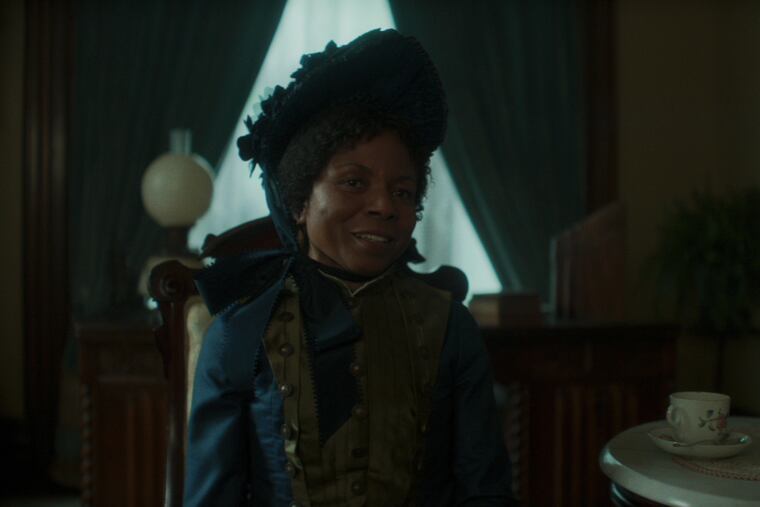
In HBO’s hit series The Gilded Age, the actor LisaGay Hamilton plays Philadelphia poet, abolitionist, and suffragist Frances Ellen Watkins Harper. In one scene set in New York in the season’s penultimate episode, she addresses an integrated room of high society women fighting for their right to vote in the posh Upper East Side home of the van Rhijns.
“As I’ve said in the past, we are all bound up together in one great bundle of humanity and society cannot trample on the weakest and feeblest of its members without receiving a curse in its own soul,” she says. “So, let us continue to make progress for the vote and for equality together.”
In this moment, Philadelphia history enthusiasts cheered.
The story of Harper, one of the first African American women to be published, is rooted in Philadelphia’s 19th-century free Black and abolitionist communities. A sought after speaker on the Colored Convention Circuit, she drew large crowds to her passionate speeches demanding civil rights for all in antebellum and post-Civil War America.
In this pop-culture moment, Harper may finally be taking her rightful place beside celebrated thinkers and orators of the time, like Frederick Douglass, William Still, and Mary Shadd Cary.
“She was just as famous as Douglass,” said Sherita L. Johnson, director of Penn State’s Africana Research Center, a Harper scholar, and co-organizer of Penn State’s Frances Ellen Watkins Harper at 200, a research symposium commemorating Harper’s 200th birthday this year.
“She helped lay the groundwork for generations of Black writers and activists who came after her, like Ida B. Wells and Paul Laurence Dunbar,” Johnson said. “There is no reason we should not know who she is.”
A Philadelphia legend
Harper — whose rowhouse at 1006 Bainbridge Street with a blue state historic marker in front of it — was born in 1825 to a Maryland family of educated, free Black people.
Her first book of poetry, Forest Leaves, was published in 1845 when she was 20 years old.
In 1854, she moved to Philadelphia and lived with abolitionists and Underground Railroad conductors William and Leticia Still, and began building her career as a speaker.
She married Fenton Harper in 1860 and lived in Ohio for a few years where her daughter, Mary, was born. After Harper died in 1864, she moved into her Bainbridge Street home, further immersing herself in Philadelphia’s free Black and formerly enslaved communities, the foundation of America’s Black society.
“You can’t tell the story of that era and not bring in the Philadelphia connection,” said Michiko Quinones, cofounder of the 1838 Black Metropolis, referring to The Gilded Age. “Philly is the foundation of the Black elite. It is the capital city. Black people from New York and Rhode Island are traveling to and from Philadelphia because of their connections there.”
Philadelphia as a ‘Gilded Age’ character
The Gilded Age is written by Julian Fellowes (Downton Abbey) and Sonja Warfield (Will & Grace and The Game). Historian, University of Pennsylvania graduate, and a Penn Towne Link, Erica Armstrong Dunbar is the HBO show’s executive producer.
Philadelphia has been a part of The Gilded Age landscape since the series debuted in 2022 with protagonists Peggy Scott (Denée Benton) and Marian Brook (Louisa Jacobson) meeting fortuitously at a Main Line train station en route to New York City.
The story centers on fictional high-society families: the van Rhijn/Brooks, the Russells — modeled after the Vanderbilts — and the African American Scott family. Real-life historical figures Caroline Astor, J.P. Morgan, Booker T. Washington, and T. Thomas Fortune add spice to the juicy plotlines revolving around loves lost, found, unrequited, and denied.
Scott is Agnes van Rhijn’s secretary. Her father, Arthur, escaped enslavement and settled in Philadelphia, where he started a pharmaceutical business and married Peggy’s mother, Dorothy, (Audra McDonald), a free Black woman. Arthur and his family move to New York and he opens a pharmacy in Brooklyn. But they travel to Philadelphia often.
The family is shown attending a church that looks very much like Philly’s Mother Bethel. They are connected to the Black elite in New York and Newport, R.I., where the doyenne of Black high society, Elizabeth Kirkland (Phylicia Rashad), rules.
By the mid-1880s, Scott, a graduate of the Institute for Colored Youth, is a journalist and aspiring novelist. Her character is a composite of several prolific Black writers of the era, including Ida B. Wells and society journalist Gertrude Bustill Mossell, the wife of Nathan Mossell, the first Black man to graduate from the University of Pennsylvania Medical school.
Both Wells and Mossell wrote for T. Thomas Fortune’s newspapers the New York Freeman and the New York Age. As does Peggy.
“Philly is ground zero for the abolitionist movement,” Johnson said. “By the 1880s, it was a well-established community of free and formerly enslaved people, central to the creation of Black society.”
Philadelphia’s community of educated Black women, Johnson continued, joined women’s clubs, led temperance movements, and worked with white women to secure women’s right to vote.
During the Jim Crow era, these Black women warned that Black Americans were on the verge of losing the rights gained during Reconstruction. Philly’s Harper led these movements and was one of the few Black women able to make her case in front of integrated audiences, the kind that gather in van Rhijn’s parlor in the show.
“Harper certainly would have been in those high society rooms,” Johnson said. “People like [Rep.] Jasmine Crockett and [journalist] Nikole Hannah-Jones are following in her footsteps right now as advocates for social justice in an era that’s eerily similar to post-Reconstruction.”
In celebration of Harper’s 200th birthday, the Colored Conventions Project will host virtual readings of her work. A mural of Harper at Greene Street Friends School in Germantown, created in partnership with Mural Arts, is scheduled to be completed this fall.
“She was so very important: her work, her speeches, her longevity,” Johnson said. “If you are talking about Philadelphia in this era and the work of women, you just have to mention Harper, you just have to.”
The season finale of “The Gilded Age” airs Sunday, Aug. 10, on HBO and Max.