Tapping into his own inner child
Nicholas Karabots' philanthropy is all for the children. "That's all I care about.
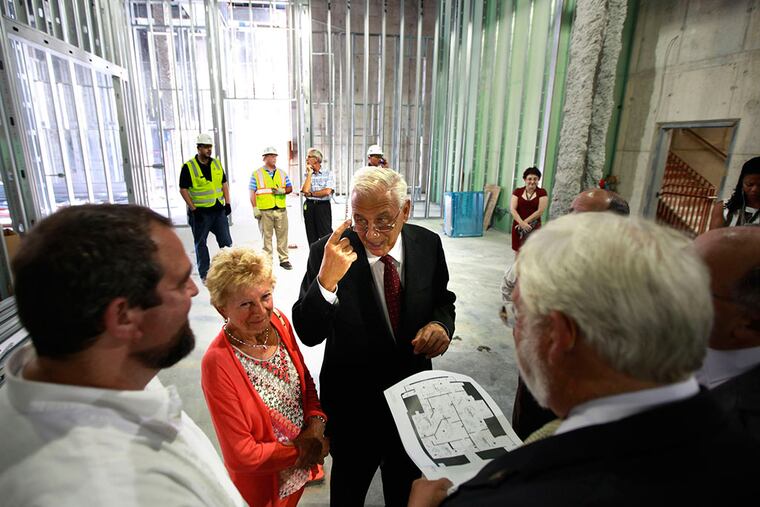
Nicholas Karabots is the man who doesn't have a particular passion for science who has nonetheless given the Franklin Institute $10 million - its biggest gift ever. He's not a huge fan of art, but is talking to the Philadelphia Museum of Art about funding a significant new program. He lives in sylvan splendor in the northwestern suburbs, but is mostly interested in the life of the city.
And yet the gifts being doled out these days by Nicholas and Athena Karabots - namesakes of the Franklin Institute's new wing - are anything but arbitrary. In each case the Karabotses' philanthropy, one way or another, benefits children. "That's all I care about," says Nicholas Karabots.
A tall, silver-haired 80-year-old prone to bear hugs and the occasional friendly headlock, Karabots wears his own inner child exuberantly. Somehow, when showing visitors his rows of grapevines, herds of sheep (plus a few swans), and impressive vineyard operation on 240 acres in Fort Washington, he isn't so much bragging as baffled that he has done so well for himself. After making his fortune in printing supplies, publishing, real estate, and other ventures, Karabots is having the time of his life making connections between who he was as a child and what he can do for children now.
"We are all products of our experiences," he says.
When he was growing up in the South Bronx - a gang member, he says - he remembers going to Lincoln Hospital and being treated "no questions asked," an experience that has translated into a recent $7.5 million for Einstein Healthcare Network facilities in Norristown and East Norriton, and $7.5 million for a West Philadelphia branch of Children's Hospital of Philadelphia, both to provide better access to medical care for underserved populations.
"Part of the deal is, anyone who comes to the ER, they have to give them service, and they send me a report every year of everyone they see," he says.
The Karabotses have funded the College of Physicians' Karabots Junior Fellows Program, which helps high school students on their way to becoming health-science professionals. Now, the University of Arizona is looking to emulate the program, and the Karabotses are in discussions with Philadelphia Museum of Art director and chief executive officer Timothy Rub about a similar program using art to spark as-yet-unkindled fires in the hearts of underserved youth.
"We are talking to Tim about trying to capture those kids who are on the verge of getting into trouble. That's the linchpin as far as I'm concerned," Nicholas Karabots says.
He and his wife previously funded the museum's purchase of a set of early Renaissance armor, and, once again relating the gift to his own childhood, he thinks of the arms and armor gallery as a means of entree. "When I was a kid I made my own gun. We made zip guns from car antennas."
As a bridge to greater possibilities, the College of Physicians program has already yielded impressive metrics. In the first two graduating classes of 24 young scholars, all have gotten into college. "That's unheard of," he says.
Their gift to help build the Franklin Institute's 53,000- square-foot Nicholas and Athena Karabots Pavilion was motivated by the chance to use science as a positive beacon "beyond what they see every day in their neighborhood," Karabots said.
Through the Pavilion's classrooms, its conferencing technology, and the ability to share, digitally, what it produces, "the Franklin Institute is on its way to projecting science in the city and outside the city . . . to encourage more interest in the field of science.
"I'm not looking to give these kids money, but to give them the insight that there is something more out there. Without education you can't do anything in this country."
Karabots doesn't fool himself into thinking he can heal society through art or science. Still, he says: "If you provide kids with the opportunity to open their eyes, some will take advantage of it."
215-854-5611