Style that's alive
For those who recognize his vibrant biomorphic style, the work of designer Marc Newson shows up everywhere.
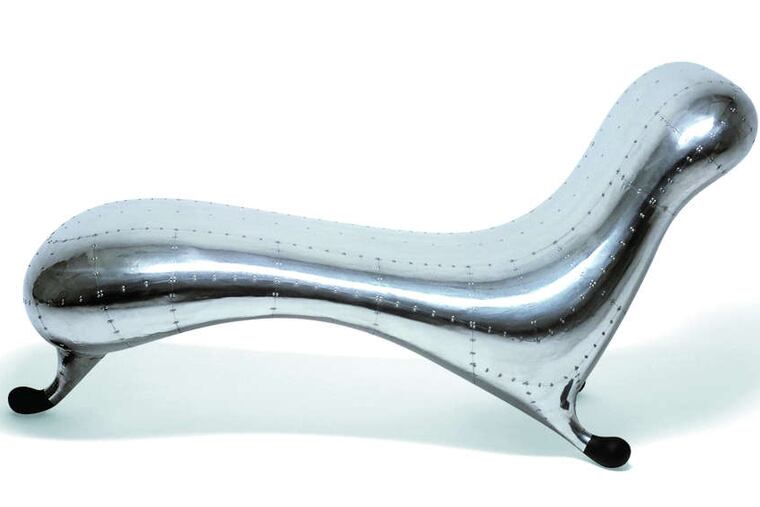
For those who recognize his vibrant biomorphic style, the work of designer Marc Newson shows up everywhere.
Justin Bieber wears Newson's star-spangled G-Star Galaxy hoodie. Qantas airlines passengers travel ensconced in his designs, including the first-class lounges, the plane seats, even the dining utensils. Kanye West tweeted a photo of Newson's Aquariva boat, adding, "I'm inspired to work harder now." And Newson's riveted aluminum Lockheed Lounge appeared in Madonna's 1993 "Rain" video, and made a cameo as a puppet-scale version in the 2004 film Team America: World Police.
Sought by a stream of prestigious clients, the Sydney-born, London-based industrial designer has the rare luxury of being able to turn away work. It's been that way almost since his career began in the mid-1980s.
The fruits of that charmed and prolific career are on display in "Marc Newson: At Home," the first U.S. exhibition of his residential products, which starts Saturday at the Philadelphia Museum of Art.
Appropriately exhibited as rooms in a 2,000-square-foot house - adult and child bedrooms, kitchen, living room, bathroom, and garage - each space contains pertinent contemporary items that sprang from the mind of Newson. The kids' room, for example, has his plastic modular Bunky Bunk Bed, the three-legged Embryo Chair, and the jousting-ready Rocky Rocking Horse. In the kitchen, there's a mustard-hued stove and hood made for Smeg. His fixtures for Caroma are in the bathroom. In the garage, a concept car for Ford.
Kathryn B. Hiesinger, curator of the exhibition, makes the case that "no one has designed a broader, more varied range of products than Marc Newson since the early days of industrial design in America, when Raymond Loewy boasted that he had designed everything from a lipstick to a locomotive.
"Even more importantly, it is not simply the range of Newson's work that distinguishes it," Hiesinger continues, "but the fact that it is invariably characterized by a diverse and highly innovative use of materials and processes."
While the exhibition presents an overview, Newson's body of work includes projects too large to fit on the first floor of the Perelman Building. His portfolio spans interior design, sea craft, and aircraft (even a jet pack). And although he often designs limited editions or one-offs such as a camera for Leica, he also has designed mass-marketed items like hairstyling appliances for Vidal Sassoon, and more recently, a home beer dispenser for Heineken called the Sub, manufactured by Krups.
With that much creative output across that many categories, one might assume he farms out projects to a team of underlings. But in fact, Newson, 50, consciously limits the size of his company to maintain control of designing "every single thing."
"The one part of the job I enjoy is designing stuff," Newson said. "Once that stops, I can't see the point in continuing. It's a very fine balance."
So how does someone trained as a designer understand the workings of, say, a jet pack?
Newson, a self-described "control freak," teaches himself.
Some designers just sketch something out on a napkin, but without understanding the engineering, "products won't look how you want them to look because that's what drives the design in many cases," Newson said. "It's not just the way something looks; if you can't understand what all these things do, what you present will be unrealistic and unachievable."
Newson credits his ambition to growing up in the 1960s and '70s.
"They landed on the moon when I was growing up," Newson said. "I was really convinced we'd be traveling into space by the time I was 50. I think that was a reasonable assumption, and that's what inspired me."
His travels have made their mark, too.
"It's all about finding different solutions for people, and different cultures provided different solutions for the same problem."
That diversity of experience means he doesn't lean heavily on one style, like midcentury, in creating modern silhouettes. For instance, inspiration for his 1987 Super Guppy Lamp came from a Japanese streetlamp, and the pattern for 2007's Voronoi Low Shelf was based on the diagrams of the 19th-century Russian mathematician Georgy Voronoi.
Originality is "always a big issue for people in design, but the reality is even the guys who were the midcentury modern designers were referencing things in the past, as well we all do, and it's important to and inevitable and impossible not to," Newson said. "If you're not referencing midcentury modern, it's minimalism or postmodernism and so on."
Even so, Newson has cross-referenced mediums for original outcomes: He designed footwear for Nike, then soon after, when working for Samsonite, realized how much the two had in common.
"Luggage and shoes are both abused and both come in contact with the ground all the time," Newson said, so he employed some of the footwear materials in his Samsonite designs.
With so many future projects in the pipeline, Newson confesses he can't remember them all. But off the top of his head: There's the eyewear collection, more aviation projects, and a "rather fantastic program" of office furniture with complex engineering for the Pennsylvania-headquartered furniture manufacturer Knoll.
"At the end of the day, I just want to have everything I've done," Newson said of what he chose for the exhibit. "There's nothing I've designed that I'm embarrassed about."