The Flyers are in Rick Tocchet’s ‘blood.’ Now he’s tasked with returning the once-proud organization to prominence.

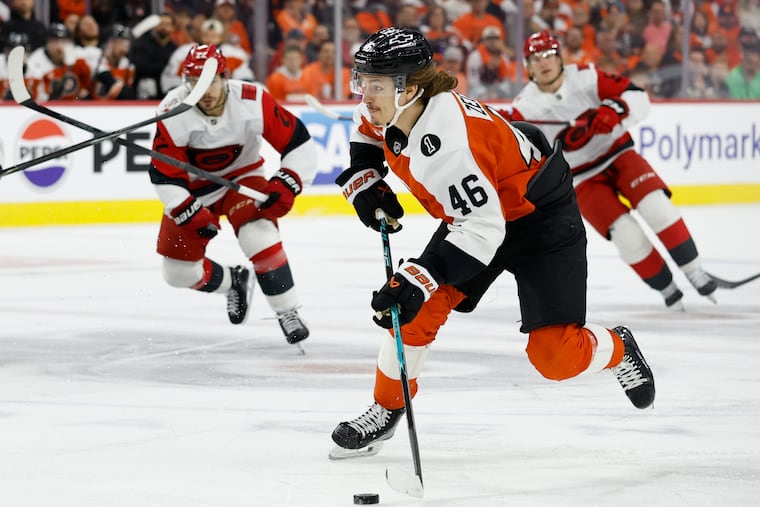
If you walked along the concourse at Xfinity Mobile Arena before the Flyers’ final preseason game this past weekend, you’d come across countless jerseys sporting names like Giroux, Couturier, Konecny, and Foerster.
Those are regularly spotted. But as the people weaved and bobbed through the traffic to grab some food and beers before the game against the New Jersey Devils on Saturday, they seemed to part like the Red Sea to make way for a few special jerseys.
There, among the sea of orange and black, were sweaters sporting No. 22, with an “A” or a “C” in the top left and “Tocchet” on the back.
“[My father] just said that he was, like, the best,” said Logan Bitner, a senior at Temple from Lancaster who was wearing his father’s Tocchet jersey. “He’s just his favorite player, so, had to rep the jersey.”
A member of the Flyers Hall of Fame, Rick Tocchet played 621 of his 1,144 NHL games on Broad Street, accumulating 232 goals, 508 points, and a franchise-record 1,815 penalty minutes across two stints. He was beloved and revered by the fans for his grit and in-your-face style but equally for his ability to put the puck in the net as a key member of Flyers teams that made several deep postseason runs, including trips to the Stanley Cup Final in 1985 and 1987.
The hope is that, after being hired as the organization’s 25th head coach in May, Tocchet can reestablish the once-proud Flyers’ winning culture and make the city fall in love with its hockey team again.
‘I owe that to them’
It has been a running theme since Tocchet was introduced as the new bench boss that he hasn’t spent much time in Philadelphia since he hung up his skates in 2002. He’ll quickly tell you it’s been 20-something years since he’s gone to Wawa and grabbed a coffee and a turkey hoagie.
And while it’s been even longer since he was a youngster driving over the Walt to play his first game at the Spectrum, orange and black still course through his veins. “For me, it’s a big part of my blood is the Flyers,” Tocchet told The Inquirer in 2023.
“Even though I’ve been gone for a lot of years, I feel gratitude,” Tocchet said last week. “There’s a little bit of humility and gratitude for the Flyers. I was an 18-year-old kid coming here. They helped me grow, helped my career, helped me become a man, and I owe that to them.
There’s a little bit of humility and gratitude for the Flyers. I was an 18-year-old kid coming here. They helped me grow, helped my career, helped me become a man, and I owe that to them.
“Who knows, you go somewhere else, [and] I wasn’t the most talented guy, who knows, could have been in the minors. I don’t know. So there’s, I guess, the gratitude,” he added, giving credit to Dave Poulin and the late Brad McCrimmon in particular for helping him after he was selected in the sixth round of the 1983 draft.
“And I want to be a part of the solution of bringing the Flyers back to dominance. It’s going to be a lot of work. It’s going to be hard, but I just want to be a solution.”
Tocchet knows this city. He knows how its heart beats and bleeds for his teams. He knows how alive the building can get when the Flyers are in the Stanley Cup playoffs and how electrifying it is when they reach the ultimate destination: the Final.
In his first NHL season in 1985, while playing under coach Mike Keenan — who, along with the legendary Scotty Bowman, he uses as a reference for his role today — the Flyers played in the pinnacle series, losing in five games to the vaunted Edmonton Oilers. Two years later, they were back again, pushing the Oilers to Game 7.
“I think the part that he played in Philadelphia was a motivating factor for him, because he knows what it was like when he was here,” Flyers president Keith Jones said. “Some of the success that they had — they went to the Stanley Cup Final a couple times — and he was involved in some really good teams here, and the feeling around the city was an awesome one.
“So that, I think, it benefits [us] in that regard that he wants to get the team back to that type of situation that he played in.”
Tocc the teacher
As of today, the Flyers remain in a rebuild. They are going “brick by brick,” as described in their motto, with the intention, according to Flyers general manager Danny Brière, of “not just to make the playoffs one year, get knocked out, disappear for two years. ... It’s about building a team that eventually will have a shot at winning some rounds and winning a Stanley Cup for years to come and be there year after year.”
And the 61-year-old Tocchet knows a thing or two about winning Stanley Cups; he has three, all with the Pittsburgh Penguins, including two as an assistant coach. He’s played with superstars like Wayne Gretzky, Mario Lemieux, and Jaromír Jágr, and coached countless others, including Steven Stamkos, Sidney Crosby, and Evgeni Malkin. And as someone who has filled several roles within a team from 40-goal scorer to fourth-line enforcer, he can relate to almost every player in a lineup as a coach.
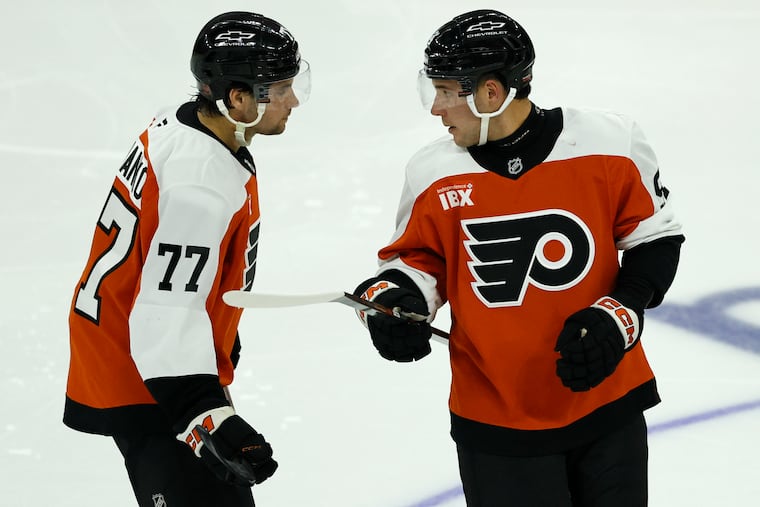
“If I make a play or I see something a certain way, then I might be able to explain it to him in a different way than other coaches, where he might be able to understand what I’m saying,” forward Travis Konecny said after the first day of training camp.
“Or he kind of sees it, and without even reacting, he kind of understands what’s going on. ... He’s legitimately been there, so he knows exactly how we’re feeling.”
Tocchet often has been spotted speaking to players for long stretches on the ice. He and Konecny spent time recently going over something along the boards — Konecny, when asked, said with a wry smile, “Top secret” — and the bench boss has spent time talking with and teaching anyone from rising star Matvei Michkov to depth defenseman Adam Ginning and grinding winger Nikita Grebenkin.
“I think that’s the worst part as a coach is going to a player all the time,” Tocchet said, using Michkov as an example. “You have to build a relationship where he’s comfortable to come to me, whether it’s [to talk about] a good thing, or a teachable moment, or something that he did wrong. It’s OK.”
Tocchet spends ample time speaking with his players and is excited to work with the roster. Long known for his open-door policy, he sees it as a partnership between himself and the team. He’s excited to work with a roster that he sees potential in but is embracing that he has to start from the bottom.
“You can’t put the roof up unless you have the foundation,” he told The Inquirer recently. “... We’ve got to build that foundation so it withstands hurricanes and withstands wind and rain and sleet and all the bad stuff that can hit a house. If you can handle all that stuff and it can still be standing, you know you have a good foundation.”
‘Protect the crest’
Tocchet and Michkov may have different roles on the team, but the two are extremely competitive and just want to win. In his introductory news conference, the young Russian dropped several times that he was “here to win,” while mentioning the playoffs and the Stanley Cup.
With the Flyers coming up on 51 years without drinking from Lord Stanley’s Cup and five without a sniff of the playoffs, it’s music to Philly’s ears.
“I was excited,” Northeast Philly native Tom Pacek, 64, said of Tocchet’s hiring. Pacek, a lifelong fan who now lives in New Jersey, was at the game with his son and grandson, Nathan, 4, who was watching his first game as a birthday present.
“I thought he’d be a good coach for this team, especially a young team that needs to grow. And I think he’ll bring some discipline to the team that they need to have as well.”
Some have questioned the return of yet another former Flyers player to a leadership position, as Tocchet joins Jones, Brière, and advisers Patrick Sharp, John LeClair, Bobby Clarke, Paul Holmgren, and Bill Barber. But the organization feels that the connection they have to the city, the fans, and the history of the team — and what it means to have a competitive Flyers squad — gives them an extra drive to bring the Flyers back to prominence.
“At the end of the day, the No. 1 priority is to find ways to win hockey games. But it’s pretty cool to be able to use the city’s vibes. And that’s, to me, what the logo represents,” Brière said in September.
“It’s the city; it’s the passionate fans that we have. I think if he can reach some players and instill that in them, I think it’s an advantage. I always say there’s not a lot of teams that can play to the vibes of the city, but the one place that can probably do it more than any other city is here in Philadelphia.”
It’s why Tocchet is so passionate when he speaks about the crest. To him, it’s not just a flying “P.”
“When you walk off a bus as a visiting team, I don’t know, there’s something about you play for the Flyers, it’s that crest,” he said. “You don’t want to disappoint the fans, but also, knowing, going into the other people’s buildings, like, ‘Hey, you’re going to be in for a rough night.’ That’s the city, right? They want the grittiness. They love the dominance when their team can dominate other teams. So, I don’t know, it’s in my blood.
“So, how do you protect the crest, right? You go in and you work hard; you don’t beat yourself. You battle for pucks. You’re a selfless guy; you protect your teammates. That’s how you protect the crest because if you don’t do those sorts of things, all of a sudden, you lose our identity and and then when you lose our identity, the crest gets weak.
So, how do you protect the crest, right? You go in and you work hard, you don’t beat yourself. You battle for pucks. You’re a selfless guy; you protect your teammates.
“So we’ve just got to build some armor around it. We have to build bricks around that thing and protect it. That’s what I believe in.”
The crest. The city. Philly’s blue-collar identity. The Flyers and their fans are ready to get back to work to become a contender again. They believe it starts with a player who embodies what it means to be a Flyer like Tocchet.
“When they announced it, I was like, ‘OK, new sheriff in town. That’s it. They’ll start playing like they used to, how when he played,’” said Joe Tocket, 65, who lives at the Shore and was at last Saturday’s game with his brother, Van, and two friends.
“... [Tocchet] said there used to be a time when people would look at their calendar and see a big ‘P’ on there, and they knew they were in for a fight. Here it comes again.
“Fasten your seat belts.”