The Flyers out to play with more ‘structure’ after a loss to the Jets in the midst of their homestand
There’s a saying in the NHL about team’s playing “a good road game,” which is how the Flyers described the visiting Jets on Thursday. Can the Flyers turn things around in their next two home games?
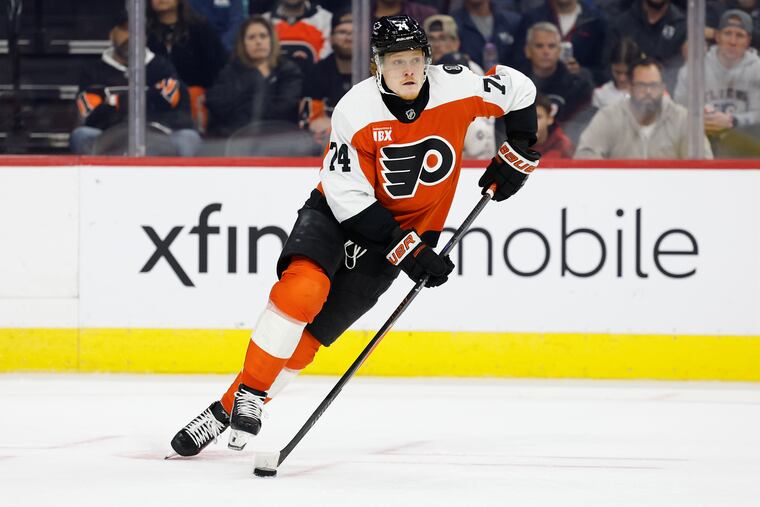
Standing in the locker room at Xfinity Mobile Arena after the Flyers’ loss, defenseman Cam York said of the visiting Winnipeg Jets, “They played a good road game.”
It’s a term heard repetitively in the NHL. Sometimes it’s the Flyers saying how they played a good road game. Other times, like on Thursday night, it is about the visitors.
So, with the Flyers amid a four-game homestand, and just one short trip to Ottawa on Thursday across the next eight games — including Saturday night’s matchup against the Minnesota Wild (7 p.m., NBCSP) — what exactly does a good road game mean?
“I think there’s a different mindset of, obviously, you want to play a structured game on the road, but I think it’s just harder because you don’t have the fans behind you, you don’t have the energy. So you’re kind of creating your own energy, in a sense,” said forward Owen Tippett.
“Look at Winnipeg, they didn’t do anything crazy, they were kind of simple. Didn’t really have too much going on. They just played a simple game and capitalized on their chances.”
Although some players quipped it’s just a saying, there is something to the idea of keeping it simple. While the general rule in hockey is that the starting line’s job is to get the puck deep and either get a goal or make the goalie create a stoppage, the Jets came out smothering and stopped the Noah Cates line — probably the Flyers’ best forecheck trio, which usually has an energetic opening shift — from getting anything going.
It set the tone for the night.
On Saturday, York called the low-event night against the Jets, with its limited attempts, shots on goal, and even chances, a “boring game.”
“When we’re on the road, we preach having a good road game,” he said. “We know that the home team is going to come out hard and aggressive and have a strong push, and [the road team will] make it as boring of a game as possible, I think.”
Added captain Sean Couturier: “[Winnipeg] sucked the wind out of the building. Honestly, there were no emotions, and I think you can tell we were getting frustrated; fans were getting frustrated.”
» READ MORE: Flyers takeaways: Owen Tippett and Matvei Michkov get going but turnovers prove fatal vs. the Jets
The keys to a good road game are starting to sound like a checklist: Keep it simple and low scoring; stay out of the penalty box and not give them free offense. In general, “don’t give them any opportunities, any freebies,” said Travis Konecny.
“You’re almost waiting waiting waiting instead of trying to force things,” Tippett added.
So what is the counter for home teams like the Flyers on Saturday night?
“You dictate play,” said coach Rick Tocchet. “Everybody has to play somewhat in structure. I mean, there’s creativity you want, but everybody’s got [to be] a little more predictable, everyone’s got to know where the puck goes, a little more speed. ... We’ve got to get to our game right from after the national anthem, not after 20 minutes.”
Added York: “I think if we can instill into their minds that it’s going to be a long night for them right from the start, that’s going to benefit us.”
Prospects flying
Five Flyers prospects faced off on Friday night in Boston, with Porter Martone, Shane Vansaghi, and Michigan State beating Jack Murtagh, Owen McLaughlin, Carter Amico, and Boston University, 4-2. According to the telecast, president Keith Jones, general manager Danny Brière, director of player development Riley Armstrong, and special advisors to hockey operations John LeClair and Patrick Sharp were in attendance.
Martone, the sixth-overall pick in June, is still looking for his first NCAA goal but had five shot attempts on Friday, including an absolute snipe off the pipe in the third period. He also had 14 penalty minutes, which included a 10-minute misconduct when he was called for roughing late in the game.
Vansaghi led the way as he consistently controlled the boards, was strong on the puck, and drove to the net. He had a game-high 10 shot attempts and tied teammate Maxim Strbák with six shots on goal, including one that found the back of the net.
As for the Boston trio, McLaughlin, who hails from Spring City in Chester County, was all over the ice and often mentioned on the ESPN2 telecast. Coach Jay Pandolfo put the North Dakota transfer back at center, and he was on the first power-play unit.
Amico is back in action after suffering a fractured kneecap that required two surgeries to be corrected early last season with the United States National Team Development Program and had a plus-minus of minus-1. And Murtagh had the biggest night for the Terrier trio, notching an assist on Sascha Boumedienne’s power-play goal.
They all meet again on Saturday at 7 p.m. (ESPN+).
» READ MORE: Boston University is the No. 1 team in college hockey. A trio of Flyers prospects are a big reason why
Breakaways
Dan Vladař gets the start in net as the Flyers continue to rotate goalies. ... The Flyers had some switches to the lines during morning skate — some of the time. Before they skated on the usual lines, it appeared that Couturier and Konecny now had Bobby Brink with them, and Matvei Michkov was skating with Cates and Tyson Foerster. Asked about it in his media availability, Tocchet asked: “Who broke it up?” He then added, “No. Maybe they screwed up or something,” with a smile before jokingly bringing up the old-school tactic that, “It was a smokescreen. Hopefully, Minnesota saw that.” ... Forwards Jett Luchanko and Nikita Grebenkin, and defenseman Adam Ginning are out with Rodrigo Ābols, Nic Deslauriers, and Egor Zamula in for them, respectively.