Erik Johnson almost joined the Flyers’ front office but gave TV a shot instead. Now at ESPN, he’s not looking back.
After 17 NHL seasons, the former No. 1 pick has proved to be ‘a natural’ on television and has been at the center of some of the most memorable broadcast moments this year.

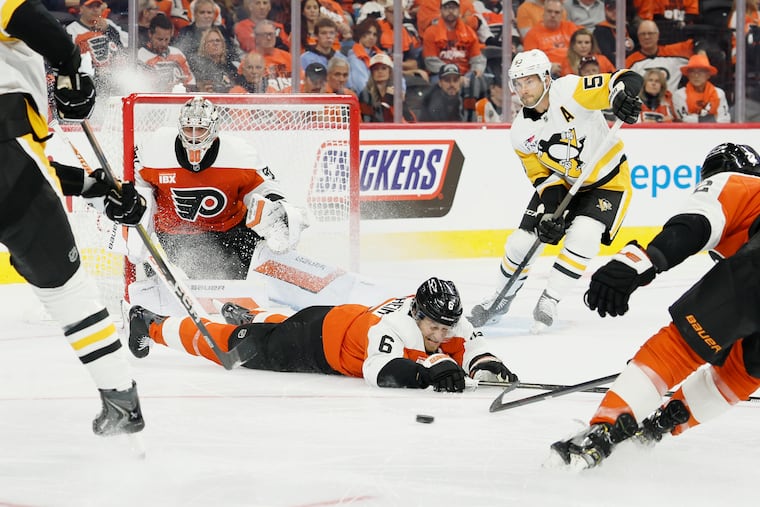
After retiring from the NHL in October, longtime defenseman Erik Johnson almost took a job in the Flyers’ front office.
But Johnson, 38, who spent parts of his final two NHL seasons in Philadelphia, knew that general manager Danny Brière and team president Keith Jones would wait a year for him if he wanted, so he decided to accept an offer from ESPN, looking at it as a one-year trial.
If he hated television, he could start working with the Flyers the next year.
“Keith Jones actually reached out to me after he heard one of my games, and he said, ‘Don’t do anything else. You’re right where you’re supposed to be,’” Johnson told The Inquirer. “For as long as he did TV, that was a good compliment.”
Johnson’s rise from calling local Colorado college hockey to becoming one of the primary color analysts on ESPN started in 2024 at the NHL’s broadcast boot camp. The training was a new NHL initiative that year to help teach NHL players the basics of television and introduce them to local and national broadcasters and executives.
NBC Sports Philadelphia’s Ashlyn Sullivan was one of the instructors and led a seminar on becoming a rinkside analyst. Even just from working with Johnson on the Flyers broadcasts, she noticed two things that few did: He always used her name when answering a question, and he would stay put until the interview ended.
“I’m so grateful [the players] give us our time, period, but normally they just run off, which isn’t the best look on TV because you’re standing there awkwardly,” Sullivan said. “E.J. always would stay in place, stay put until we went to commercial break, and hold his gaze into the camera. I was like, ‘Who teaches you these things?’”
» READ MORE: Stay or Go: Which Flyers players should return next season? Read expert opinions and vote.
Even when Johnson was a healthy scratch or playing few minutes for the Flyers, he gave his time to the social media team and to the broadcast, Sullivan said — although Johnson himself joked that he was always the guy trying to avoid doing media. But Sullivan knew before he started the camp that Johnson had the right personality and approach for TV.
“You just know with some players that they’re going to be good at this, and Erik was always that,” Sullivan said. “He was so charismatic. He’s got so much personality. … He gets it. He gets what hockey is trying to do, which is to add more personality to this and make hockey players more marketable to fans.”
Now, deep into his first year calling playoff hockey, Johnson is a “natural” on television, said play-by-play man Bob Wischusen. “There was hardly any learning curve with him.”
Johnson and Wischusen had never met before they were paired together in January as part of ESPN’s NHL coverage. Johnson works between the benches as a rinkside reporter and analyst to Wischusen’s play-by-play.
» READ MORE: Five questions for Danny Brière and the Flyers as they embark on their first offseason with expectations
Johnson has always been personable, so it was perhaps no surprise that he and Wischusen immediately clicked. Wischusen said it feels like they’ve known each other for years.
“We can goof on each other, and you very quickly realize that he’s someone that’s going to give it back as good as he gets, so we have laughs in that way,” Wischusen said. “I think it’s accelerated the relationship a few steps down the road.”
As a former player with over 1,000 career games, Johnson has that ability to break down the action for fans who possibly never played, Wischusen said. But he does it without dumbing down the product too much for those who have played.
“I’m asking a lot of questions I already know the answers to, but I have to ask them, because I know a lot of people that are watching don’t know,” Johnson said. “That’s a hard part as well. Sometimes I feel like I’m asking a stupid question, but it’s not stupid, because a lot of people find it interesting.”
» READ MORE: Flyers GM Danny Brière addresses Matvei Michkov’s benching, key offseason questions, and the team’s future
After 17 NHL seasons, Johnson also is well-positioned because of his personal relationships and understanding of players’ mindsets. The No. 1 overall draft pick in 2006, he already was well-known across the league, which provides a level of comfort to players and coaches he’s interviewing.
So it’s no coincidence that Johnson is responsible for some of the best TV moments this season, whether it was him chirping former Flyers coach John Tortorella or getting his allegedly fake tan criticized by former teammate Nathan MacKinnon.
Despite those personal relationships, Johnson said it isn’t hard to separate his friendships from the job.
“I know when a mistake is made — and I’ve made all those mistakes — so if I see it, I’m going to say it,” he said. “At the same time, if they make a great play, I’m going to see it and say it.”
» READ MORE: Rick Tocchet talks power play, Matvei Michkov’s ‘vengeance tour,’ and more at his end-of-season media availability
Occasional constructive criticism hasn’t impacted how beloved Johnson is around the league. The difference now is that a new audience of hockey fans gets to see why.
“He’s the best guy ever,” Flyers defenseman Jamie Drysdale said. “I’d imagine he’s one of the most-liked teammates among the league. He’s got the face for it, he’s freshly got the smile for it, new teeth, new hair, fake tan — he’s unreal. He’s got the good suits. He’s built for it.”