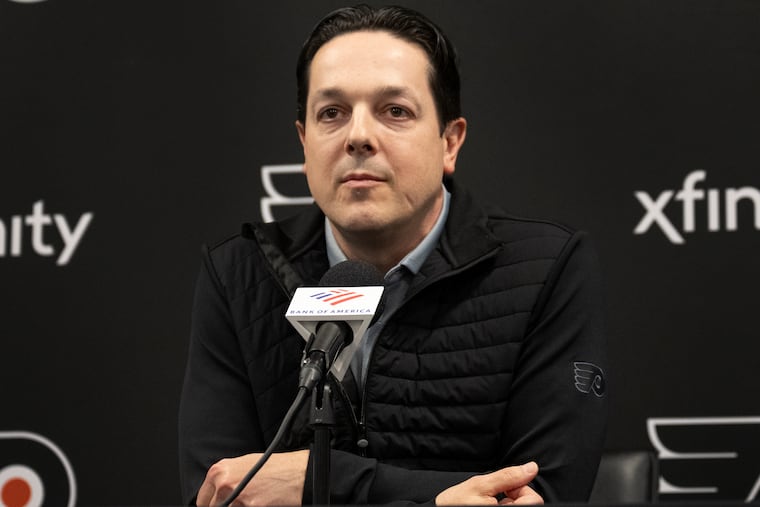
The Flyers largely stood pat at the recent trade deadline, making one significant move by shipping Bobby Brink to Minnesota for David Jiříček. As the team hits the homestretch, we caught up with general manager Danny Brière to talk about the team’s approach to the deadline, how he’d evaluate Matvei Michkov and Rick Tocchet’s performances this season, the team’s ongoing search for a center, and more. This is Part 1 of a two-part interview that was conducted Saturday.
Brière reiterated that the value wasn’t high enough to trade Rasmus Ristolainen and that his injury history was something that “teams were worried about.”
The GM called Matvei Michkov’s play since the Olympic break “really exciting” and said that everyone in the organization remains committed to helping him succeed.
Regarding the team’s search for a No. 1 center, Brière said the team is “always looking” but also believes the Flyers might be able to get away with having No. 2 centers due to the potential presence of “elite wingers.”
» READ MORE: GM Danny Brière on not trading Rasmus Ristolainen, adding David Jiříček, and the Flyers’ center void
The Flyers largely stood pat at the recent trade deadline, making one significant move by shipping Bobby Brink to Minnesota for David Jiříček. As the team hits the homestretch, we caught up with general manager Danny Brière to talk about the team’s approach to the deadline, how he’d evaluate Matvei Michkov and Rick Tocchet’s performances this season, the team’s ongoing search for a center, and more. This is Part 1 of a two-part interview that was conducted Saturday.
Q: How would you assess your trade deadline?
A: We’re happy with what we did. I’m on the inside, I know everything that went on. I know what the offers were. There’s a reason why it was a little mellow. I knew going in that we probably weren’t going to make a lot of noise. I’m OK with that. There are a lot of reasons for that as well. It starts with what we were talking about as far as the trade, the value. My job is to bring the most value to the organization. I’m not going to try to make trades just to please people. I have to make trades that make sense for the team and where we’re at at the moment.
» READ MORE: GM Danny Brière on not trading Rasmus Ristolainen, adding David Jiříček, and the Flyers’ center void
Q: There are a lot of questions about David Jiříček’s skating. Do you feel like that’s something the organization does well and can help him with, like it did with Bobby Brink and Tyson Foerster?
A: Absolutely. Yes, we do. And I think a big part of it, too, is his confidence. David is still a young player who’s trying to figure out his game. You give him some confidence — I’ve seen him play before — when he plays with that confidence, he’s a totally different player. … I lived it myself. It doesn’t always happen right away. There are only so many Macklin Celebrinis, and Connor McDavids, and Sidney Crosbys who figure it out at 18 years old, and they dominate right away. Most players go through some ups and downs. We’ve seen it with Trevor Zegras, we’ve seen it with Jamie Drysdale. There’s no guarantee, but we do believe that what we’ve seen in the past, that David has something special that can help us in the future.
Q: Rasmus Ristolainen did not get moved at the trade deadline. How do you foresee your future on defense with him still here? Are you planning on making other adjustments?
A: So having Risto around is going to help in that regard, and we’ll see where it goes. He’s a top-four defenseman, and honestly, there’s probably not going to be, and I don’t know that for sure, but there’s probably not going to be a big difference in the value [we got offered for him] next year than what we got this year. People have to realize that other teams are also aware that Risto was hurt for most of the year. He was hurt for the last part of last year. He was hurt and didn’t come back until December, and then got dinged up a lot. People do their research, other teams do their research, too, and it’s obviously something that teams were worried about.
Q: Because you have high-end wingers like Porter Martone, Matvei Michkov, Travis Konecny, and Zegras, does that ease the need for elite centers?
A: You might be able to get away with No. 2 centers, because down the road, you might have some elite wingers. It might be, how, at the end of the day, we’re built, and it gives you the freedom to maybe spend somewhere else. So it’s possible, but at the same time, we need our wingers to keep developing. But it’s obviously a nice luxury when you look at all the wingers that we have still in their early to mid-20s. I don’t think there are too many teams around the NHL that have a collection of wingers in their early 20s like we have.
Q: How would you assess Rick Tocchet’s first year as coach?
A: We’ve been happy with him. I’ve been happy with how he’s handling the young guys. The improvement that we’ve seen in Matvei Michkov alone. Like, people were really down on how the organization and the coaching staff handled Matvei. But if you watched him play the last little bit, it’s been really exciting to see more of his complete game come to the surface. That’s what I’m excited about. It wasn’t easy to get that in him, for him to understand, but I’ve been really happy with how he’s played lately, especially since we came back from the Olympic break. Down the road, we look at our young guys, how they’ve improved and are going in the right direction, playing the right way. I’ve been happy with, and not just Rick, I would say, the whole coaching staff.
» READ MORE: Grading Danny Brière’s trade deadline moves and decision to hold onto Rasmus Ristolainen
Q: There have been questions about Michkov’s ice time, his position, and his conditioning. How do you balance teaching him the hard lessons without stunting his development?
A: Yeah, it’s a fine line. And not just with him, with everyone, right? It’s always a question that comes back. That’s always what we’re trying to manage, especially with our younger guys. We always discuss that … Denver Bartkey is the same way. Like, where does he get the most? If he’s playing eight minutes a night here, is it worth keeping him here, but if he’s getting 13, 14 minutes? So we’re all always discussing those situations about all our young players. Where do you get the most development for the future?
The Flyers largely stood pat at the recent trade deadline, making one significant move by shipping Bobby Brink to Minnesota for David Jiříček. As the team hits the homestretch, we caught up with general manager Danny Brière to talk about the team’s approach to the deadline, how he’d evaluate Matvei Michkov and Rick Tocchet’s performances this season, the team’s ongoing search for a center, and more. This is Part 1 of a two-part interview that was conducted Saturday.
Q: How would you assess your trade deadline?
A: We’re happy with what we did. I’m on the inside, I know everything that went on. I know what the offers were. There’s a reason why it was a little mellow. I knew going in that we probably weren’t going to make a lot of noise. I’m OK with that. There are a lot of reasons for that as well. It starts with what we were talking about as far as the trade, the value. My job is to bring the most value to the organization. I’m not going to try to make trades just to please people. I have to make trades that make sense for the team and where we’re at at the moment.
» READ MORE: GM Danny Brière on not trading Rasmus Ristolainen, adding David Jiříček, and the Flyers’ center void
Q: Do you feel like the team is in a better place today than it was before the trade deadline?
A: Let’s be honest. You lose a top-nine forward who was helping for a defenseman who’s not here helping today. So in that regard, we didn’t help the team take a step to make the playoffs this year, and I’m aware of that. We make the trade to try to solidify our future. And when I looked at the standings, the six points are one thing, but having to also leapfrog so many teams makes it really tough. I hope that we’re never in that position again. It’s another year of that, and I realize that, but I also feel that we’re getting closer, and we’re moving in the right direction. And adding a guy like David Jiříček helps us for the future.
Q: There are a lot of questions about Jiříček’s skating. Do you feel like that’s an area the organization can help him with, like with Bobby Brink and Tyson Foerster?
A: Absolutely. Yes, we do. And I think a big part of it, too, is his confidence. David is still a young player who’s trying to figure out his game. You give him some confidence — I’ve seen him play before — when he plays with that confidence, he’s a totally different player. … I lived it myself. It doesn’t always happen right away. There are only so many Macklin Celebrinis, and Connor McDavids, and Sidney Crosbys who figure it out at 18 years old, and they dominate right away. Most players go through some ups and downs. We’ve seen it with Trevor Zegras, we’ve seen it with Jamie Drysdale. There’s no guarantee, but we do believe that what we’ve seen in the past, that David has something special that can help us in the future.
Q: You mentioned on Friday that you did not make Jiříček any promises regarding the NHL, but it’s well known that he wanted out of Columbus — which led to the trade to Minnesota — because he wasn’t getting NHL minutes. What was the conversation like with him? And how do you address it with someone who maybe doesn’t recognize that they need the development?
A: I think you bring honesty with him. I had a good, honest conversation with him when we talked yesterday, although it was relatively brief. I had a great, honest conversation with his agent later last night. Riley Armstrong and his staff are going to get into that. John Snowden as well, and eventually, hopefully, here as well. We’d love to see him play some games. I made no promises, but it would be great to see him in some games. But we also want to put him in a good position first, before that. So, we don’t see it as an issue. That’s all part of working with the player and making sure that he knows that we want the best for him.
Q: Rasmus Ristolainen did not get moved at the trade deadline. How do you foresee your future on defense with him still here? Are you planning on making other adjustments?
A: We’re always looking. We didn’t feel there was enough value to move him for what he brings and what he’s going to bring next year as well. And then when you look at like the young guys that we have, Jiříček, [Oliver] Bonk, who’s getting closer, Hunter McDonald is another guy who improved this year — you have to be careful when to bring them in, what kind of position you put them in to succeed. I think in a sense, you saw it with Drysdale; expectations were raised too high in his case. I don’t know if it was the case with David in his previous stop. Our goal as an organization is to put those kids in the best position to have a chance to succeed and not overload them with unrealistic goals.
So having Risto around is going to help in that regard, and we’ll see where it goes. He’s a top-four defenseman, and honestly, there’s probably not going to be, and I don’t know that for sure, but there’s probably not going to be a big difference in the value [we got offered for him] next year than what we got this year. People have to realize that other teams are also aware that Risto was hurt for most of the year. He was hurt for the last part of last year. He was hurt and didn’t come back until December, and then got dinged up a lot. People do their research, other teams do their research, too, and it’s obviously something that teams were worried about.
» READ MORE: Grading Danny Brière’s trade deadline moves and decision to hold onto Rasmus Ristolainen
Q: If you had a checklist, what’s the next box to check off? Center? Another left-shot defenseman in the top four? Goaltending?
A: One of the nice, I guess, luxuries that we have is when you have a guy like Travis Sanheim, who can play both left or right, that gives you so many more options and freedom to look at the right or the left, since he can move. We’re very fortunate there, to have our top defenseman have the ability to play both sides. So it’s not necessarily just right or left, so that opens the door to that. But, look, I don’t think it’s a secret that we’d like to add in the center position, but we’ve said it for years, the asking price for those guys is huge. We’re always looking, we just haven’t found the right fit for the right price.
Q: Because you have high-end wingers like Porter Martone, Matvei Michkov, Travis Konecny, and Zegras, does that ease the need for elite centers?
A: You might be able to get away with No. 2 centers, because down the road, you might have some elite wingers. It might be, how, at the end of the day, we’re built, and it gives you the freedom to maybe spend somewhere else. So it’s possible, but at the same time, we need our wingers to keep developing. But it’s obviously a nice luxury when you look at all the wingers that we have still in their early to mid-20s. I don’t think there are too many teams around the NHL that have a collection of wingers in their early 20s like we have.
Q: How would you assess Rick Tocchet’s first year as coach?
A: We’ve been happy with him. I’ve been happy with how he’s handling the young guys. The improvement that we’ve seen in Matvei Michkov alone. Like, people were really down on how the organization and the coaching staff handled Matvei. But if you watched him play the last little bit, it’s been really exciting to see more of his complete game come to the surface. That’s what I’m excited about. It wasn’t easy to get that in him, for him to understand, but I’ve been really happy with how lately he’s played, especially since we came back from the Olympic break. Down the road, we look at our young guys, how they’ve improved and are going in the right direction, playing the right way. I’ve been happy with, and not just Rick, I would say, the whole coaching staff.
Q: Speaking of Michkov, were you surprised by his comments that he said he was much happier on the right side? And was the shift to the left side because you had a glut of right wingers?
A: That’s part of it, but I think the coach liked him better on the left. And I don’t think it was anything in Matvei’s response that he was trying to send a message. I think you were just listening to a 21-year-old being honest because he has a history of playing on the right side. That’s all he said. I didn’t really take it as much more than that.
The way he’s playing now, it’s really refreshing, and he should be happy with how he responded, especially going through — because he got caught in that storm too, not just me and Rick and the organization, but Matvei too. I’m sure it was challenging for him to go through all that. But, again, you think about all the things that … this person … has gone through already in his life. It’s pretty amazing how strong he is. We all want him to succeed.
» READ MORE: Sielski: Acquiring David Jiříček is the latest example of the Flyers’ unorthodox approach to rebuilding. It’s worth the risk.
Q: There have been questions about Michkov’s ice time, his position, and his conditioning. How do you balance teaching him the hard lessons without stunting his development?
A: Yeah, it’s a fine line. And not just with him, with everyone, right? It’s always a question that comes back. That’s always what we’re trying to manage, especially with our younger guys. We always discuss that … Denver Bartkey is the same way. Like, where does he get the most? If he’s playing eight minutes a night here, is it worth keeping him here, but if he’s getting 13, 14 minutes? So we’re all always discussing those situations about all our young players. Where do you get the most development for the future?