‘When do they kiss?’ and other NHL playoffs basics for bandwagon Flyers fans
Everything new Philadelphia Flyers fans need to know about the NHL Stanley Cup Playoffs and hockey basics.
Let me guess, the Flyers are doing well, all your friends are wearing orange, and you’ve suddenly decided you want in.
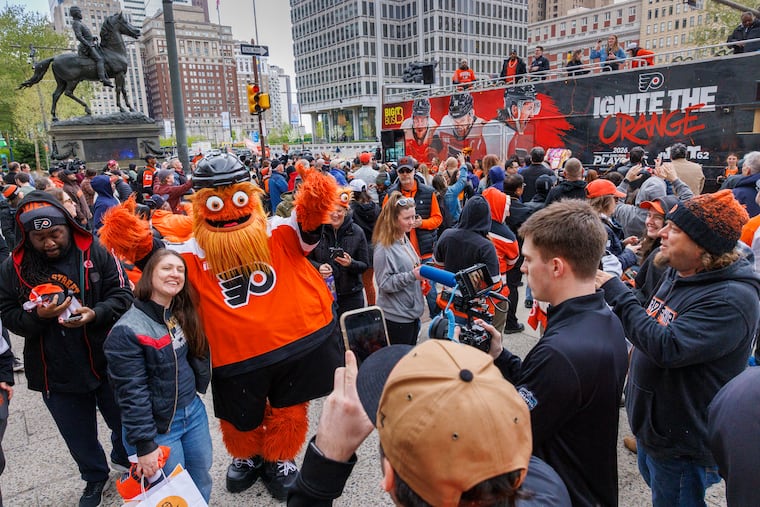
You’re a “hockey person” now, despite no prior interest or knowledge of this game aside from what you’ve seen in Heated Rivalry and the fact that Gritty exists.
It’s OK, you’re not alone — Google search trends reflect a spike in folks trying to understand how hockey works and what the playoffs entail.
This one’s for the novices.
I know nothing about the sport of hockey, please help me
OK we’re starting with league basics: The NHL is short for National Hockey League and the league has 32 teams.
Those 32 teams make up two conferences (Eastern and Western) with 16 teams each, and four divisions (Metropolitan and Atlantic in the East; Pacific and Central in the West) with eight teams each.
As for the game itself, hockey is really just soccer but with sticks and skates (if you don’t know how soccer works, we have some work to do).
Teams are made up of three forwards, two defensemen, and one goalie — and they rotate out often (every 30 to 60 seconds), meaning you’ll see a lot of skaters going on and off the bench throughout the game so they stay fresh.
Games begin with a starting play, the dramatic faceoff at the center of the ice that you’ve probably seen in Heated Rivalry or The Mighty Ducks. The players use their sticks to pass, shoot, and control a puck. It’s a fast-paced, intense game with a lot of action.
There are three 20-minute periods and whoever scores the most goals wins. But if there’s a tie, which happens pretty often in hockey, then the game goes into overtime.
During the regular season — not the playoffs, we’ll get there later — overtime means five additional minutes of gameplay with three skaters and a goalie on each team. Whoever scores the first goal wins and the game is over. If no one scores after those five minutes, the game goes to a shootout (again, like soccer and penalty kicks), with skaters facing off one-on-one against the opponent’s goalie. It’s best-of-three. If a shootout stays tied, teams then attempt to score one at a time. This keeps going until there’s a winner. The first team to score without allowing a goal in the same round wins.
In hockey, there’s also a penalty box — very literally a timeout chair for players who did something wrong — where players sit and wait for a set amount of time, leaving their team short a player, as punishment for breaking a rule. Penalties, and the amount of time a player has to wait it out in the box, vary by severity.
A minor penalty lasts two minutes and is usually for offenses like tripping, hooking, high-sticking, or generally roughing up another player. This is also when “power plays” happen, aka a time where one team has an advantage on the other because one or more opposing players are serving time in the penalty box. In most cases, once a team scores on a power play, the penalized player can return to the ice.
A major penalty results in five minutes in the box. It usually happens when there’s a fight big enough that it interferes with gameplay. In cases like this, both teams lose a player to their respective penalty boxes (and there’s no power play). There are also double-minors, which are four minutes, and misconduct penalties (10 minutes).
You should know that there are a lot of fights and general physicality in hockey.
It’s part of the culture. It’s a scrappy, messy game, as you may have seen with Team USA Olympian Jack Hughes’ famous bloody toothless smile during the Winter Games. Truly, it’s very normal and NHL team dentists stay very busy.
Those are the most basic of basics. If you want to get more into it, or learn what icing is (besides the sugary topping on a cake), the NHL has an AI bot programmed to answer “Hockey 101″ questions.
Who are the Philadelphia Flyers, exactly and are we any good?
The Flyers are the city’s NHL team, part of the Metropolitan Division in the Eastern Conference. The team was founded in 1967 as part of a league expansion, and they play at the Xfinity Mobile Arena (as do the 76ers).
The team built a reputation throughout the 1970s for being extremely physical and intense, gaining the nickname the Broad Street Bullies.
The team colors are orange, black, and white. Over the years, they’ve won 16 division titles, eight conference championships, and two Stanley Cups.
Without getting too into it, the team has seen many highs and lows. Getting into the playoffs this year marks the end of a five-year drought for the team.
The last time the Flyers won the Stanley Cup was 1975. So, it’s been a while.
Where does Gritty come in?
Before Gritty, there was short-lived mascot named Slapshot in 1978. Slapshot was out by the next season.
And then everything changed. In 2018, the Flyers brought on Gritty, the giant orange weirdo the whole city is rightfully obsessed with.
We’re gonna assume you know who Gritty is because honestly, we couldn’t explain him if we tried. He’s just a vibe, OK?
What’s the best way to prove I’m a Flyers fan right now?
You’re wearing lots of orange, you’re listening to Olivia Dean’s “Man I Need” and Van Halen’s “Ain’t Talkin’ ‘Bout Love,” and you’re talking a lot of smack.
Some key players to know include Porter Martone (the rookie rising star), Travis “TK” Konecny (the scrappy tone setter), captain Sean “Coots” Couturier (the seasoned vet), and Dan Vladař (the goalie who Philly currently loves, which isn’t always a given).
» READ MORE: How did Olivia Dean’s ‘Man I Need’ become the Flyers’ victory anthem?
When in the game do the players kiss?
If this is why you’re suddenly excited about hockey, I have bad news: This isn’t Heated Rivalry and there’s no designated period for kissing during gameplay.
This NHL season marked the first since the debut of the hit Crave original/HBO Max series, Heated Rivalry, which features hockey! And also a lot of steamy sex scenes!
Some teams have embraced the overlapping interests more than others. In Philly, Flyers staff caught onto the hype, playing “All the Things She Said” by t.A.T.u. (which marks an important scene in the series) in the arena. The Flyers have also hosted Pride nights for several years.
How do the playoffs work, specifically?
The Stanley Cup playoffs happen every year after teams finish their regular 82-game season.
Sixteen teams — the top three teams in each division plus the next two best in each conference — make it into the postseason.
It’s also worth noting that the teams that don’t make it into the playoffs get elevated draft picks for the following season (in Heated Rivalry, that’s how historically bad fictional teams scored Ilya Rozanov and Shane Hollander).
In the playoffs, teams play each other in a best-of-seven series, with the first team to win four games advancing to the next round. The teams that advance all the way to the Stanley Cup Final will play in four rounds.
Importantly, playoff overtime is different from regular-season overtime. Playoff overtime continues with full 20-minute periods of 5-on-5 hockey until someone scores a “sudden death” goal. No 3-on-3’s or shootouts. This means a game can keep going for hours until someone wins.
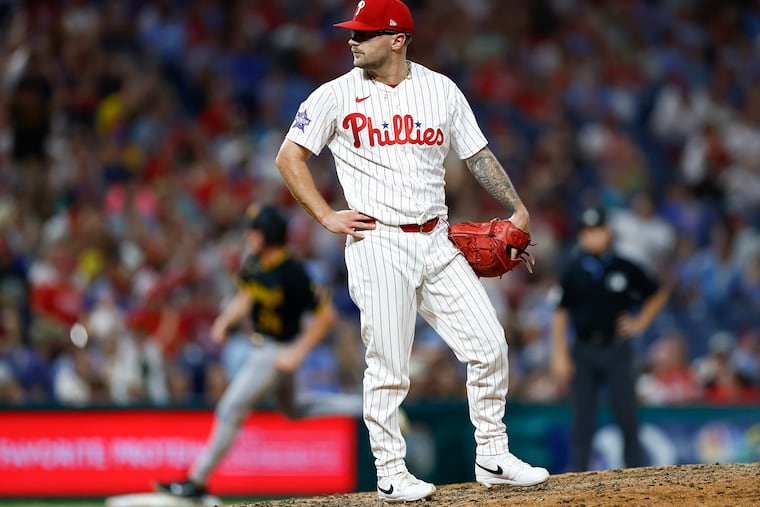
In 2000, the Flyers faced off against the Pittsburgh Penguins with an overtime that lasted five periods (92 minutes and one second) before the Flyers won. In the first round of this year’s playoffs, the Flyers’ decisive Game 6 overtime win against the Penguins took just one extra period.
When a team finally wins the Stanley Cup Final, they get to hoist the big ol’ Stanley Cup over their heads and take victory laps. (Winning would also mean a parade, but let’s not jinx things.) The team gets all their names engraved on the trophy. It’s a big deal.
Where are the Flyers in the playoffs now?
The Flyers just advanced to the second round of the playoffs after their spicy “revenge” series, beating their Penguin rivals 4-2.
It’s the first time the Flyers won a playoff series in a non-COVID-19 bubble year since 2012 with fans able to attend and enjoy the moment.
Next, they’ll play the Carolina Hurricanes. The Flyers won the last regular-season game they played against the Hurricanes in April, but Carolina, the East’s top team, was resting several players.
How can I watch playoff games?
Tickets for Round 2 have not been made available on the Flyers website, but are available on secondary sites like StubHub starting at $350.
If you’re looking to watch from home instead, all Stanley Cup playoff games will air on ESPN, ESPN2, TNT, or TBS. Since the second-round schedule has not been announced yet, the TV assignments are also unclear. We’ll provide an update once it’s announced.
Keep up with The Inquirer’s Flyers coverage via www.inquirer.com/flyers.