Two harsh lessons the Flyers need to learn, and quickly, from Tuesday’s loss to the Capitals
If the Flyers want to continue their push for the playoffs, they will need to heed the warnings from their 6-4 loss in Washington.
WASHINGTON ― There are valuable lessons to be learned for the Flyers as they head down the stretch.
Isn’t that what this time of year is about for a young team anyway? Learning how to play in meaningful games. Learning what is needed to be not just a playoff team but a playoff team that succeeds.
It’s about forcing personal growth through trial and error. And about taking those teachable moments, learning from them, and applying what has been learned.
The Flyers have eight games left and are just two points out of the second wild card in the Eastern Conference and three back of the third spot in the Metropolitan Division. With a win on Tuesday, they could have jumped into a playoff spot.
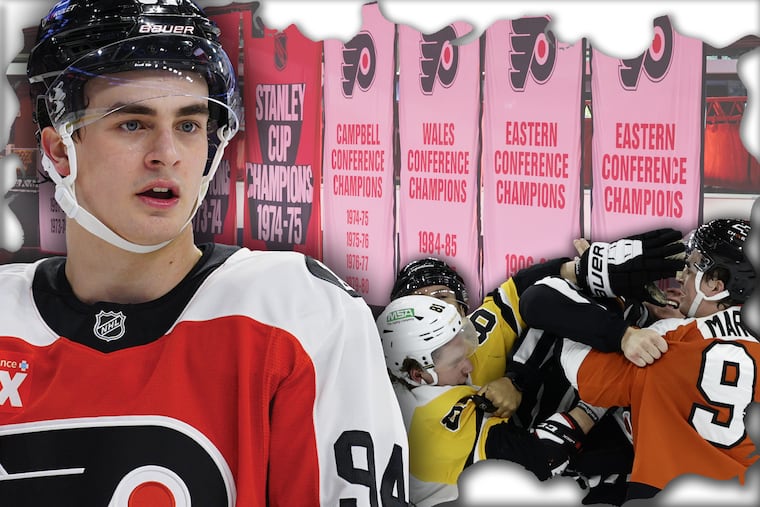
» READ MORE: Flyers’ playoff push and Porter Martone’s debut spoiled by Alex Ovechkin and the Capitals in 6-4 loss
Instead, they need to heed the lessons of failure from their 6-4 loss to the Washington Capitals, because while everything the Flyers do is built on long-term growth, if they want to be a playoff team this year, they must apply them fast.
Here are two big lessons the Flyers learned Tuesday that they can easily correct down the stretch.
1. Stop taking bad penalties
This is an ongoing theme for the Flyers, dating back to the last two seasons at least. Penalties happen, and each team will assuredly commit them on a given night. There are good penalties, like taking down a guy on a breakaway. But it’s the bad penalties, the avoidable ones, that can crush a team.
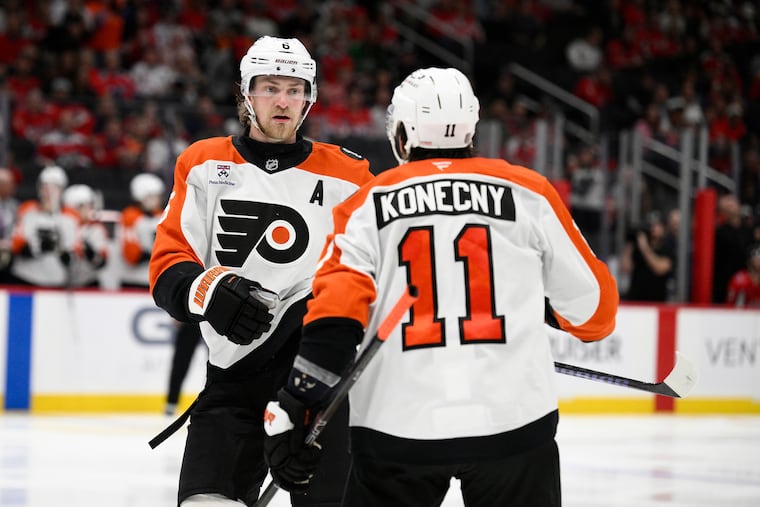
On Tuesday night, those types of infractions caught up with the Flyers big time when Travis Konecny and Trevor Zegras each took offensive-zone penalties. Granted, it looked like Konecny was reaching for the puck and off balance, but he still tripped Anthony Beauvillier for a minor. And Zegras, who leads the team with 14 penalty minutes in the last six games — which is also tied for 17th in the NHL since March 21 — was called for tripping Pierre-Luc Dubois (who, the more I look at it, may have embellished slightly).
Regardless, the referees are going to call it, and the result was two power-play goals by the Capitals after the Flyers had battled back to tie the score at 2.
“Me and Zig are going to own it,” Konecny said. “I can’t take that penalty 200 feet from my net; it’s unacceptable. It’s just hard to climb back into a game twice in a row down two goals.”
The penalty kill had been better of late, going a perfect 9-for-9 the last four games after allowing at least one power-play goal in nine of the previous 10. The Flyers now have the 25th-ranked penalty kill in the NHL since the Olympic break (75.5%).
“That’s good that he takes responsibility,” coach Rick Tocchet said of Konecny. “But we just can’t take those stick penalties, they’re killers. I’ve got to give the team credit, we’ve been really disciplined with the penalties. When we were in January, that’s the ton of penalties we were taking, so we’ve got to nip it in the bud.”
2. Start on time
The Flyers did not come out of the gate raring to go, especially when you consider the magnitude of Tuesday’s game.
“They came out the first 10, 12 [minutes], and tried to bully us, and [I] thought after that we started to get our game, but it’s good for some guys to understand that they’ve got to be ready to go,” Tocchet said.
In a physical game that saw the teams combine for 59 hits, with the Flyers actually having the 34-25 upper hand, the Capitals started things off with four crunching checks before the game was three minutes old.
And while the Flyers did balance it out, the hits they took often could be heard way up in the rafters and the press box.
» READ MORE: Porter Martone is going from NCAA freshman to an NHL playoff race. That precedent is rarer than you think.
“Right from the drop of the puck, it felt like a playoff game,” said rookie winger Denver Barkey, who captained London of the Ontario Hockey League to the Memorial Cup in June. “Bodies were flying. It was an intense game, fast-paced, and playoff-style game.”
“It’s a good experience,” he added. “It’s a learning curve. A lot of this stuff’s a learning curve coming up to playing the NHL. But I think games like this really help teach you what it takes to win the big games and continue to push for the playoffs.”
Tocchet felt his team played better as the game wore on, and it did, tying the score at 2, then making it 4-3, and, lastly, 5-4 with more than 12 minutes to go. And while the Capitals didn’t score during that opening 10-12 minute spell, they didn’t allow the Flyers to get going.
Two years ago, the Flyers stalled down the stretch in a season that saw them finish with 87 points — the first time they broke 80 since the COVID-19-shortened 2019-20 campaign, which was also the last time the Flyers made the playoffs.
This year, they are trending in the opposite direction, having won 12 of 17; however, they just can’t seem to get past a three-game winning streak, something the organization last did in February 2024.
“It’s exactly what you’re going to see in the playoffs, and teams are going to come hard, be physical, and sometimes you’ve got to just take a hit to make a play,” defenseman Travis Sanheim said. “I thought as it progressed, we handled it much better than we did early on.
“I thought we struggled with it, let the emotions get to us a little bit, and then gathered ourselves, started to play better, and then just gave up those two on the power play that really hurt us.”
» READ MORE: Porter Martone grew up in Canada rooting for the Flyers. He’ll make his NHL debut with them on Tuesday.