Porter Martone’s fast start with the Flyers was forged in Michigan State’s gym: ‘The best decision I ever made’
With the extra off-ice training time that the NCAA schedule allows, Martone put on 12 pounds of muscle and dropped 3% body fat. Flyers GM Danny Brière described it as going "from a teenager to a man."
The drive from East Lansing, Mich., to Peterborough, Ontario, is about 5½ hours.
But the Martones had barely left the borders of the Michigan State campus after a recruiting visit last spring with men’s hockey coach Adam Nightingale and his staff before Porter Martone spoke up.
“When we left there for the ride home, he said if he’s going to play college hockey, that’s where he was going to play,” Mike Martone, Porter’s father, told The Inquirer last week.
“It was just the impact that they had during that moment, and it was a great decision. He grew as a person, grew as a player, and it’s a great program there at Michigan State.”
» READ MORE: Porter Martone has made an instant impact, and his Flyers teammates say they’re not surprised
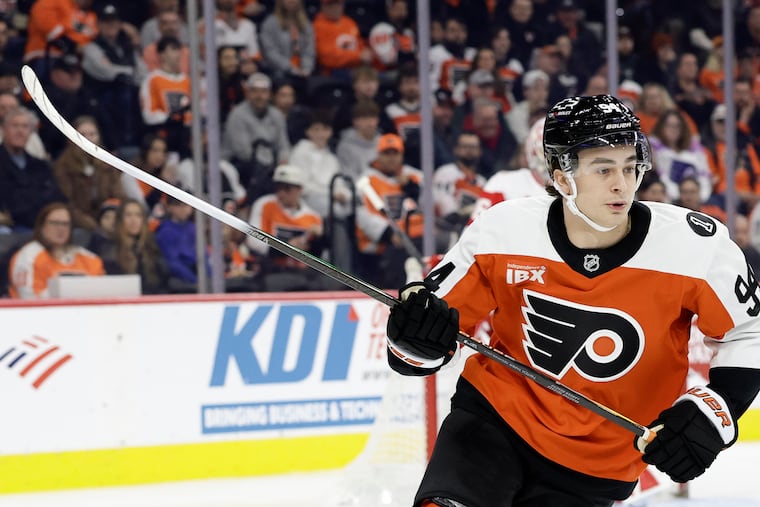
Nine months after he was drafted No. 6 overall by the Flyers, the Martones — dad Mike, mom Angela, sister Audrey, Mike’s parents, and an uncle — were in Washington to see Porter Martone make his NHL debut on Tuesday against the Capitals. They were in Philly two days later, with even more family, including Angela’s parents, to see him record his first NHL point against Detroit at Xfinity Mobile Arena. On Sunday, Martone scored his first career NHL goal, an overtime-winner in Philly against Boston, which lifted the Flyers into a playoff spot with five games to play.
“I think that’s a compliment in the fact that I didn’t notice anything during the game,” Travis Konecny said Tuesday of Martone’s debut.
“He plays the right way. He’s a sponge. He asked questions before the game, and you go out there, and he’s just doing the right things that we talked about before. So he seems to take in info, and he’s able to apply it right away.”
Martone’s hockey IQ, playmaking skills, and scoring touch have never really been in doubt. But at Michigan State, the winger leaned into playing a grittier, more abrasive style, all while showcasing his uncanny nose for the net. The result was a more physically dominant and well-rounded player.
“I look back, and I guess the best decision I ever made [was] to go in there to Michigan State,” Martone said last week. “I have a ton of thanks to Adam Nightingale and the whole staff there.
“They did a tremendous job developing me. ... I think I learned so much as a player, in the gym, created pro habits, and I really learned what it’s like to be part of a winning culture and winning team there.”
‘The best of both worlds’
You couldn’t miss Riley Armstrong’s excitement on the other end of the phone line last week.
The Flyers director of player development described Martone’s freshman year at Michigan State as “his coming-out party.”
Martone racked up 61 assists compared to 37 goals in his final year of juniors for Brampton of the Ontario Hockey League. But when you look at his Michigan State stats — 25 goals, 50 points, and 78 penalty minutes in 35 games — you can see how he became more balanced offensively, upping his goal scoring while maintaining his high-end playmaking.
He also changed his game in another way.
Compared to juniors, from where Martone was drafted, college hockey has fewer games — he played 57 regular-season OHL games and six playoff games in his draft year — and they are usually on the weekend.
“I’ve always said that there’s things you get out of junior playing in the CHL that you don’t get out of playing college and that there’s things you get out of college that you don’t get out of playing junior,” said Mike Martone, who played a handful of games in the American Hockey League and won a Kelly Cup with Mississippi of the ECHL in 1999.
“So fortunately, with the rule change, he was able to get the best of both worlds. And I think he’s going to be better for it in the long run.”
The “better for it” is showing already in the NHL. The NCAA schedule gives players ample time to hit the gym, and because of that, Martone transformed his body in preparation for the rigors of the league.
“We’re in the weight room four days a week, and we practice hard,” said Nightingale in January. “There’s really no light days, and I think we owe it to our guys to take a long-term approach to their development.
“And it’s not just in the weight room, it’s lifestyle, right? It’s eating the right way, and fortunately, we’re supported really well, where our guys have two really good meals at the rink each day.
“Your body’s your ticket,” he added, “and the more you can build it when you’re in college, the more you’re going to be ready to be a pro.”
» READ MORE: Porter Martone is going from NCAA freshman to an NHL playoff race. That precedent is rarer than you think.
The Spartan Way
After the Spartans beat Penn State at Pegula Ice Arena in late January, Martone was busy cooling down in the hallway with Will Morlock, the hockey team’s director of athletic performance. He stretched and rode the bike, ensuring that he was ready to go in less than 24 hours for the outdoor game at Beaver Stadium.
“My philosophy is, kind of, everybody does everything, but everybody does different amounts of it,” Morlock told The Inquirer after the Spartans won the outdoor game.
“So some guys may spend more time on body comp and getting bigger. Some guys [spend] more time on getting stronger. Some guys just maybe [focus on] lighter, faster, they need more mobility-focused.”
The Spartans would usually be off on Sunday, but “Monday’s the day to kind of get them going. Tuesday, [we] really push them, kind of come down after that on Wednesday, and then Thursday is a shorter day, but kind of rev them up before we play again,” explained Morlock of the weekly workout schedule.
Martone has called Morlock, who also works with a nutritionist, “a game-changer.” Listed at 6-foot-3 and 214 pounds, the 19-year-old power forward added 12 pounds of muscle and dropped 3% body fat as a freshman.
“So we measure body comp. So we look at: Is that weight? Is it muscle mass, or is it lean weight, or is it fat?” Morlock explained.
“We look at things from a performance standpoint ― speed, power, they’re all relative. So it’s making sure relative to the body weight, they’re still explosive, they’re still strong, and it’s weight that’s actually benefiting them and not holding them back.”
On-ice results
The results weren’t given; Martone had to do the work. Nightingale instills a mindset with his program that it doesn’t matter where you were drafted; you need to earn your playing time.
“The way he’s developed physically, that was the biggest reason for encouraging the move to the NCAA this season. To have a kind of a stepping [stone] from the OHL to the NHL, developing his body, getting stronger,” Flyers general manager Danny Brière said last week after Martone inked his entry-level contract.
» READ MORE: Porter Martone grew up in Canada rooting for the Flyers. He’ll make his NHL debut with them on Tuesday.
It was all part of the plan, because although Mike Martone tells his son to “be where your feet are,” he also says, “you never know what’s coming next.” And everything the younger Martone did was building for his future.
“You could see, over the course of the year, his first three steps improved, his power improved just within his skating, just in one year,” Armstrong said.
The hard work to improve his skating was done both in the gym and on the ice. Martone and the training staff worked on plyometrics, short acceleration, hip projection — explosive forward motion during sprinting or acceleration to generate horizontal force — rotational, multi-planar movements — like lunges with rotational twists — medicine ball exercises with fly-outs, and pushing sleds.
“It’s such a variable sport, we need to prepare for that variable demand,” Morlock said. “So the best way to do that is to train in a way that kind of gives them a good toolbox.”
But there was also an on-ice component to strength and conditioning.
“I think probably the best way to do it is actually doing it on the ice. [It] is high quality, even lightly resisted acceleration, sprint work on the ice, because that’s where the game happens,” Morlock said. “So all these things off the ice support that, and unless you really address it on the ice, I think you can’t assume it transmits from one to the other. But off the ice, you know, plyo, short sprints, loaded sprints, basic things like that.”
Ready for the show
The Flyers consistently checked in on Martone the past year. Team Hall of Famer John LeClair, who is a special adviser in hockey operations, greeted Martone after the first game at Penn State in January.
The teenager also talked to Armstrong at least once a week, whether via text or Zoom, to go over videos of what the Flyers saw and wanted him to improve on. Armstrong’s son, Ezra, often popped on to chat about gear. “They’re both gear nerds,” Armstrong joked.
The communication jumped to three or four times via Zoom during the two weeks of the World Juniors, where Martone captained Canada to bronze.
“All of them really touched in with me throughout the season, and it was great,” Martone said on Monday. “They were there for me anytime I need [a] question [answered], anytime you [want to] talk something, they’re a phone call away.
“And whenever they come to Michigan State, [we] go out for dinner, and you just chat about things, life, and hockey. And it’s just great always being in touch with the Flyers organization.”
Through strength and conditioning and learning how to be a pro, including improving his nutrition and sleep schedule, as well as the Zooms and in-person chats, the Flyers saw Martone grow into an NHL-ready player.
» READ MORE: Resetting the Flyers’ future: Which prospects beyond Porter Martone and draft picks are on the way?
The decision to go to Michigan State — and all that extra time in the gym that came with it — is paying immediate dividends. Martone has fit in so seamlessly with the Flyers through his first four games that it is easy to forget he doesn’t turn 20 until October. The right winger, who has a whopping 20 shots on goal through four games, has a goal and three points thus far for a team right in the thick of a playoff race. Martone’s also become an instant fan favorite at Xfinity Mobile Arena thanks to his heroics on Sunday.
“I’ve got to give a lot of credit to Michigan State,” he said on Sunday. “What they did with me this year really translated my game into kind of a pro style.”
After a year of work on the ice, Martone has stepped onto the game’s biggest stage and quickly opened eyes. But the message is clear, it’s been the work off the ice that has made the biggest difference as he goes up against the NHL’s best.
“I think the amount of time he spent in the gym, you can see in his body how it’s changed,” Brière said. “It’s almost going from a teenager to a man.”