Flyers make more tweaks to the power play; Jon Cooper discusses Travis Sanheim’s Olympic chances
Ahead of the Flyers' contest against the Tampa Bay Lightning, Cooper, who is also the head coach of Canada, had some nice things to say about Sanheim and Rick Tocchet.

TAMPA BAY — Look, a power play isn’t expected to score every single time. It would be nice, but it just doesn’t happen.
The best one in the NHL right now has a 32% effectiveness, which means the Pittsburgh Penguins roughly score every three opportunities. Currently, the Flyers’ power play sits at 17.5%. The unit’s not last in the NHL — that belongs to the New York Islanders (13.3%), who the Flyers face on Black Friday (4 p.m., NBCSP) — but it does rank in the lower-third (23rd).
And while the Flyers’ power play struggled before and during the John Tortorella era, the ranking is all-too-familiar. Although the current coach, Rick Tocchet, thinks it’s in a good spot, it can be better.
“Everybody wants plays, but sometimes it’s good old-fashioned beat pressure and then attack, and we’ve got to get that mentality, and we’re close, but we’ve got to keep working,” he said on Saturday morning, adding two days later that he wants his players to play inside more.
Entering Monday’s matchup with the Tampa Bay Lightning (7 p.m., NBCSP), the Flyers have 10 power-play goals. The last one came five games ago against the Edmonton Oilers — they are 0-for-8 since — and Tocchet said his units may be more interchangeable.
» READ MORE: The Flyers’ power play has improved from previous years. Trevor Zegras is a big reason why.
Practice on Friday had four more players involved, and on Saturday night in the Flyers’ 6-3 win against the New Jersey Devils, new power-play units were deployed.
Another tweak came on Monday in Florida.
One power play has Noah Cates, Travis Konecny, Tyson Foerster, Trevor Zegras, and Cam York. What? York and Zegras reunited? Makes a whole lot of sense that the two former USA Hockey teammates are together; York has been on the ice for eight power-play goals this season — just one without Zegras.
Konecny was also switched to that unit, and while he has played a lot on the left flank the past two seasons, he is back to his familiar bumper spot.
“I feel a little bit more comfortable in there. I feel like I can make quick little plays, be fast on loose pucks, and recovery, stuff like that. … On the power play, I got to know my strengths. And I think it’s, I don’t have the hands that Trevor has,” Konency said with a grin, alluding to Zegras’ effectiveness on the right flank to draw in defenders, create space, and find seams.
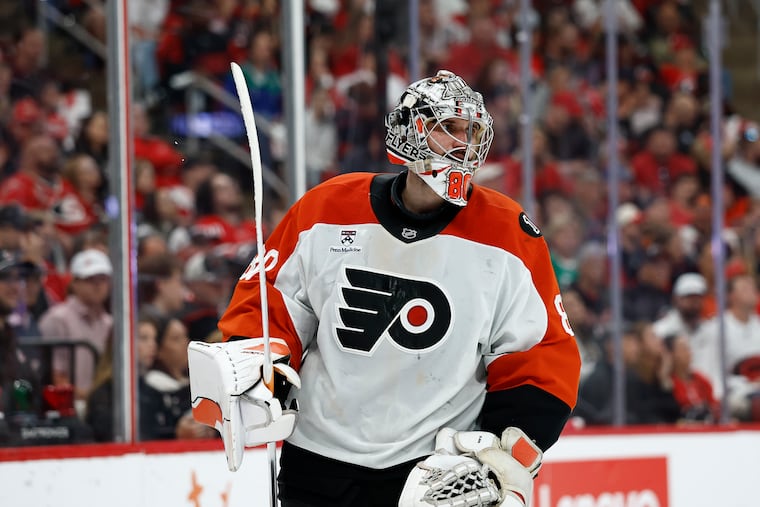
The other power play has Travis Sanheim, Emil Andrae, Owen Tippett, Bobby Brink, and Matvei Michkov. No center? “It’s interchangeable,” Tocchet said.
Sean Couturier will be on the ice when there is a face-off, but when they switch units “on the run” or on the fly when play is happening, that is the unit that will be on the ice.
It’s also interesting having two defensemen, with Sanheim being more of the pointman and Andrae on a flank. Tocchet thinks Andrae is not only good with the puck but “his shot’s pretty good,” too. The Swedish defenseman, who has been moved to the second pairing, knew that he had to build up trust with the new coaching staff, and it looks like he has.
“I like to be on the power play,” Andrae said. “I like to make those plays, and like to use my vision and my passing to create chances. So obviously, it boosts my confidence to know that the coaches rely on me on that side of the game. So, yeah, just make the most of it.”
Sanheim, who hasn’t spent much time on the man advantage in his career, is looking forward to the opportunity. It’s something he’s “always wanted to add to my game.”
“I think they’ve been doing a pretty good job in trying to grasp some of the structural components of what they’re trying to get across,” said Sanheim, who has been able to watch a lot of the power plays this season from the bench.
“And I think it’s just continuing to make those reads and understanding certain situations, depending on how the penalty kill is structured. And, maybe that’s a benefit, I guess, [being on the penalty kill] so much and understanding what the other team’s doing and trying to exploit some of the weaknesses that come with that, and, in saying that, [I] just want to have an attack mentality and deliver pucks and hopefully do a good job of doing that.”
» READ MORE: What’s a bumper? Here’s a closer look at a key to power-play success for the Flyers.
Canadian pride
Speaking of Sanheim, the defenseman is continuing to build a strong case to be part of Canada’s team at the 2026 Milan Olympics. No pressure, but the guy on the other bench on Monday night just happens to be the one making the decisions. Lightning coach Jon Cooper will be Canada’s bench boss in Italy, but a plus for Sanheim is that they’ve already worked together, snagging a gold medal at February’s 4 Nations Face-Off.
“You see these players, you compete against these players, but you don’t really know till you have them. And I’ve always, I’ve really liked his game,” Cooper told The Inquirer about Sanheim. “I’m a big fan of big D that take up a lot of space, and can skate, and he can do all those things. But his ability to jump into plays, he’s got an offensive mind to him.”
Sanheim seemed a little nervous and wide-eyed at the first practice in Brossard, Quebec, with Hockey Canada ahead of the 4 Nations. And while he didn’t start the tournament in the lineup, by the end — half due to injury and half due to his play — he was not just skating in the championship game but got the first shift of overtime. The familiarity and his ability to play both the left and the right side will help Sanheim once decision day comes.
“Anytime that you get to coach players, and you win with players, I always think there’s a familiarity. Past performance isn’t going to predict future success, and so the guy’s got to keep working, but he’s done a heck of a job so far,” Cooper said.
» READ MORE: Flyers prospect Jett Luchanko traded to Ontario Hockey League favorites Brantford
There’s another familiar face for Cooper on the Flyers bench. Tocchet was his assistant coach at 4 Nations and will be beside him again in Italy, making his Olympic debut.
Tocchet did a lot of the structure, faceoff planning, and in-game adjustments; he was a jack-of-all-trades for Cooper. But what Cooper loved most was how he would often meet with players 1-on-1 or in small groups to watch videos — over a garbage can. As Tocchet explained later, he would put his laptop on a garbage can and go over things, much like he did in his days with the Penguins. His assistants on the Flyers do it now, too.
“I couldn’t have surrounded myself with a better guy,” Cooper said. “I will tell you this, because his eye for the game and what happens in real time, having that talent is a real thing. And Tocc has that. He sees it, he processes it, and then gives you the information.
“And there were countless times at the 4 Nations that he made me think of things, or I saw things in a different light, or I missed something, and he caught it. And so many little adjustments we made in between periods, because of what Tocc did.”