Is artificial turf bad for us and our kids? How to navigate the turf wars.
Industry groups say it's environmentally friendly and safe, but researchers and environmentalists point to chemical compounds that adhere to skin and leach into waterways, and call recycling rare.
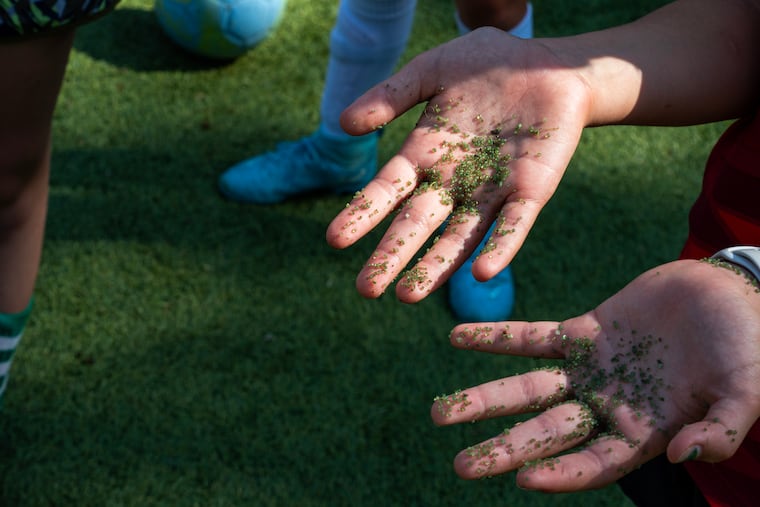
Yale epidemiologist Vasilis Vasiliou won’t let any of his five children play on artificial turf fields.
His research on the infill for synthetic turf — typically ground-up tires — identified the presence of dozens of known carcinogens, hormone disrupters, toxic metals, and phthalates. What’s really needed, he said, are rigorous studies showing the extent to which those chemicals find their way into young players’ bodies and what that might mean for their health over time.
Until then, Vasiliou said, “I would not recommend parents let their children play on there. Period.”
Given how fast we’re replacing grass with turf, it’s safe to say Vasiliou’s views remain in the minority. North America has about 18,000 synthetic turf fields, with about 1,500 new ones added each year. If kids want to play soccer, football, or lacrosse, chances are good they’ll be playing on plastic grass.
The turf industry pitches its product as a way to save money and extend playing time, while pointing to studies that show no link between artificial turf and health problems in children. “Synthetic turf is a safe and highly effective surfacing option that provides accessible year-round play, lowers maintenance costs, and reduces water needs and herbicide and fertilizer use,” Melanie Taylor, CEO of the Synthetic Turf Council, wrote in an email.
But skeptics like Vasiliou say existing studies weren’t designed to capture the potential health and environmental risks of toxins in turf. Critics also question turf’s alleged advantages over grass, especially its alleged cost savings.
So how should a community decide what to install on new fields — or whether to rip up what they have? And how can worried parents decide if their kids should play on turf?
Here’s how to navigate the turf wars.
More playing time, except when it’s hot
Synthetic turf made its professional debut at the Texas Astrodome in 1966. The dense nylon carpet was then rolled out at stadiums across the country, eventually swapping out its Monsanto brand name ChemGrass for AstroTurf.
The updated version that has taken root on youth playing fields is essentially a plastic layer cake. First, a gravel, asphalt, or concrete base is topped with a shock-absorbing pad. Next is a backing layer that anchors “grass” fibers made of polypropylene, polyethylene, or nylon. Finally, several tons of loose infill are dumped between the blades.
Most commonly, that infill is “crumb rubber,” made of ground-up tires, with a typical field requiring about 40,000 tires. But as some local governments, including Washington, D.C., have banned crumb rubber, alternatives have emerged, including coated sand, cork, nutshells, and coconut fibers.
One of the winning arguments for turf has been that it doesn’t end up muddy after rain or snow, which expands potential playing time — as much as 3,000 hours per year compared with 1,200 or so for even the best grass fields.
But hot weather is a big problem. Turf absorbs heat from the sun, while lacking grass’s ability to transpire water to cool off. That means playing time can be limited in the summer and especially during periods of extreme heat.
When Washington Post reporters visited Barcroft Park in Arlington, Va., on a 94-degree day last week, a thermal imaging camera showed the turf to be significantly hotter than both grass and asphalt, measuring above 142 degrees.
Hot turf has been known to melt cleats. It can also burn skin and contribute to heat stroke and heat exhaustion.
Once turf temperatures rise above 120 degrees or so, many schools and local governments ban or restrict activities. That means that on hot summer days, some expensive turf fields are available only in the early mornings and evenings. Night games and activities, said one sports facilities manager, are the only way to make these fields economical relative to grass, which can generally be used all day.
New field designs using water-cooling systems and organic infill materials such as cork or engineered wood may help — but those measures add to the cost.
What’s known about the other health risks of turf
Many synthetic fields, especially those using crumb rubber, contain PFAS, lead, phthalates, cadmium, benzene, nickel, chromium, and arsenic. Among those ingredients are several known carcinogens and endocrine disrupters.
But so far “very limited evidence” links synthetic turf use to adverse health outcomes, according to a review published this year in the journal Epidemiologia. A 2024 Environmental Protection Agency study found “a range of chemicals” associated with recycled tire crumb rubber in the air, on surfaces, and on the skin of participants, but the study did not detect elevated levels of those chemicals in their bodies.
What does this prove? Not much, argues Yale’s Vasiliou. Neither of those studies drew conclusions about the health risks (they were not designed as comprehensive epidemiological studies) and both explicitly cautioned against doing so.
According to the Children’s Environmental Health Center at the Icahn School of Medicine at Mount Sinai, the research remains “inconclusive” with “significant gaps in the evidence supporting the safety of artificial turf products.” Given these uncertainties, the group “strongly discourages” artificial turf playing surfaces.
Turf saves water but adds waste
The Synthetic Turf Council calls the industry “environmentally friendly,” citing lower water and pesticide use, along with the diversion of more than 20 million tires from landfills.
But critics such as the Sierra Club and European Union have flagged turf as a significant source of microplastics released into the environment. Academic studies have found artificial turf fibers floating in nearby waterways. And mountains of plastic waste associated with synthetic turf end up in landfills and other dumping sites.
Turf fields are known to have limited life spans, but it is hard to find options for recycling their materials. When I wrote Target Technologies International, one of the few U.S. firms that accepted turf for recycling in the past, the company said expensive container shipping rates meant it was “no longer cost effective.” An investigation last year by the Boston Globe also discovered that allegedly “recycled” fields were abandoned in warehouses.
The Synthetic Turf Council would not share the percentage of turf fields recycled in the United States annually, but it pointed to operations by companies such as TenCate Grass. The firm responded by email that its Louisiana facility had received more than 100 fields and “successfully completed a pilot program, processing more than 50 fields.” That’s the same number announced in 2022, equivalent to about 7% of the more than 750 fields estimated to be retired annually in the United States. “We are actively continuing our recycling efforts,” wrote TenCate spokesperson Erica Rumpke, “and will continue to accept and process fields.”
How to decide between grass and turf
Jeff Graydon managed a mix of artificial and grass fields at Princeton University for two decades. What surface would he want his own children to play on? “A well-maintained grass field,” he said.
If you’re calculating up-front costs, grass is almost always cheaper. While turf generally costs well above $1 million per field, grass fields range from $200,000 to $800,000, depending on their quality.
But Graydon, who now helps schools and cities decide on turf and grass, said maintaining natural grass to withstand constant use can send costs soaring — especially in the Northeast, where the weather isn’t ideal for year-round grass. Many organizations, he said, feel they have little choice but to turn to turf. “Synthetic turf provides opportunities for play,” he said.
While health and environmental risks remain, Graydon said that “synthetic turf has come a long way since the first field was built” in the ’60s.
Irvine, Calif., recently spent more than $4 million building two synthetic turf fields expected to host hundreds of games each year. To address health and environmental issues, wrote Alex Salazar, the city’s acting deputy director of public works, it replaced synthetic infill materials with a “100% mix of coconut fibers and other organic materials” and incorporated an irrigation system for evaporative cooling and high-efficiency washing.
“While the initial investment for converting grass fields to synthetic turf is higher,” Salazar wrote, “the long-term benefits, such as significantly reduced maintenance costs and the ability to increase usage time, ultimately make it a more economical choice.”
But Irvine is an outlier. Roughly 85% of synthetic turf fields in the United States still use recycled tire infill, as do many playgrounds.
What should you do if you or your kids can’t avoid artificial turf? The U.S. Consumer Product Safety Commission recommends washing exposed skin afterward, limiting play on very hot days, and avoiding eating or drinking beverages while directly on synthetic surfaces.
On hot, sunny days, frequent water breaks will take you only so far on turf. Parents and coaches need to learn to watch for early signs of heat exhaustion. And we’ll need to get used to the idea that sometimes it’s just too hot to play.