Could bees help relieve stress? A Temple researcher thinks so.
Frances Ratay was among those in the Temple-led research who saw improvements in wellbeing, as her fear of bees transformed into a greater appreciation for nature. "It makes me feel worthwhile."
Dozens of bees crawled along the frame in Frances Ratay’s hands as she looked down at the colony in awe.
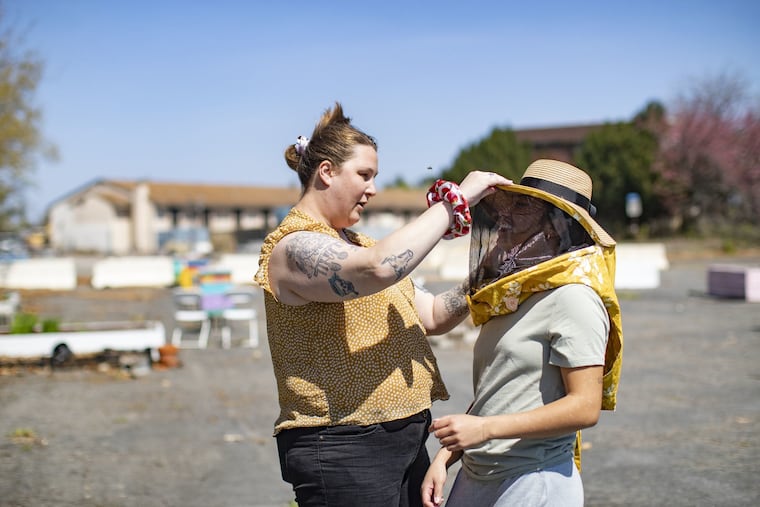
The 70-year-old retiree from South Philadelphia ordinarily would avoid bees out of fear, but this spring she suited up for a study on therapeutic beekeeping at the Half Mad Honey apiary in the Navy Yard. Led by Temple University occupational therapy student Meghan Robertson, the project tested if beekeeping could improve mental health and well-being in older adults.
Research has shown that exposure to nature can reduce stress and anxiety; however, less is known about the effects of beekeeping. Previous studies connecting the practice to improved well-being have been small and lacked quantitative data.
Seeking to fill that gap, Robertson measured the mental health of 13 older adults (average age of 73) before and after a six-week beekeeping study. She found significant improvements in the average well-being, depression, and stress levels of the cohort immediately following the intervention.
Her research is unpublished and has not yet been peer-reviewed. The limitations include the small sample size and lack of a control group or long-term data.
Ratay was among those who saw improvements in well-being, as her fear of bees transformed into a greater appreciation for nature.
“It was really life-giving to me,” she said. “It makes me feel worthwhile.”
Lessons from the bees
Half Mad Honey founder Amelia Mraz started beekeeping as an undergraduate at Temple in 2016.
At the time, she was at a low point in her own mental health, dealing with anxiety and depression. Beekeeping became a meditative practice.
“Your worries just kind of melt away because you’re so immersed in the community of the bees,” Mraz said.
She founded her Navy Yard-based apiary with the goal of bringing therapeutic experiences outside of the clinic into nature.
Mraz offers beehive tours at Half Mad Honey that are designed to help participants practice stress reduction skills and mindfulness techniques.
Partnering with Robertson for her research in senior citizens was a natural extension of that work.
Together, they designed six weekly sessions where participants learned about the structure of a beehive, painted boxes for the bees, opened the hives to identify different roles in the colony, and tasted the honey.
“They saw bees being born, they saw bees coming back with pollen on their legs, they saw the queen,” Mraz said.
Ratay, who retired from her career as a biology teacher last year, enjoyed learning about how bees work together to maintain the well-being of the hive.
Witnessing their interdependent nature boosted her own self-worth and feeling of belonging.
“It made me realize that no role is less important than another,” she said.
Robertson chose to study older adults specifically because they’re at an increased risk of experiencing mental health challenges due to loneliness, retirement, and major life changes, she said.
She assessed the participants’ well-being on a scale of 0 to 100 using the World Health Organization-Five Well-Being Index. The mean score increased from 66.15 before the program to 75.38 after.
The participants’ average depression score improved from mild to normal, while their average stress score decreased from moderate to normal.
Ratay said the experience touched on her spirit of adventure and reminded her it’s never too late to try new things. She’s since returned to Half Mad Honey to help Mraz with the hives.
“It not only buoys you up and gives you confidence, but it allows you to tackle the next fear,” she said.
A small step forward
Robertson’s next step, having recently graduated from her occupational therapy program, is to finish writing a paper detailing the research.
Meanwhile, Mraz aims to continue developing therapeutic beekeeping programming, with the goal of bringing it to mental health organizations and expanding it beyond six weeks.
Though the data is still preliminary and too small in scale to generalize beyond the study participants, Mraz is excited to have more quantitative evidence behind the practice.
“It’s really my personal mission to share the joy, the relaxation, and the lessons of pollinators with folks,” she said.
Another participant, Deborah Rosan, struggled to find purpose outside of the house since she stopped working as a schoolteacher two years ago.
The 70-year-old from Ardmore had felt isolated and anxious adjusting to life outside the classroom.
Participating in the program reminded her that, “with conscious effort, I really do not need to experience the feelings of being superfluous and sidelined in culture just because I’m older,” she said.