Inside CCP’s new simulation lab, nursing students care for an AI-powered mannequin
The Community College of Philadelphia opened its new simulation lab for nursing students with a $2 million U.S. Department of Education grant.
Inside the newest high-tech classroom at Community College of Philadelphia, a professor instructed a patient, named Trulio Bertram, to raise his right hand.
The patient described feeling under the weather. When asked who the president was, he wasn’t sure.
This would be concerning if Bertram were a real patient. But he’s an AI-powered mannequin in a simulation lab at the Community College of Philadelphia, where he’s programmed to enact scenarios for nursing students.
Priced at around $150,000, he can respond in real-time to voice commands with both dialogue and physical actions. And though he’s currently set to act confused, Bertram’s also capable of enacting a bleeding gunshot wound, being put on a ventilator, receiving a chest tube, having a seizure, and being incontinent.
He’s one of several mannequins (and the only AI-powered one) in CCP’s new simulation lab, which opened in February. Funded by a state-administered $2 million grant from the U.S. Department of Education, the lab is located in the school’s West Building at 1700 Spring Garden Street.
Modeled after a hospital unit, the 3,400-square-foot lab includes medical surgical rooms, a critical care room, two maternity rooms (one for high-risk births), and a community room.
During simulations, students are expected to act as registered nurses without help from their instructors, who are hidden away in the control room.
CCP was eager to join the many medical and nursing schools already using simulation labs. “When they come down here, they actually get the chance to be the nurse,” said Jean Byrd, an assistant professor of nursing.
In a real clinic, students’ actions are limited for safety reasons.
The simulations help them build the confidence, communication skills, and judgment needed to deliver care effectively.
“It’s not solely just about doing tasks. It’s about learning all those aspects of managing patient care when you’re in the hospital,” said Lisa Johnson, the department head of nursing at CCP.
A safe space
The instructors intentionally design simulations to target common mistakes nurses make.
When the lab first opened up, the students had a 100% medication error rate.
Students initially struggled with the transition to delivering care on their own, without their instructor there to stop them from making mistakes.
Johnson recalls an A-student who gave oral morphine through a shot instead of orally, a potentially risky error.
“They don’t realize where their weaknesses are, but when they come in here, they can see,” she said.
After just a few sessions, she said the students have learned to pay attention and are catching their own mistakes.
They now know to always double-check doses, even when it comes from a doctor.
The lab can also help struggling students, like one woman who was in danger of failing because she couldn’t take vital signs when they were abnormal.
“I can’t force a real person to have irregular vital signs, but I can force a mannequin to,” Johnson said.
All the rooms have cameras, so instructors can record and share the students’ performance.
In a CPR simulation where two patients coded simultaneously, one student told the second patient’s mother, “I’m busy. I can’t help you.”
But after seeing the video, he realized that he needed to monitor his bedside manner. “I would never say that in real life.”
Childbirth
When studying nursing, Johnson didn’t get to see any live births on her rotation in a maternity ward.
But in the simulation lab, she can expose her students on command.
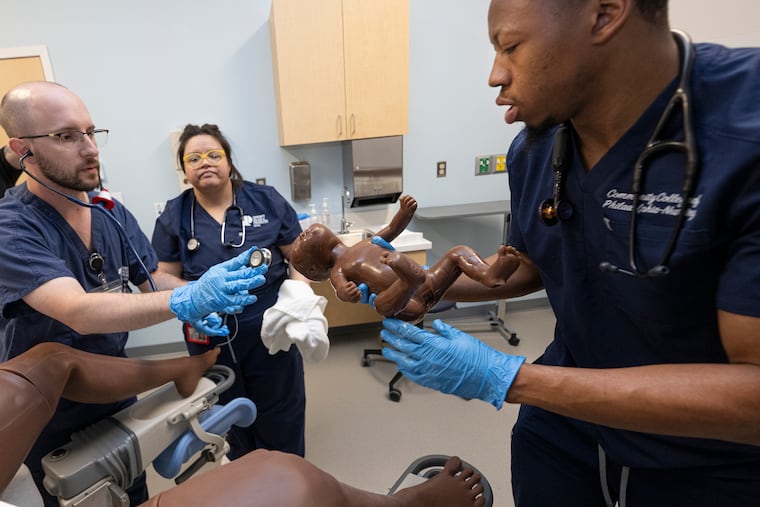
Three students, all finishing their first year in the nursing program, came in for a simulated birth with a patient mannequin named Maria Lopez.
Though this mannequin wasn’t AI-powered, she could blink, and her pupils would constrict when a light was shone. Her heart and lung sounds were audible with a stethoscope.
After introducing themselves to Maria, the students divided tasks to prep her for birth.
Edna Perrusquia, 36, of Alleghany West, monitored her heart and lung sounds with a stethoscope.
Ridge Bair, 34, of the Gayborhood, inspected her IV site and went to the medication room to grab more antibiotics.
And Aahmid Mink, 33, of West Oak Lane, checked how far long Maria was in labor.
“You are four centimeters dilated, 90% effaced,” said Mink, who proceeded to check the baby’s heart rate.
When the baby’s head started to show, the students urged Maria to take deep breaths and push until the baby was fully delivered.
Perrusquia suctioned the baby’s nose and mouth, while Bair clamped the umbilical cord off.
When the placenta was delivered and the baby latched to Maria, the students’ instructor entered the room to review what they had learned.
For Perrusquia, the simulation lab helps her to shift into the mentality of a practicing nurse.
“It puts the pressure on you to really take seriously what you’re learning, so that you can protect the public,” she said.