Norwegian Cruise Line warns there is ‘substantial doubt’ about future business
Norwegian Cruise Line Holdings said there is “substantial doubt” about the company’s ability to continue amid the COVID-19 pandemic and warned it may have to seek bankruptcy protection.
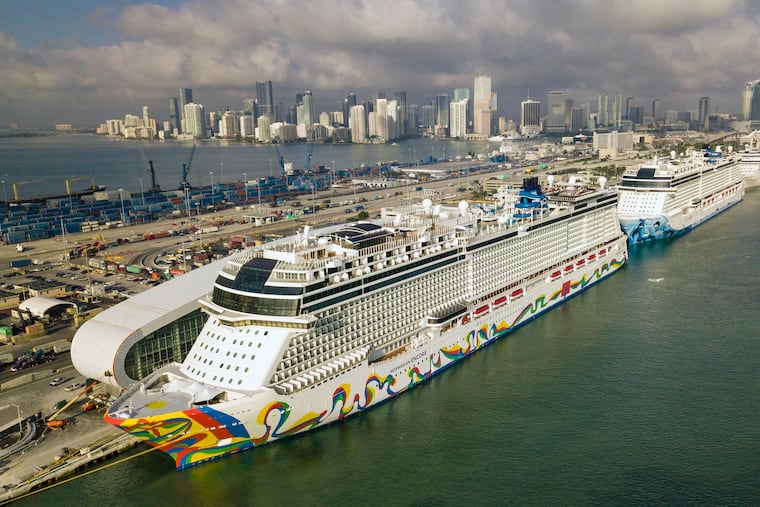
MIAMI — Norwegian Cruise Line Holdings said there is “substantial doubt” about the company’s ability to continue amid the COVID-19 pandemic and warned it may have to seek bankruptcy protection.
Despite that warning, Wall Street analysts say that as long as capital markets remain sturdy, the cruise line should still be able to weather the coronavirus pandemic.
The world’s third largest cruise company, headquartered in Miami, said in a securities filing Tuesday it expects to report net losses for the quarter ending on March 31, 2020, and for the fiscal year ending Dec. 31, 2020. The company owns 28 ships across three cruise lines: Norwegian Cruise Line, Regent Seven Seas and Oceania Cruises.
“If we are not able to fulfill our liquidity needs through operating cash flows and/or borrowings under credit facilities or otherwise in the capital markets, our business and financial condition could be adversely affected and it may be necessary for us to reorganize our company in its entirety, including through bankruptcy proceedings, and our shareholders may lose their investment in our ordinary shares,” the filing said.
Norwegian also said Tuesday that it had received a $400 million infusion into its US subsidiary, Norwegian Cruise Line Corporation Ltd., from Greenwich, Conn.,-based private equity firm L Catterton. The company, among the largest consumer-focused private equity firms in the world, was formed through a partnership between private-equity firm Catterton, luxury retailer LVMH, and Groupe Arnault, the family holding company of Bernard Arnault. L Catterton, a major investor in the Miami Design District, also has investments in Equinox gyms, Anthony’s Coal Fired Pizza and StriVectin skin care.
The deal gives L Catterton a seat on Norwegian’s board of directors.
» FAQ: Your coronavirus questions, answered.
In an effort to bolster its balance sheet, Norwegian also announced Tuesday that it is proposing to sell $650 million of its exchangeable senior notes due in 2024 in a private offering as senior unsecured obligations — described by Bloomberg as “junk bonds.” An additional $600 million in senior secured notes due 2024 would be backed by two ships and two islands — all debt-free, according to filings.
Norwegian shares fell 22.5% in Tuesday trading, closing at $11.18, for a market value of almost $2.4 billion. That puts shares down more than 80% since Jan. 1, when the company’s market capitalization was valued at $12 billion.
Jaime Katz, senior equity analyst for Morningstar, a financial services group, said the total amount of cash Norwegian expects to raise — about $2 billion — divided by a cash “burn rate” of about $150 million per month gives the company about a another year’s worth of room to operate.
“It’s a pretty healthy runway,” she said.
As of mid-April, analysts estimated that the industry as a whole had enough cash on hand for 10 cruise-less months.
By that time, Carnival had raised nearly $6 billion through new debt and equity positions. Among those purchasing stakes was Saudi Arabia’s Public Investment Fund.
Royal Caribbean has also drawn on about $3.5 billion from existing credit instruments; last month, it laid off 26% of its U.S. staff.
Norwegian Cruise Line Holdings has 4,000 employees around the world working in its shore-side operations and around 32,000 shipboard employees. Nearly 2,700,000 passengers traveled on its ships in 2019.
Norwegian reported a profit of $930.2 million in 2019, behind its larger competitors Carnival Corp., which reported a profit of $3 billion, and Royal Caribbean, which reported a profit of $1.9 billion.
The coronavirus pandemic, and subsequent sailing cancellations, has caused cruise shares to plummet. Since the beginning of 2020, Carnival’s shares have dropped 75%, to a market cap of $10.24 billion. The company has 104 ships across nine brands. Tuesday shares dropped 8.72% to close at $13.09. The company has announced it will resume some sailings in August of this year.
During the same period, Royal Caribbean’s shares have dropped 72%, to a market cap of $7.78 billion. The company operates 61 ships across six brands. Tuesday shares dropped 10% to close at $37.20. The company has announced all its cruises are halted through at least June 11.
Cash shortfall
On March 13, the cruise industry shut down new cruises for 30 days following a no-sail order from the U.S. Center for Disease Control and Prevention, which has since been extended until at least July 24 or until the pandemic is declared over. The pause means onboard revenue — which normally accounts for about one-third of income — has evaporated. Cruises for Norwegian’s three brands are currently canceled through June 30.
Last month, Norwegian said it fully tapped a $1.55 billion credit facility from JPMorgan Chase, and that its bonds had been downgraded by ratings agencies Moody’s and S&P Global. The company said in an April 27 press release that it is burning through $110-$150 million per month as cruises remain halted.
To further shore up cash, Norwegian said it has identified around $515 million of capital expenditure reductions, including furloughs for 20% of staff announced last week by chairman Frank Del Rio. Still, Tuesday’s filing said that may not be enough to get through the pandemic and beyond.
“We believe the ongoing effects of COVID-19 on our operations and global bookings have had, and will continue to have, a significant impact on our financial results and liquidity, and such negative impact may continue well beyond the containment of such an outbreak,” the company’s Tuesday filing said.
As of March 31, 2020, the company had $1.8 billion in advanced ticket sales across Norwegian’s three brands. That included $850 million for cruises that have been canceled through June 30, 2020, and $350 million for the remainder of 2020. Around half of passengers who had their cruise canceled are opting for a refund over a future credit with the company, further limiting its cash holdings. Bookings for the rest of 2020 are “meaningfully lower” than for the previous year, the company said in a press release last month.
A Miami Herald investigation found that passengers and crew from at least six of the company’s 27 ships have tested positive for COVID-19. In recent weeks the company has been shifting crew between ships without testing them for the disease. A doctor on the Norwegian Gem died last week after treating crew with respiratory illnesses. Crew on the Norwegian Escape and Norwegian Epic, docked at PortMiami Tuesday, report crowded conditions in violation of CDC’s guidelines, which advise companies to keep crew in individual cabins, provide them with masks, and enforce social distancing.
Norwegian Cruise Line was Miami’s first cruise line, founded in 1966 by Knut Kloster Sr., a Norwegian shipping magnate, and Israeli businessman Ted Arison. The pair aimed to create a cruise vacation accessible to the middle class. Arison left in 1972 to form Carnival Cruise Line.
In 2000, it was acquired by Genting’s Star Cruises after fending off a takeover by Carnival Cruise Line. Genting later sold half the company to private equity firm Apollo Management in 2008. Both companies sold their shares of the company in 2018.
In 2013, the company went public. The next year, it paid more than $3 billion to acquire two new cruise lines: Oceania Cruises and Regent Seven Seas Cruises.
Though Norwegian has remained smaller than competitors Carnival Corporation and Royal Caribbean Cruises, it has pushed the industry into new frontiers.
Norwegian purchased a private island in the Bahamas to be used exclusively by its passengers in 1977, more than a decade before its competitors would do the same. In 2000, Norwegian revolutionized the formally rigid eating and entertainment schedules for passengers by offering “freestyle cruising,” in which passengers could eat when they wanted with whomever they wanted. Other companies soon followed.
In 2010, it introduced The Haven, an exclusive all-suite area with a private pool, dining and bar. The concept has since been widely copied.