Federal crash data captures alcohol deaths, but misses drugged driving
Such information could prove useful as the nation struggles with an opioid crisis and looser drug laws. But the NHTSA division that works on impaired driving statistics has been cut to two people.
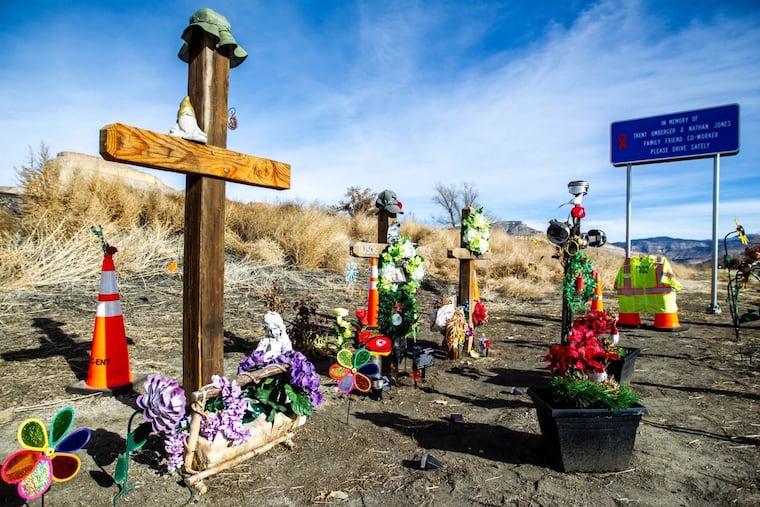
GRAND JUNCTION, Colo. — Two state transportation workers were replacing a sign on the shoulder of U.S. Highway 6 in western Colorado one morning when a Jeep Grand Cherokee swerved off the road and struck them.
The workers, Nathan Jones and Trent Umberger, died in the September 2024 crash, as did a passenger in the Jeep. Tests found that the driver, Patrick Sneddon, then 59, had oxycodone and six times Colorado’s presumed impairment threshold of THC — the psychoactive compound in cannabis — in his blood. He pleaded guilty and is serving 30 years in prison on three counts of vehicular homicide and other charges.
“Our four children are completely crushed without their dad,” wrote Kristine Umberger, the wife of Trent, in a victim impact statement for the local district attorney. “We have lost our ability to live life like we used to.”
Federal highway safety officials have long tracked the role of alcohol in fatal crashes, but they don’t track deaths that involve a driver under the influence of drugs or a combination of drugs and alcohol.
That discrepancy is partly caused by the challenges of proving impairment, because some drugs remain detectable for weeks after use. Still, tracking the presence of impairing substances would be a big first step in illuminating the scope of impaired driving.
Sneddon’s attorney, Jennifer Gregory, said a driver can be presumed impaired under Colorado law if their blood contains 5 nanograms of THC or higher per milliliter. But that “permissible inference” threshold is different from a legal limit — such as the 0.08% blood alcohol content limit — and the level set by Colorado is not supported by published scientific studies, Gregory said.
Such information could prove useful as the nation struggles with an opioid crisis, the Trump administration loosens federal regulations on marijuana, and more than 40 states have legalized or decriminalized some forms of cannabis and psychedelic drugs.
“Impaired driving is a top public safety issue that extends beyond alcohol,” said Sean Rushton, a spokesperson for the federal highway safety agency, which is tackling the issue, with resources to ensure a “comprehensive and coordinated approach.”
But President Donald Trump’s cuts to the federal workforce since he returned to office in 2025, along with dwindling federal investments, mean that efforts to expand and improve the tracking of impaired-driving deaths nationwide have slowed.
The gap in data can be significant. In Mesa County, Colorado, where Jones and Umberger were killed, the coroner’s office tracks various forms of impaired-driving fatalities. From 2017 through 2024, a third of traffic deaths involved alcohol alone, according to data from the county coroner’s office.
When drugs are factored in, nearly half of Mesa County’s traffic deaths over the same period involved a driver intoxicated with alcohol, drugs, or a combination, according to the coroner’s reports.
“If you want to solve a problem, you need to understand the problem,” National Transportation Safety Board researcher Jana Price said. “If you only know that alcohol is present, then it limits your ability to fully understand what might have been impairing a person or a population of people. It trickles into the countermeasures that we use as a society to address the problem.”
Identifying a hidden issue
NTSB researchers reported in 2022 that, across four geographical samples of roughly 26,000 drivers, about half of those arrested for impaired driving and more than a quarter of drivers killed in crashes tested positive for more than one substance, such as cocaine, sedatives, and antidepressants. The analysis also found that only four states and D.C. drug tested more than 60% of fatally injured drivers in 2020.
Those findings led the NTSB, an independent federal agency that investigates major incidents, to make several recommendations to the National Highway Traffic Safety Administration and states to establish a comprehensive, nationwide data set on impaired driving.
But hurdles remain to creating such a system. Fatality and injury reports submitted to the NHTSA database often feature missing or erroneous data, according to a 2022 report.
Varying state laws around testing arrestees and decedents for drugs make getting uniform data difficult, according to Caroline Cash, a former employee of NHTSA’s impaired-driving division, as does a lack of proven metrics like blood alcohol content to measure drug impairment, not just the presence of a drug.
“It’s a slow process, which is incredibly difficult when you know that each day that passes is risking a lack of safety for however many people facing the potential of a drug-impaired-driving crash,” Cash said. “But some progress is better than no progress.”
Acknowledging how long those efforts will take, the NTSB also recommended that NHTSA build an interim surveillance system that would use data from trauma centers to create a national sample of crash-involved impaired drivers.
The agency made some headway, reporting in 2023 that it was conducting its own study with the help of 11 trauma centers and medical examiner offices. It also helped California establish a 19-month statewide surveillance system, which NHTSA will use to evaluate the feasibility of a nationally representative system.
Such programs are useful for public awareness and for improving the ability of police to understand drugged driving patterns that can help departments tailor enforcement, said James Chenoweth, a University of California at Davis associate professor who researches toxicology and was involved in the California program. But some trauma centers, especially in rural areas, often lack the research infrastructure necessary for round-the-clock drug testing and participation.
Still, it’s possible, and he said the benefit is apparent in the findings from California’s surveillance system.
“If you go out there and tell people that 44% of drivers who ended up in the ER from a car accident had at least one potentially impairing substance in their blood at the time of the accident, that gets people’s attention,” Chenoweth said.
Shrinking research teams
Since NHTSA’s update to the NTSB three years ago, however, the agency has yet to follow up on the recommendation. Staff cuts and departures at NHTSA last year paint a poor outlook for change.
From 2021 to 2024, the agency grew from 600 employees to 790. At the end of Trump’s first year of his second term, NHTSA had dropped to about 550 people because of governmentwide cuts and people leaving on their own.
Cash, who now works for the nonprofit Governors Highway Safety Association, was one of five employees who left NHTSA’s impaired-driving division last year. That leaves just two staff members in the division, she said.
Ian O’Dowd, a former employee in NHTSA’s behavioral research division, said he was part of a team of 16 people who studied, in part, impaired driving. Only three or four team members are still with the agency, he said.
“At some point, it becomes unwieldy for a handful of people to be managing all of the research work going on,” O’Dowd said.
NHTSA Communications Director Sean Rushton said the agency has “both the financial and personnel resources necessary to support its programs with multiple offices carrying out this work collaboratively, ensuring a comprehensive and coordinated approach.”
The 2021 infrastructure law, passed under the Biden administration, increased funding for the NHTSA state highway safety program from about $667 million in 2021 to nearly $953 million this year.
The law included $750 million to modernize crash-data programs, but as of January, over $475 million was unused. The funds expired in September 2025 unless they were obligated through a signed agreement.
A report by the U.S. Government Accountability Office found that nearly a quarter of entities awarded grants in 2022 had not received a signed agreement when surveyed between December 2024 and March 2025. It also found that over one in five grantees reported that obtaining timely replies from Transportation Department staff was moderately or very challenging.
With the Biden-era infrastructure law expiring later this year, Congress could extend the unused crash-data fund or implement a new approach to impaired driving.
In mid-April, House Transportation and Infrastructure Committee Chairman Sam Graves (R-Mo.) said proposed legislation could appropriate between $500 billion and $550 billion — less than half of the current bill’s $1.2 trillion — with a more “traditional” focus on roads and bridges.
The bill has since stalled amid negotiations for more funding, leaving future support uncertain.
“Certainly, we are always hoping that there will be an increase in the amount of money available to do this work,” Cash said. “Whether or not that will happen this year, I don’t know.”
KFF Health News is a national newsroom that produces in-depth journalism about health issues and is one of the core operating programs at KFF — the independent source for health policy research, polling, and journalism.